The Iliad of Homer Engraved From the Compositions of John Flaxman, R.A., Sculptor
Original title: The Iliad of Homer Engraved From the Compositions of John Flaxman, R.A., Sculptor
kurzbeschreibung
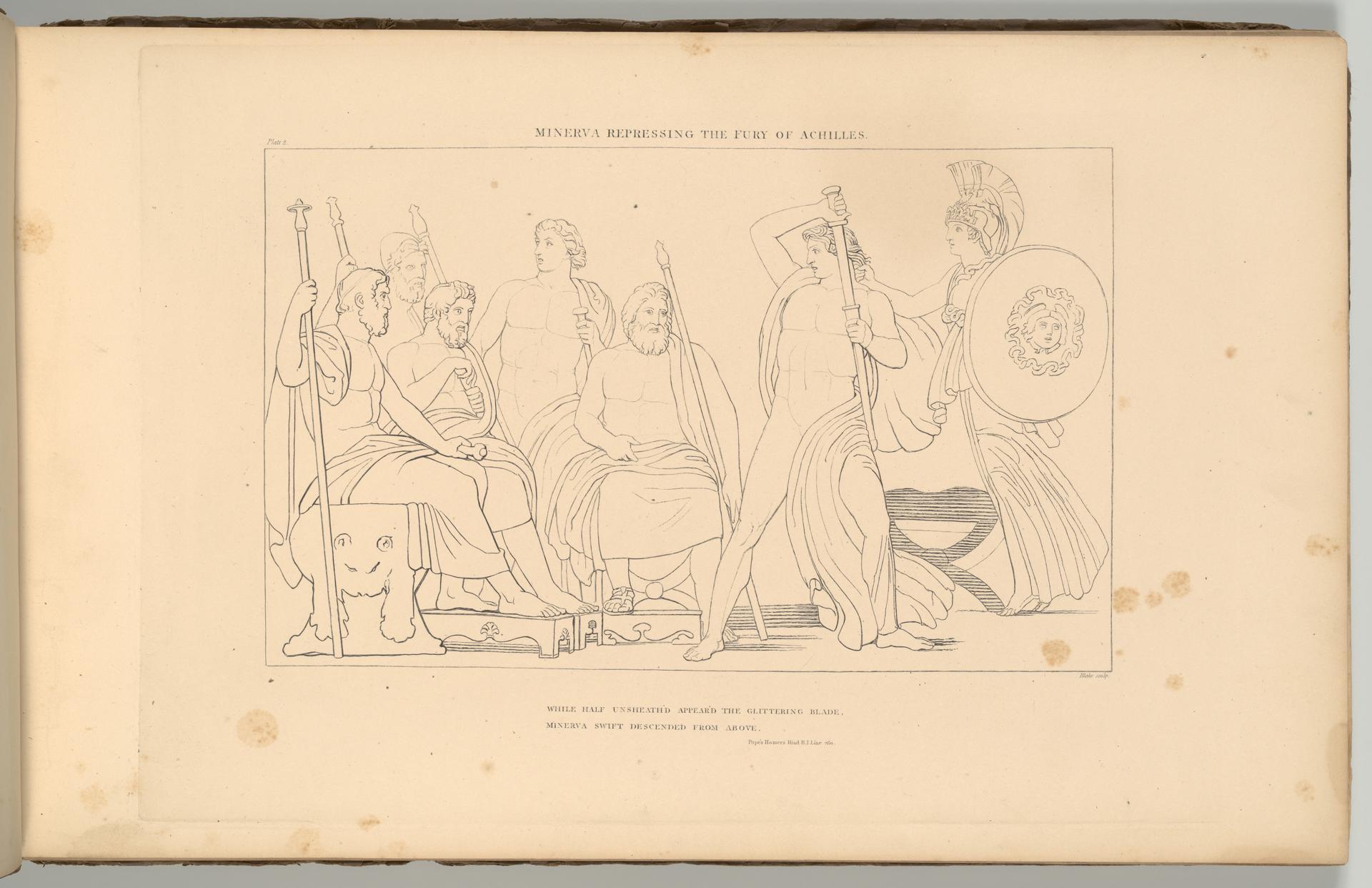
This 1805 volume collects copperplate engravings after drawings by John Flaxman, illustrating scenes from Homer's Iliad. They are executed as line engravings. The book measures 27.6 x 44.6 x 1.8 cm. The illustration shown captures the moment when Minerva tempers Achilles' wrath.
Description
Two seated men occupy the left half of the image, one of them with shield and spear. Facing them on the right stands a man, also with shield and lance, who is calming another figure. A bearded man and a woman appear in the background. Color and shading are entirely absent; the rendering remains pure line drawing. The layout is symmetrical, the main figures are centered, and the light is evenly distributed.
Context
The work was published in 1805 within a book edition of the Iliad, whose engravings were made after designs by John Flaxman. Flaxman, a British sculptor and draughtsman, created these designs in the neoclassical style; they circulated widely in England. As illustrations for a new edition of Homer's epic, the engravings attest to the contemporary interest in ancient mythology and literature.
Impact
Clear, precise lines stand out and give the figures a calm, almost sculptural presence. The symmetrical arrangement and even lighting produce an orderly, harmonious whole. Because shadows are absent, the contours come forward, and the scene acquires a timeless, idealized aura.
Technique
Copper plates were used for printing, into which the drawings were engraved as line engravings. This process is characterized by monochrome reproduction without grays, relying on clear, continuous lines. The printing was done on paper; the volume measures 27.6 x 44.6 x 1.8 cm.
AI-generated description text
Source: Metropolitan Museum of Art · Public Domain (CC0 1.0)