Gustave Doré, calling card
Original title: Gustave Doré, calling card
kurzbeschreibung
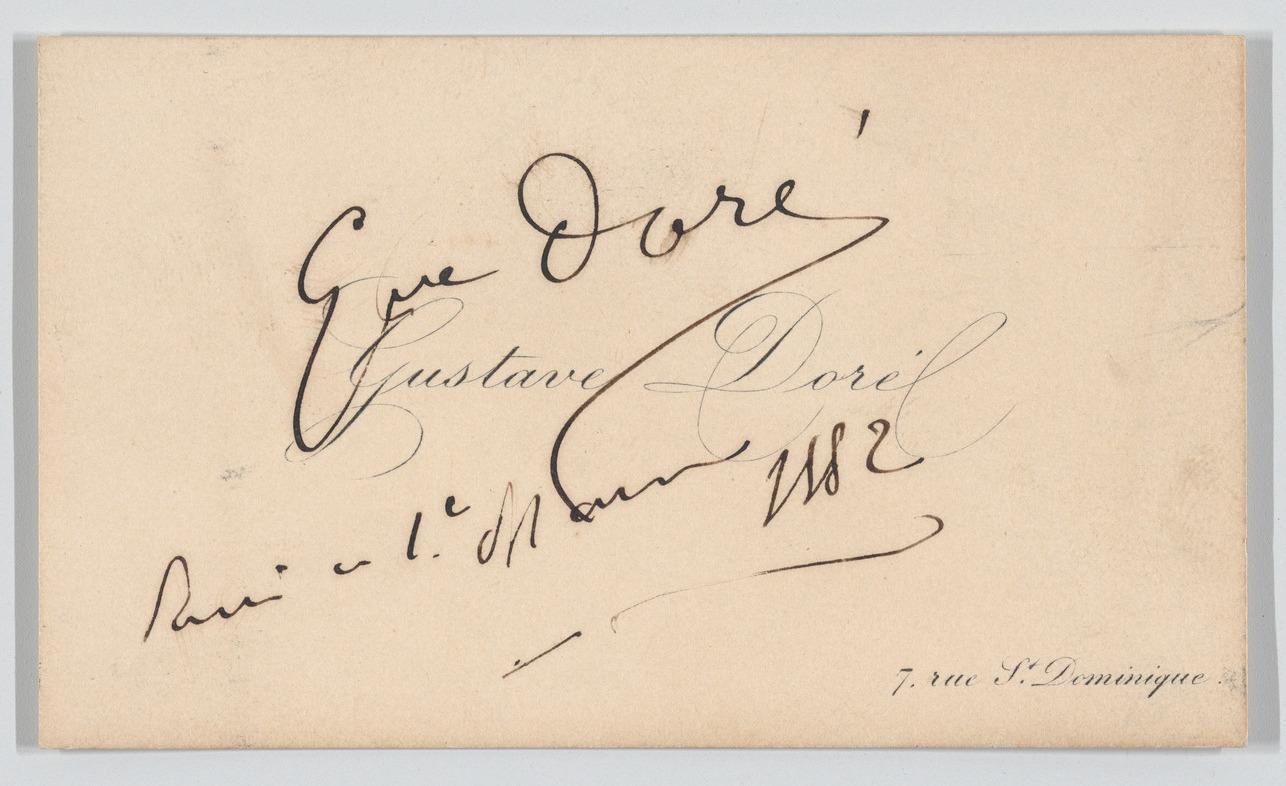
This anonymous engraving dates from around 1849 to 1883 and reproduces a visiting card of the French artist Gustave Doré, bearing the date 1 March 1882. The sheet measures 6 × 10.1 cm and shows Doré's signature and his Paris address on Rue St. Dominique.
Description
Cream-coloured paper forms the ground, and an elegant cursive hand fills almost the entire surface. The signature 'Gustave Doré' stands out prominently, with the line 'Paris 1er Mars 1882' below it. At the lower right one reads the address '7, rue St. Dominique'. There are no ornaments or coloured elements—only black ink on a plain support.
Context
Gustave Doré, a well-known nineteenth-century illustrator and painter, achieved fame with his wood engravings for literary works. In the Victorian era, visiting cards served social communication and were often annotated with handwritten notes or signatures. This example comes from Doré's late period, shortly before his death in 1883; Rue St. Dominique was then his Paris home address.
Impact
The card feels plain and personal, almost more intimate than a printed portrait. The flowing handwriting gives the object an immediate human presence that evokes the artist himself. The minimal, unadorned style underlines the elegance and social etiquette of the age.
Technique
Engraving as a technique depends on lines being incised into a copper plate and then printed on paper. The handwriting and address were evidently transferred to the plate to produce a reproducible graphic. The delicate lines and the precise rendering of the cursive script attest to the high craftsmanship of the print.
AI-generated description text
Source: Metropolitan Museum of Art · Public Domain (CC0 1.0)