Petit Journal pour Rire vol. 1, (nos. 1-52)
Original title: Petit Journal pour Rire vol. 1, (nos. 1-52)
kurzbeschreibung
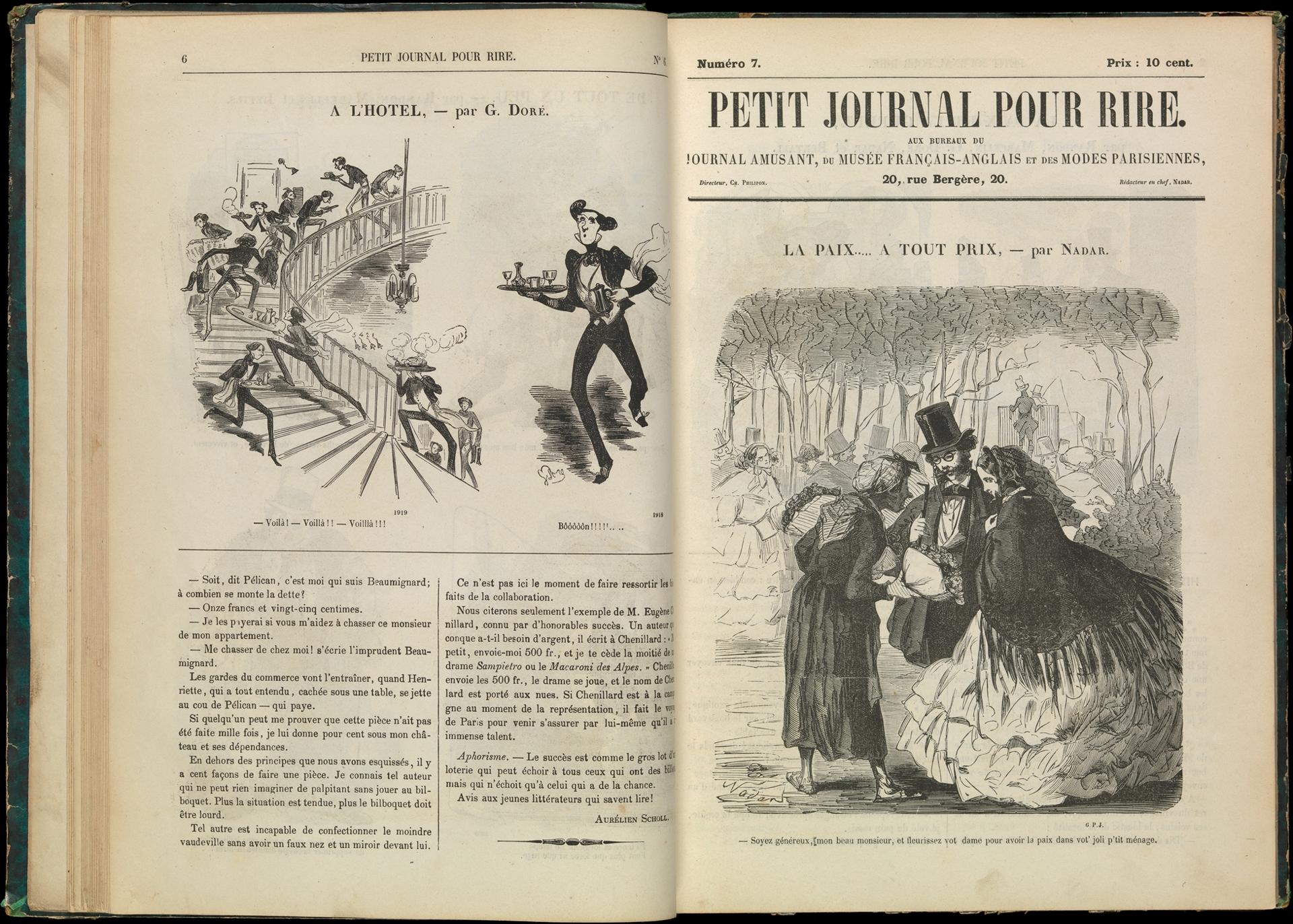
In 1856, Paris saw the launch of the Petit Journal pour Rire, a satirical paper with letterpress text and wood engravings, overseen by Charles Philipon. This issue contains two illustrations by Gustave Doré.
Description
A crowd jostles on a winding staircase; some figures tumble, others reach out to help. On the left, the open booklet shows Doré's illustration 'A l'Hotel', its throng restless and full of movement. To the right follows 'La Paix... A tout prix': in a parkland setting, a man in a top hat and jacket stands in the foreground, addressing a woman, while other figures are scattered behind them. Printed text accompanies both images, presumably explaining the scenes.
Context
The paper was the work of Charles Philipon, a well-known caricaturist and publisher who had previously brought out La Caricature and Le Charivari. Under Napoleon III, the French press faced strict censorship in the 1850s, so satirical journals often resorted to indirect criticism. The drawings are by Gustave Doré, then a rising artist who later became famous for his illustrations of the Bible and Dante. Handy in format, the journal was aimed at the mass market.
Impact
Witty humor and detailed wood engravings make the booklet a lively record of Parisian satirical culture. Doré's images impress through their narrative density and their ability to tell everyday scenes with surprising drama. The journal thus conveys a sense of the visual liveliness and wit of the illustrated press of the time.
Technique
The magazine was printed by letterpress, with text set from movable type. For the illustrations, wood engravings were used: the motif was cut into a woodblock and printed in the same pass. This method allowed high print runs at relatively low cost—a decisive advantage for a mass-market paper like the Petit Journal pour Rire.
AI-generated description text
Source: Metropolitan Museum of Art · Public Domain (CC0 1.0)