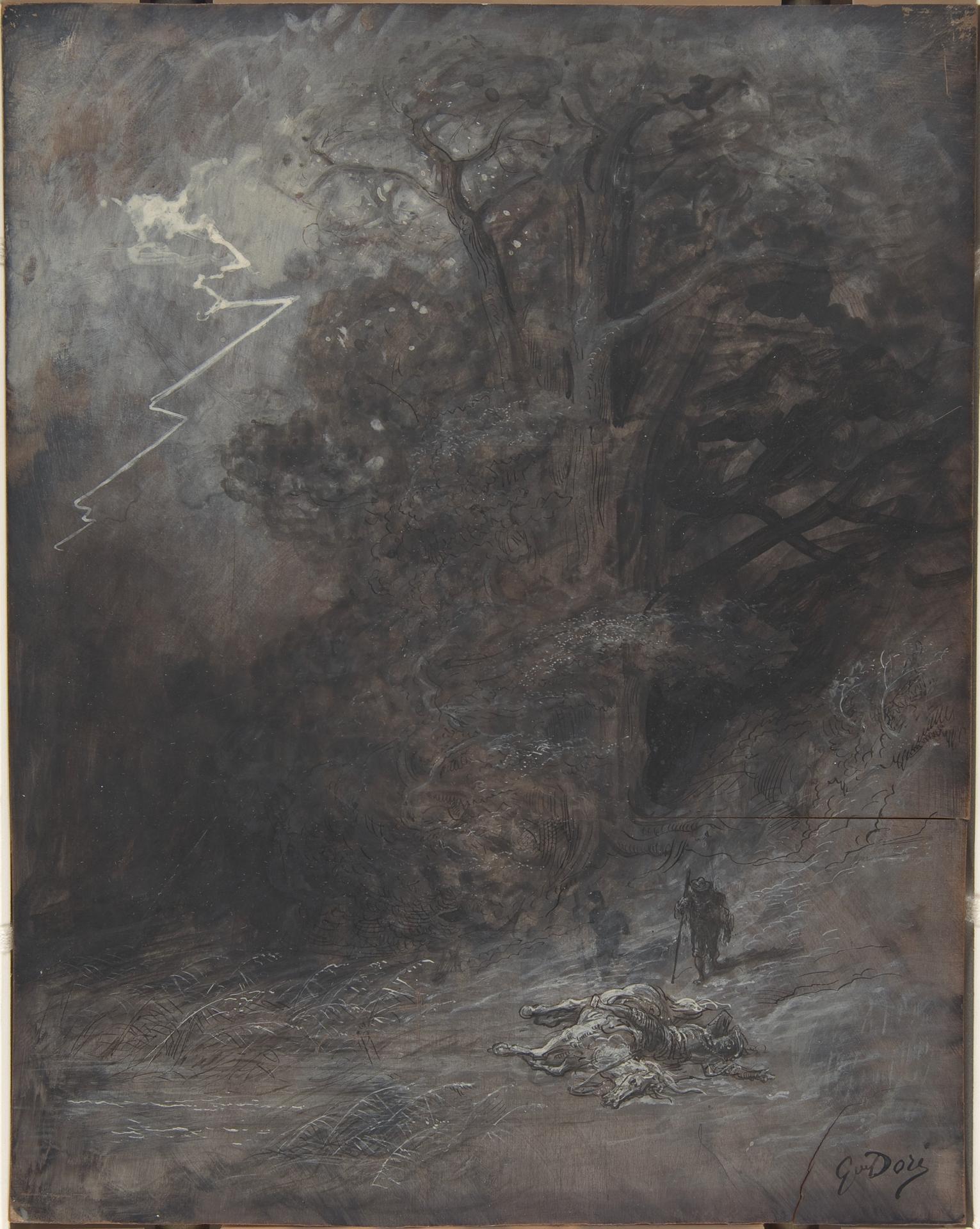
A Rider and a Dead Horse in a Landscape
Original title: A Rider and a Dead Horse in a Landscape
kurzbeschreibung
A dead horse lies in the foreground of a landscape drawing by Gustave Doré, with a rider carrying a rifle standing behind it. The sheet is executed in pen and black ink, with added brush and black wash and white heightening on a woodblock. The date of creation has not come down to us; the dimensions are 23.6 x 18.7 cm.
Description
A dead horse lies on the ground in the foreground while a rider with a rifle stands further back. Dark trees and a threatening sky, from which a bolt of lightning strikes, define the landscape. Grey tones predominate and add to the somber mood. Muted light falls from the upper left and heightens the drama. The style feels impressionistic with expressionist overtones, evident in the expressive handling of tone and the arrangement of the elements.
Context
Gustave Doré, a nineteenth-century French artist, is known for his illustrations and paintings. Exactly when this work was made is unknown, which makes it hard to place precisely within his output. Dark, dramatic scenes, often prompted by literary or historical subjects, are nonetheless typical of him. Today the sheet is kept at the Metropolitan Museum of Art.
Impact
The dark palette and the threatening sky create a melancholy, uncanny mood. The lightning and the dead horse deepen the sense of loss and danger and invite reflection. The expressive layout gives the work a dramatic intensity.
Technique
Pen and black ink were used, along with brush and black wash, supplemented by white heightening on a woodblock. The interplay of linear and broader tonal passages produces a strongly contrasted impression. The brush wash allows soft transitions and reinforces the atmospheric effect.
AI-generated description text
Source: Metropolitan Museum of Art · Public Domain (CC0 1.0)