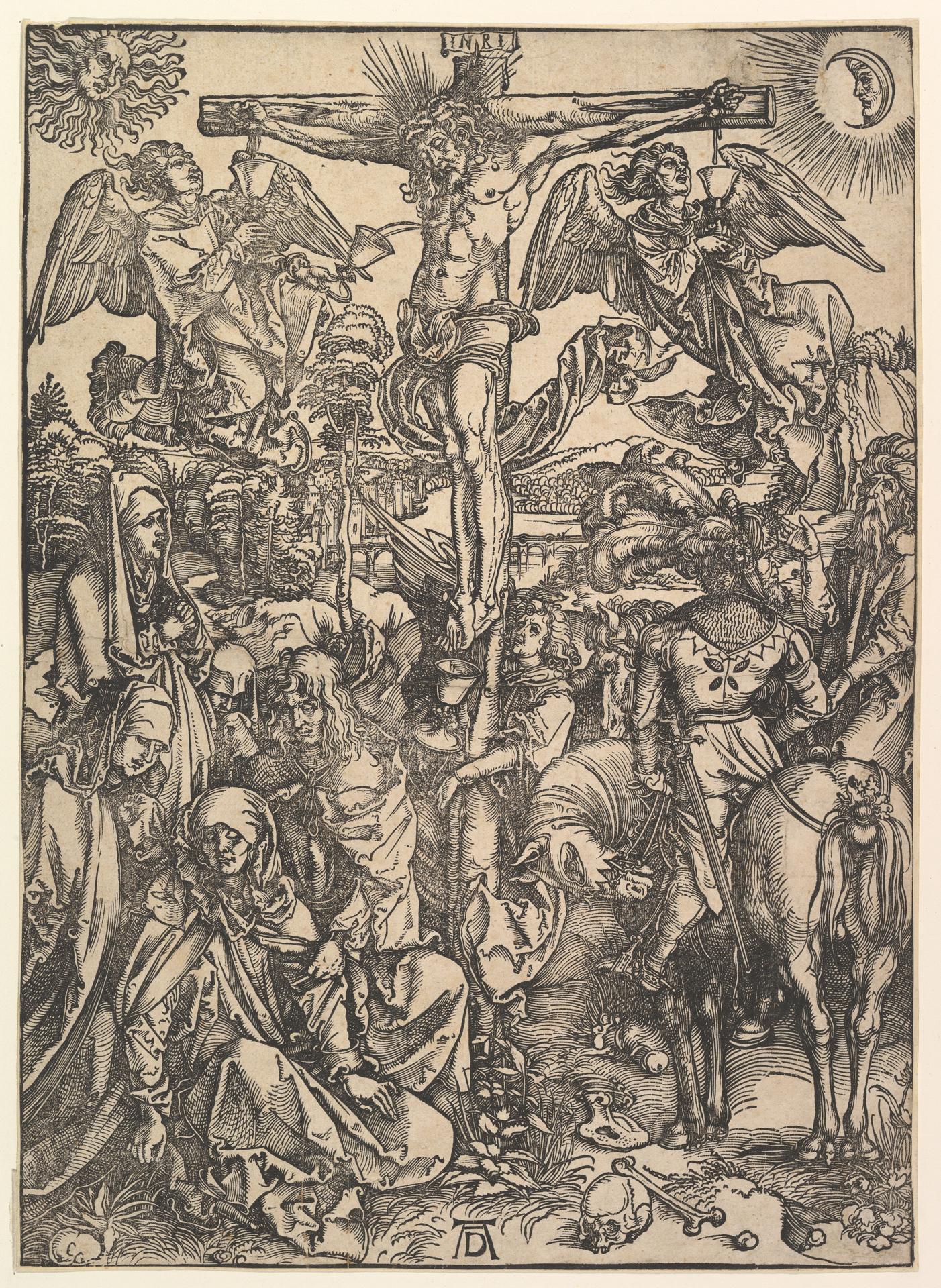
The Crucifixion, from "The Large Passion"
Original title: The Crucifixion, from "The Large Passion"
kurzbeschreibung
Albrecht Dürer's woodcut 'The Crucifixion' (c. 1498) from 'The Large Passion' depicts the crucifixion of Christ, surrounded by angels and mourners. The scene is rich in detail, with a landscape background and a mounted soldier, showcasing Dürer's mastery of the woodcut medium.
Description
At the center, Christ hangs on the cross, crowned with thorns, his body showing signs of suffering. To the left, two angels hover, one holding a chalice and the other a basin. On the right, another angel carries a lantern, while below the cross a group of women kneel in prayer and grief. A soldier on horseback is visible on the right, and in the foreground a seated woman mourns, with trees and a landscape forming the backdrop. The composition is dense with figures and details, all rendered in precise, expressive lines.
Context
Dürer created 'The Large Passion' as a series of woodcuts illustrating the Passion of Christ, published as a book in 1511, though the designs date to the late 1490s. This work reflects the late Gothic and early Renaissance style, blending Northern European realism with Italian Renaissance influences. Dürer's woodcuts were highly influential, elevating the medium from simple illustration to fine art.
Impact
The image conveys intense emotion through the mourners' gestures and the dramatic composition, drawing the viewer into the sorrow of the scene. Dürer's intricate linework creates a sense of depth and texture, making the woodcut both visually striking and deeply moving.
Technique
This is a woodcut, a relief printing technique where the image is carved into a wooden block, inked, and pressed onto paper. Dürer's skill is evident in the fine, varied lines that model forms and create shading, achieving a level of detail uncommon in woodcuts of the period. The monochromatic print relies on line and contrast rather than color.
AI-generated description text
Source: Metropolitan Museum of Art · Public domain (CC0)