Le Christ sortant du tombeau
Original title: Le Christ sortant du tombeau
kurzbeschreibung
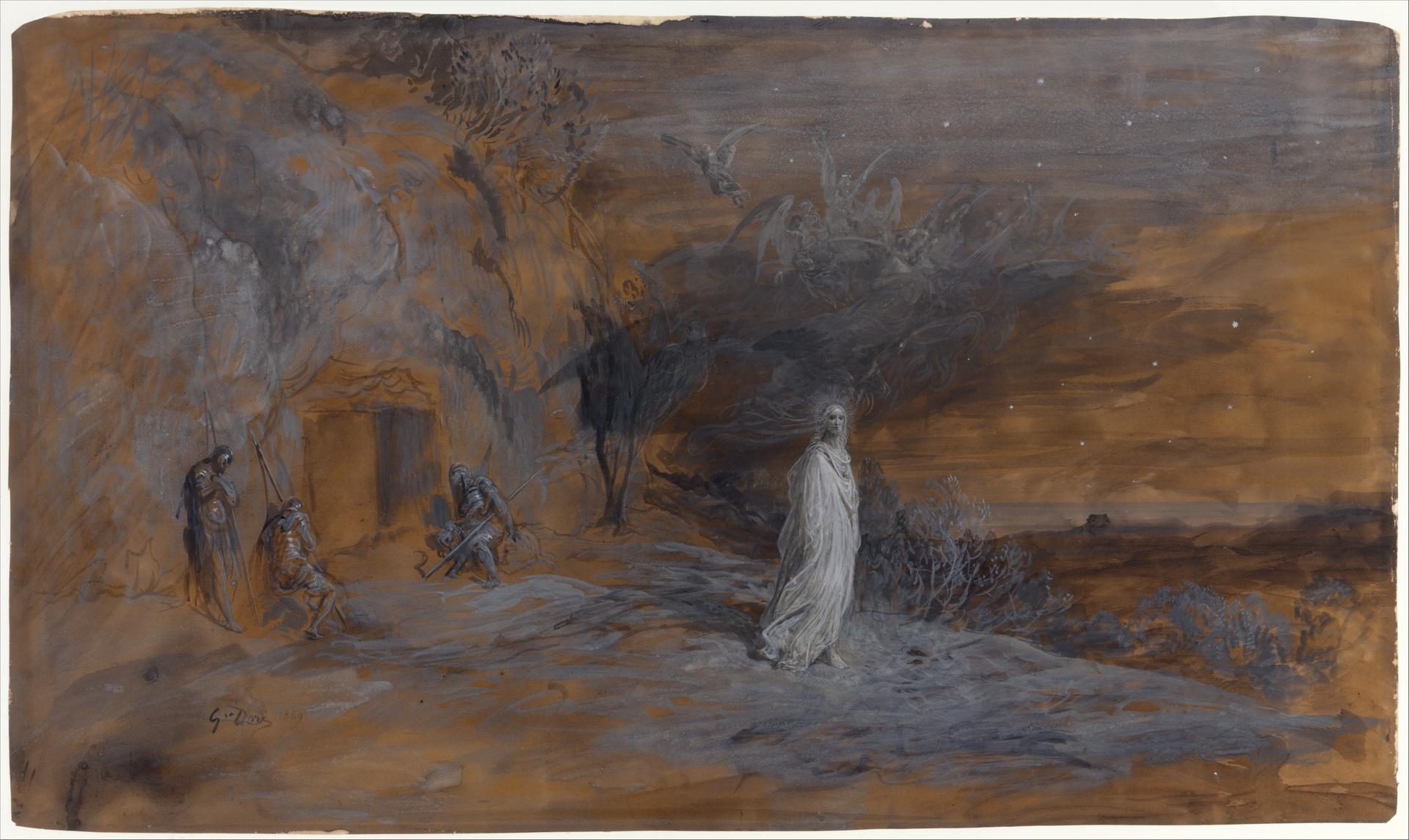
Gustave Doré's Christus verlässt das Grab is a drawing in gouache and ink made between 1850 and 1883. It pictures the Resurrection of Christ, stepping out of the opened tomb while Mary Magdalene stands by as a witness.
Description
Up front, a figure in white robes, most likely Mary Magdalene, turns toward the mouth of the tomb. From it emerges a shape wrapped in an aura and hemmed in by dark, fluttering forms. Farther back, other people are on the move, two of them carrying lances that bring soldiers or guards to mind. Browns and grays govern the nearly monochrome palette. The arrangement feels restless and pulls the eye toward the central figure and toward the others pressing on toward the grave.
Context
In the second half of the nineteenth century Doré turned increasingly to biblical subjects. His Bible illustrations brought him fame and reached a very wide audience. This sheet probably belongs to the circle of those biblical works, which appeared around 1866 as La Grande Bible de Tours.
Impact
A somber, almost apocalyptic mood settles over the picture and gives it a haunting presence. Harsh contrasts of light and shadow heighten the spiritual charge of the resurrection moment.
Technique
Doré laid gouache, brush, and brown ink over black chalk on brown paper. The result is a grainy, restless surface that carries the dramatic tone of the sheet.
AI-generated description text
Source: Metropolitan Museum of Art · Public Domain (CC0 1.0)