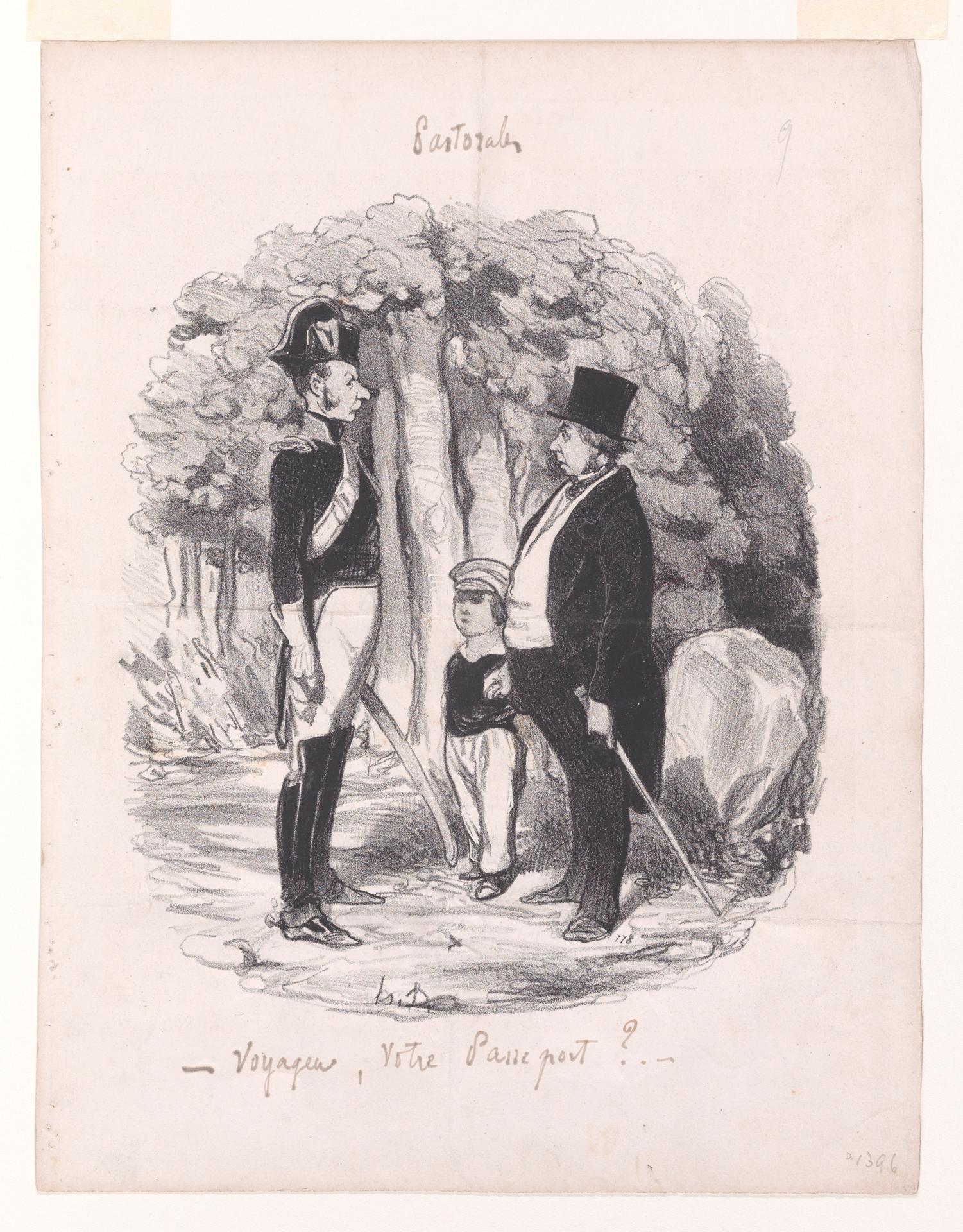
Traveler, Your Passport?, from Pastorales (Romance of Country Life)
Original title: Traveler, Your Passport?, from Pastorales (Romance of Country Life)
kurzbeschreibung
Unlike the other sheets in the series 'Pastorales (Romance of Country Life)', this chalk lithograph by Honoré Daumier from 1845 does not take place in a salon or at a market but in the forest, where three figures come upon one another. The print was executed as a chalk lithograph on wove paper.
Description
On the left stands a figure in military uniform holding a staff; between them a child in plain clothing; on the right someone in a suit with a top hat and cane. Trees and rocks are only hinted at in the picture ground. Black and white face each other, as was customary for lithographs of those years. Along the lower edge runs the inscription 'Voyageur, votre passeport ?'.
Context
In 1845 the 'Pastorales' series was made for the French journal 'Le Charivari', in which Daumier followed everyday life with a satirical undertone. The passport check in the countryside points to the administrative practice of the July Monarchy. That a proof of the first of two states is present here speaks for close control of the printing.
Impact
Clear lines and hard black-and-white contrasts separate the three figures cleanly from one another. Uniform, child and top-hatted gentleman meet in such a way that the situation seems at once comic and credible.
Technique
Printing was done from a stone into which the artist had drawn with greasy chalk — a process known as chalk lithography, used here on wove paper. The present impression was pulled as a proof of the first state, that is, before the plate received further reworking.
AI-generated description text
Source: Metropolitan Museum of Art · Public Domain (CC0 1.0)