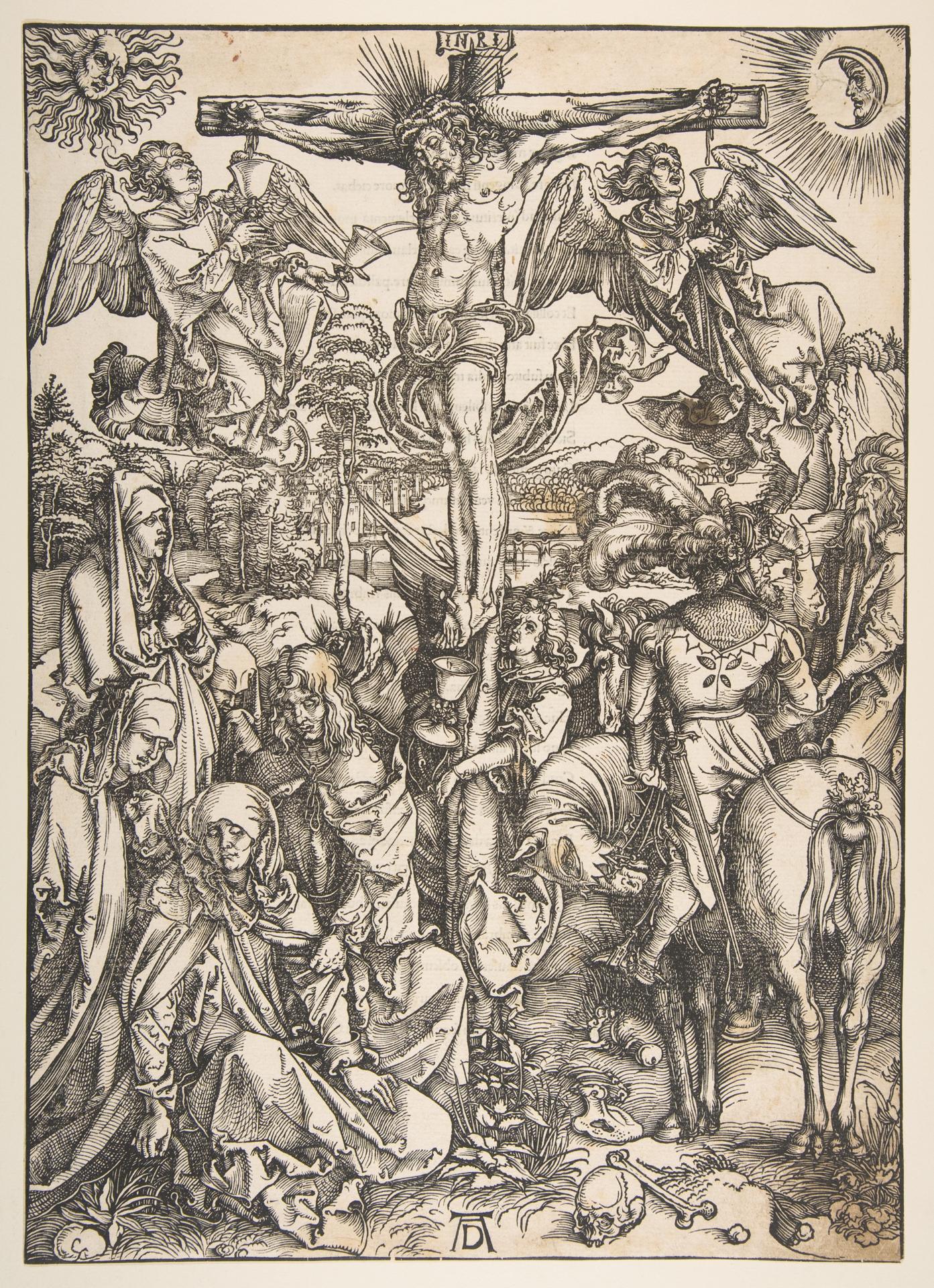
The Crucifixion
Original title: The Crucifixion
kurzbeschreibung
The Crucifixion is a woodcut by Albrecht Dürer, likely created around 1500. It depicts the crucifixion of Jesus Christ, a central theme in Christian art, with a detailed and symmetrical composition.
Description
The woodcut shows Jesus on the cross at the center, with the INRI plaque above him. Two angels flank the cross, each holding a chalice. Below, a group of figures includes praying women, observing soldiers, and mourners in traditional clothing. The background features trees and a landscape, while a sun head appears on the upper left and a moon head on the upper right. The composition is balanced and monochromatic, with fine, even lines typical of Dürer's printmaking.
Context
Dürer, a German Renaissance artist, created this woodcut during a period when religious imagery was in high demand. His prints circulated widely across Europe, and this piece reflects the late medieval tradition of depicting the Crucifixion with symbolic elements like the sun and moon. The work likely served as a devotional image, intended for personal meditation or church use.
Impact
The symmetrical arrangement and the calm, detailed figures give the scene a solemn and reverent atmosphere. Dürer's precise linework draws the viewer's eye to the central cross, while the surrounding details invite closer inspection. The monochrome palette enhances the stark emotional weight of the subject.
Technique
This woodcut was created by carving the image into a wooden block, inking it, and pressing it onto paper. Dürer's mastery of the medium is evident in the fine, controlled lines that define both the figures and the landscape. The even lighting and lack of shading variation are characteristic of early woodcuts, relying on line density rather than tonal gradation.
AI-generated description text
Source: Metropolitan Museum of Art · Public domain (CC0)