The Scourging of Christ
Original title: The Scourging of Christ
kurzbeschreibung
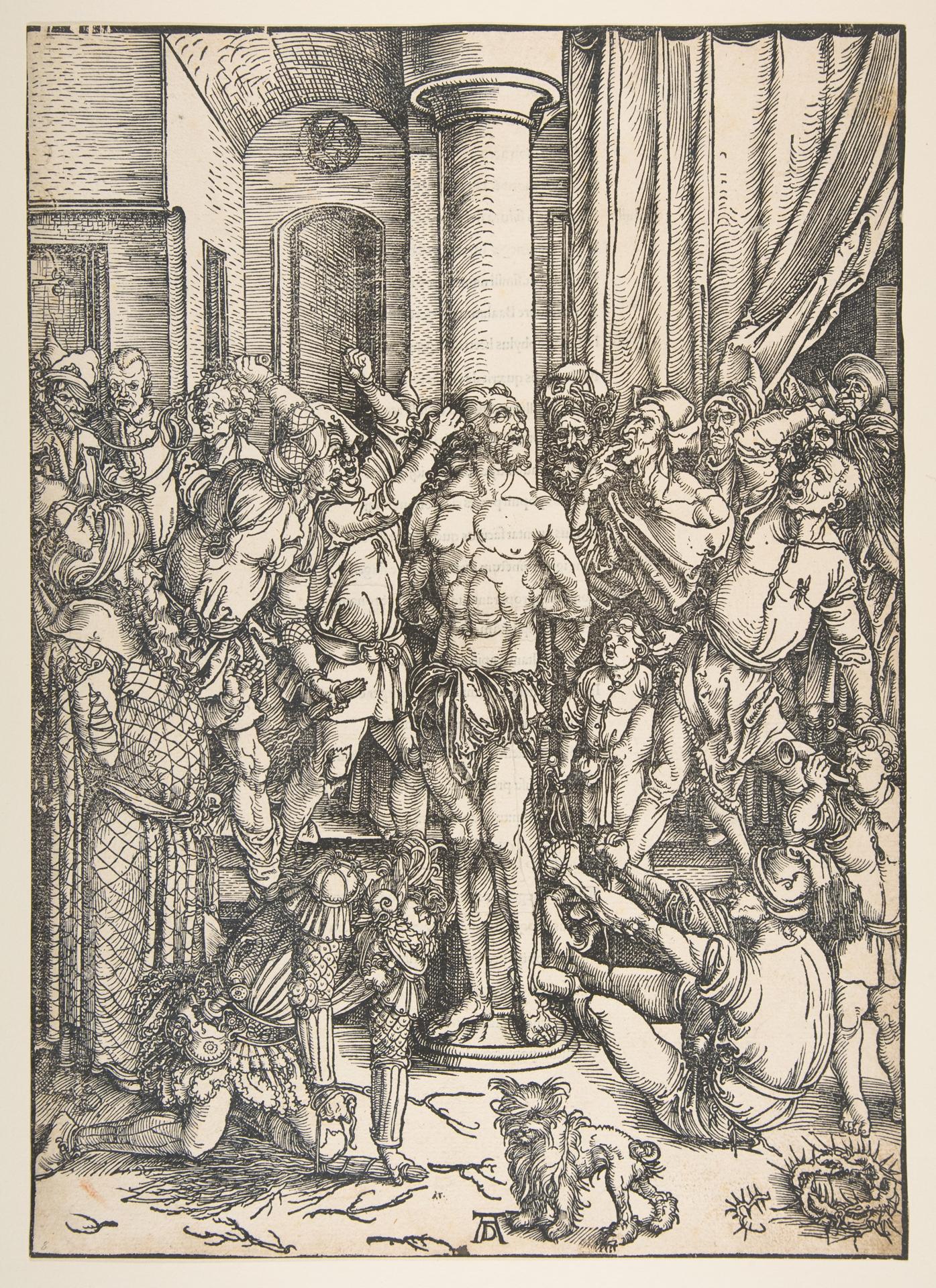
The Scourging of Christ is a woodcut by Albrecht Dürer, dating from around the early 16th century. It depicts the flagellation of Christ, surrounded by soldiers and onlookers in a detailed interior setting. The print is notable for its intricate linework and dramatic portrayal of violence.
Description
In the center, Christ stands bare-chested, encircled by several figures, some in armor and others in civilian clothes. Men raise their arms to strike him while others hold him in place. In the background, columns and a curtain suggest an interior space. Two figures lie on the ground, appearing injured or dead, and a dog is visible in the foreground. The scene is packed with detail, emphasizing the brutality of the moment.
Context
Dürer created this woodcut as part of his larger Passion series, which was widely circulated in early 16th-century Europe. The work reflects the late medieval emphasis on Christ's suffering as a subject for devotional meditation. Dürer's prints were instrumental in spreading Renaissance artistic ideas north of the Alps, and his woodcuts were renowned for their technical mastery. The exact date of this particular print is uncertain, but it aligns with Dürer's mature period of printmaking.
Impact
The image conveys a visceral sense of chaos and cruelty, drawing the viewer into the physical reality of Christ's ordeal. The dense composition and expressive faces heighten the emotional impact, making the scene both disturbing and compelling. Dürer's skill in rendering texture and detail gives the woodcut a remarkable intensity.
Technique
This is a woodcut, a relief printing technique where the image is carved into a wooden block, inked, and pressed onto paper. Dürer's use of fine, parallel lines and cross-hatching creates shading and depth, demonstrating his mastery of the medium. The visible wood grain and crisp edges are characteristic of high-quality early 16th-century German printmaking.
AI-generated description text
Source: Metropolitan Museum of Art · Public domain (CC0)