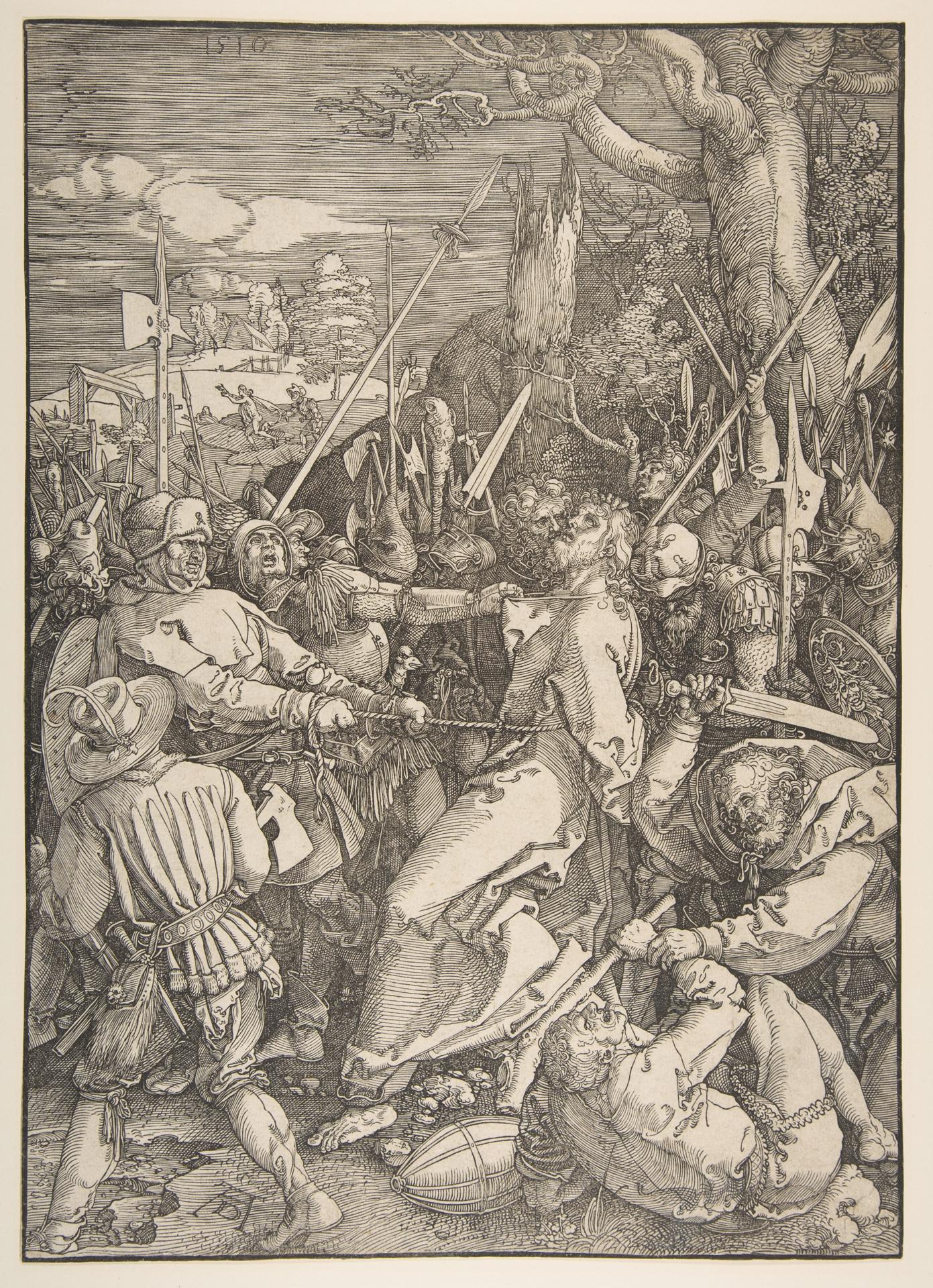
The Betrayal of Christ
Original title: The Betrayal of Christ
kurzbeschreibung
This woodcut by Albrecht Dürer, dating to 1510, depicts the arrest of Jesus in the Garden of Gethsemane. It shows a chaotic scene of soldiers seizing Christ, who is surrounded by armed men. The work is part of Dürer's series on the Passion, known for its dramatic intensity.
Description
The composition centers on Christ, who is held by a group of soldiers, some in armor and helmets, others barefoot in simple garments. They threaten him with lances and sabers, creating a dense, dynamic cluster of figures. In the background, more figures are involved in the confrontation, adding to the sense of turmoil. The scene is asymmetrically arranged, heightening the tension. The monochrome woodcut uses fine, detailed lines and shading to define forms and convey movement.
Context
Dürer created this woodcut as part of his Passion series, which was published in 1511. The series reflects the late medieval devotional focus on Christ's suffering, popular in Northern Europe. Dürer's woodcuts were widely distributed, making his work influential across Europe. The scene follows the Gospel accounts of Judas's kiss and the arrest, a subject frequently depicted in Renaissance art.
Impact
The image conveys a sense of urgent violence and impending fate. The crowded, asymmetrical composition draws the eye across the scene, emphasizing the chaos of the arrest. Dürer's precise linework gives the figures a sculptural solidity, making the moment feel immediate and dramatic.
Technique
This is a woodcut, a relief printing technique where the image is carved into a wooden block, inked, and pressed onto paper. Dürer's mastery of the medium is evident in the varied line weights and cross-hatching that create depth and texture. The monochromatic palette is inherent to woodcut, relying entirely on line and tone for effect.
AI-generated description text
Source: Metropolitan Museum of Art · Public domain (CC0)