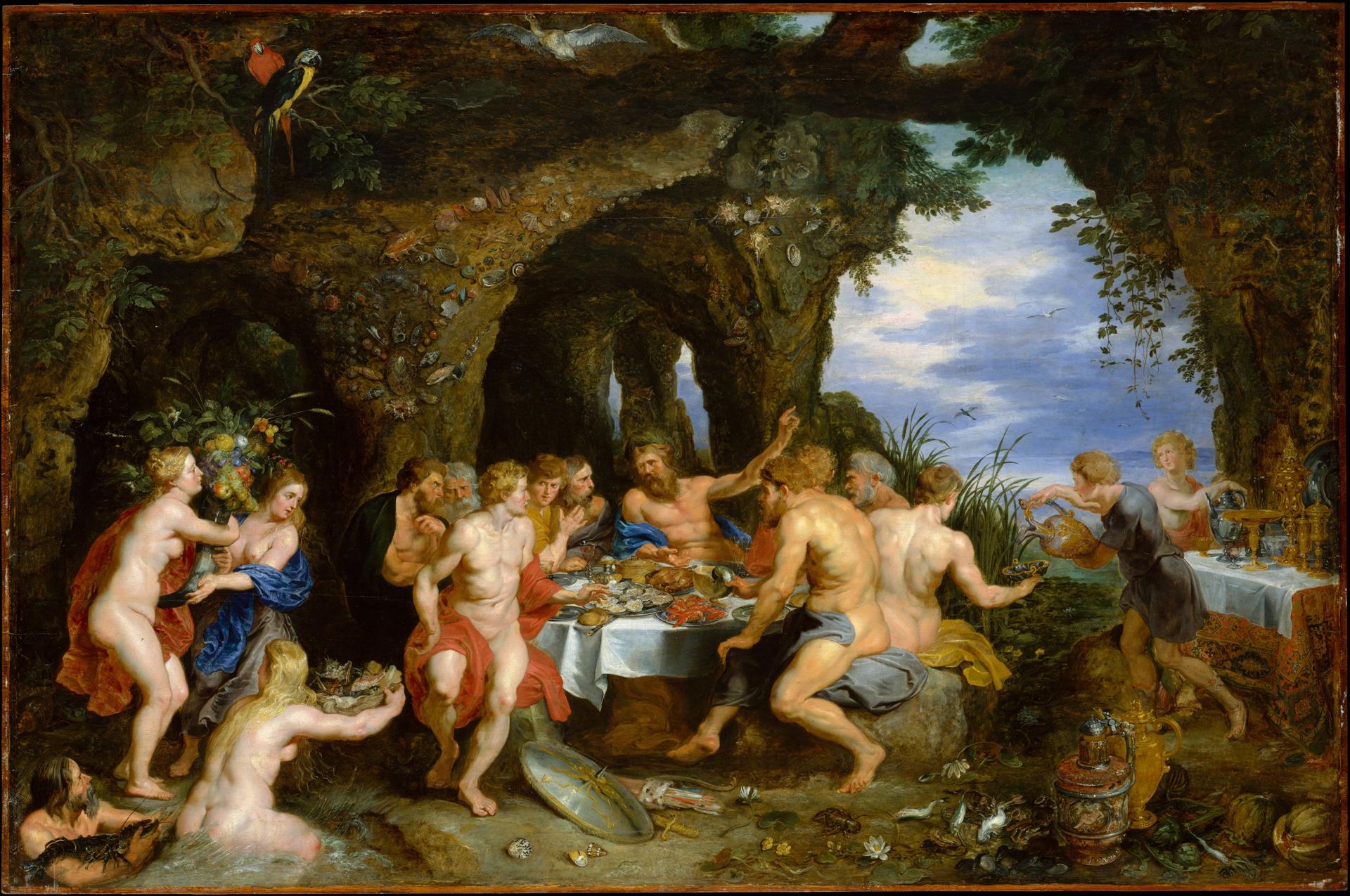
The Feast of Acheloüs
Original title: The Feast of Acheloüs
kurzbeschreibung
Peter Paul Rubens painted 'The Feast of Achelous' around 1615 in oil on wood. This allegorical scene takes love and spring as its theme and presents a group of men at a meal in an idyllic landscape.
Description
Several barefoot men in simple garments have taken their places around a table and are eating. On the left, two women stand with fruit, while in the foreground another woman sits and holds something in her hand. To the right, a woman with a bowl can be seen. The setting is a natural landscape with trees, rocks, a stream and a bird on a branch. Earth and blue tones dominate the muted colouring; the layout feels symmetrical, with the figures placed centrally and landscape elements framing them.
Context
Rubens worked as a respected painter in Antwerp, where this piece was made. It belongs to a group of mythological and allegorical pictures he created for wealthy patrons. The river god Achelous from Greek mythology, known from Ovid's Metamorphoses, serves as a point of reference. Rubens combined classical themes with a naturalistic rendering of landscape, as was typical of his Baroque art.
Impact
The symmetrical arrangement and natural hues evoke a calm, harmonious mood. Through the precise rendering of textures and shadows, the scene feels alive and draws the viewer into the idyllic landscape.
Technique
Oil paint on wood, a common method for panel paintings at the time, was used here. The precise manner of painting with fine brushstrokes produces realistic surfaces and soft shadows, making figures and landscape stand out with a sculptural quality.
AI-generated description text
Source: Metropolitan Museum of Art · Public Domain (CC0 1.0)