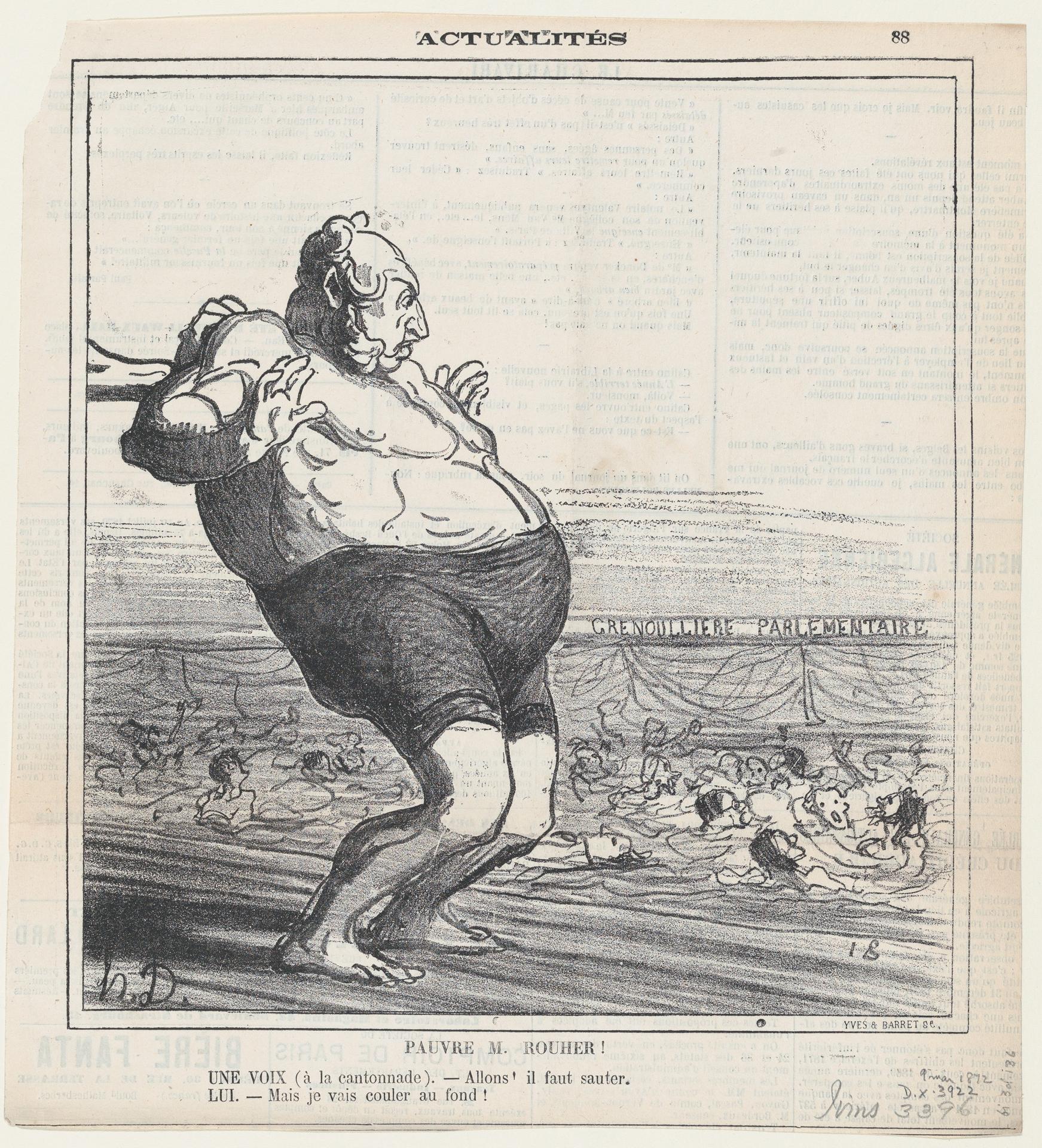
Poor Mr. Rouher! A voice (in the wings): –Go ahead! Jump! He: –But I'll sink to the bottom!, from 'News of the day,' published in Le Charivari, May 9, 1872
Original title: Poor Mr. Rouher! A voice (in the wings): –Go ahead! Jump! He: –But I'll sink to the bottom!, from 'News of the day,' published in Le Charivari, May 9, 1872
kurzbeschreibung
Honoré Daumier's lithograph from 1872, published in Le Charivari, caricatures a political situation involving Monsieur Rouher: an oversized figure stands at the edge of a pool, surrounded by bathing deputies, while a voice from offstage urges him to jump. The ironic caption sharpens the scene.
Description
A lanky man in uniform-like clothing, arms outstretched, face worried, stands ready to leap. Around him swarms of smaller figures swim in a pool; above them blares 'GRENOUILLERE PARLEMENTAIRE', below runs the dialogue 'PAUVRE M. ROUHER! UNE VOIX (à la cantonade). - Allons! il faut sauter. LUI. - Mais je vais couler au fond!'. Crisp contours and fine hatching define the monochrome print.
Context
On 9 May 1872 the satirical journal Le Charivari published this caricature, part of Daumier's series 'News of the Day'. The cartoonist thus addressed politics after the Franco-Prussian War and the Paris Commune. The main figure refers to Eugène Rouher, an influential politician of the time nicknamed 'Vice-Emperor'.
Impact
The contrast between the giant and the small swimmers creates both comedy and unease. The dynamic pose, together with the ironic dialogue, prompts reflection on political absurdity. The bold lithographic line gives the sheet immediate presence.
Technique
For printing, the image was drawn on stone with greasy chalk and then reproduced on newsprint—a lithographic process that allowed fine gradations and clear edges. The monochrome execution on cheap paper shows that the sheet was intended for mass distribution.
AI-generated description text
Source: Metropolitan Museum of Art · Public Domain (CC0 1.0)