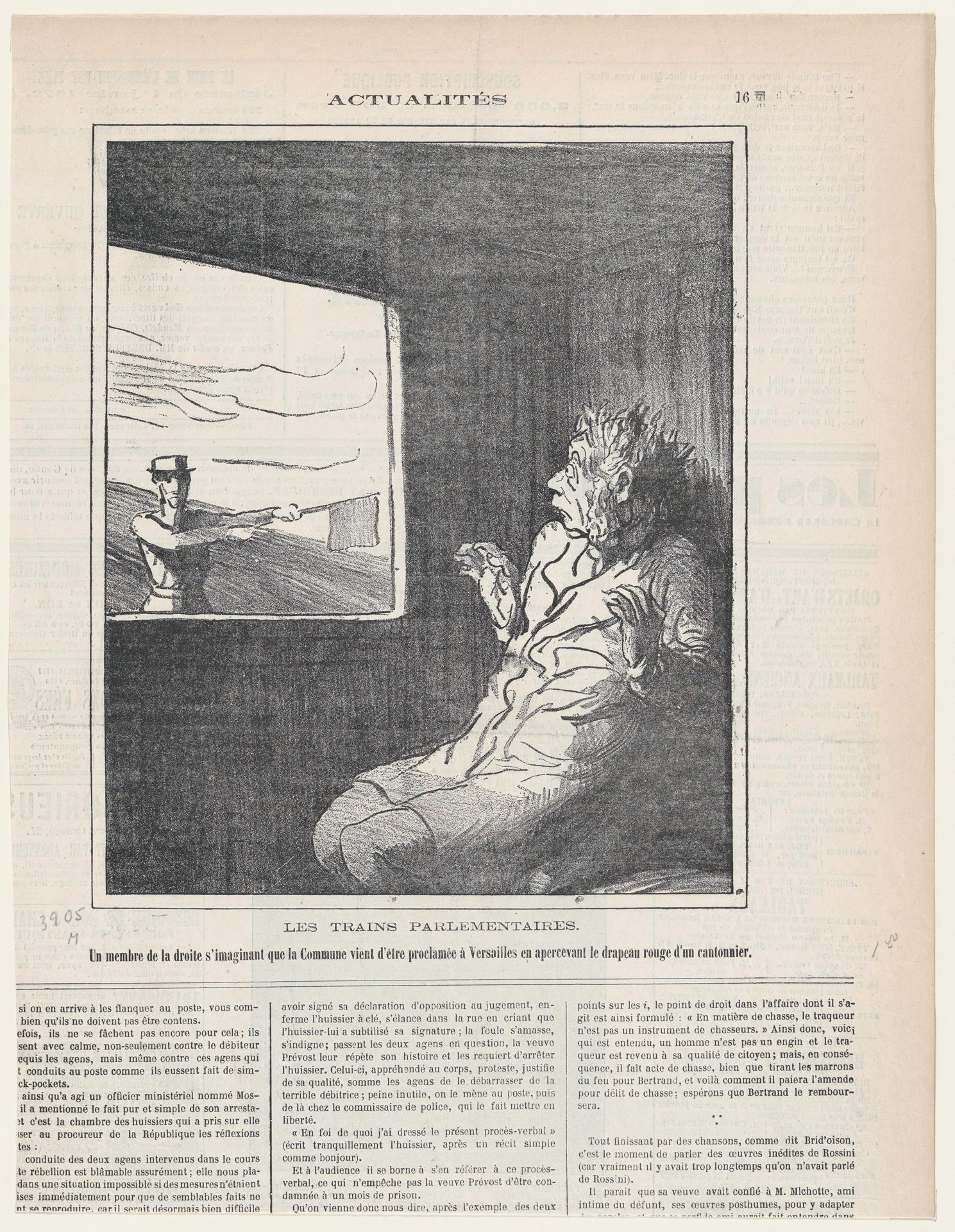
The parliamentary trains: A right wing deputy is shocked by the sight of the red flag of the signal-man, assuming that the Commune has been proclaimed at Versailles, from 'News of the day,' published in Le Charivari, January 22, 1872
Original title: The parliamentary trains: A right wing deputy is shocked by the sight of the red flag of the signal-man, assuming that the Commune has been proclaimed at Versailles, from 'News of the day,' published in Le Charivari, January 22, 1872
kurzbeschreibung
A right-wing deputy sits in a train compartment, staring out in alarm at a signalman holding a red flag. In this 1872 lithograph Honoré Daumier treats the red flag as a supposed sign of the Paris Commune, letting his protagonist fear the worst. The print appeared in the satirical paper Le Charivari as part of the series 'News of the Day'.
Description
Inside a train carriage a man in dark clothing recoils, his face a mask of horror. Through the window a second figure is visible holding a pole with a red flag attached to it — evidently a signalman. The red flag forms the only accent of colour in an otherwise grey-toned lithograph, drawing the eye straight to it. Text along the lower edge points to the image's publication in a newspaper.
Context
Daumier brought out the print in January 1872, only a few months after the Paris Commune was crushed in 1871. The caricature picks up on the lingering nerves and political tensions in France after the Franco-Prussian War. By presenting the red flag, a symbol of the Communards, as a harmless signal, Daumier mocks the conservatives' exaggerated fear of a new revolution. The series 'News of the Day' ran regularly in Le Charivari.
Impact
The overblown terror with which the deputy mistakes a mere signal flag for a revolutionary emblem makes the image comic. Daumier's lively, almost caricatural linework underlines the absurdity of this political anxiety. The contrast between the calm atmosphere of the train and the panicking figure sharpens the satirical point.
Technique
For his satirical prints Daumier often turned to lithography on newsprint, as he did here. The drawing was transferred to a stone and then printed; this is the second of two states (Delteil). The method allowed fine lines and fast production, which mattered for regular publication in the press.
AI-generated description text
Source: Metropolitan Museum of Art · Public Domain (CC0 1.0)