Philosophy
Original title: Philosophy
kurzbeschreibung
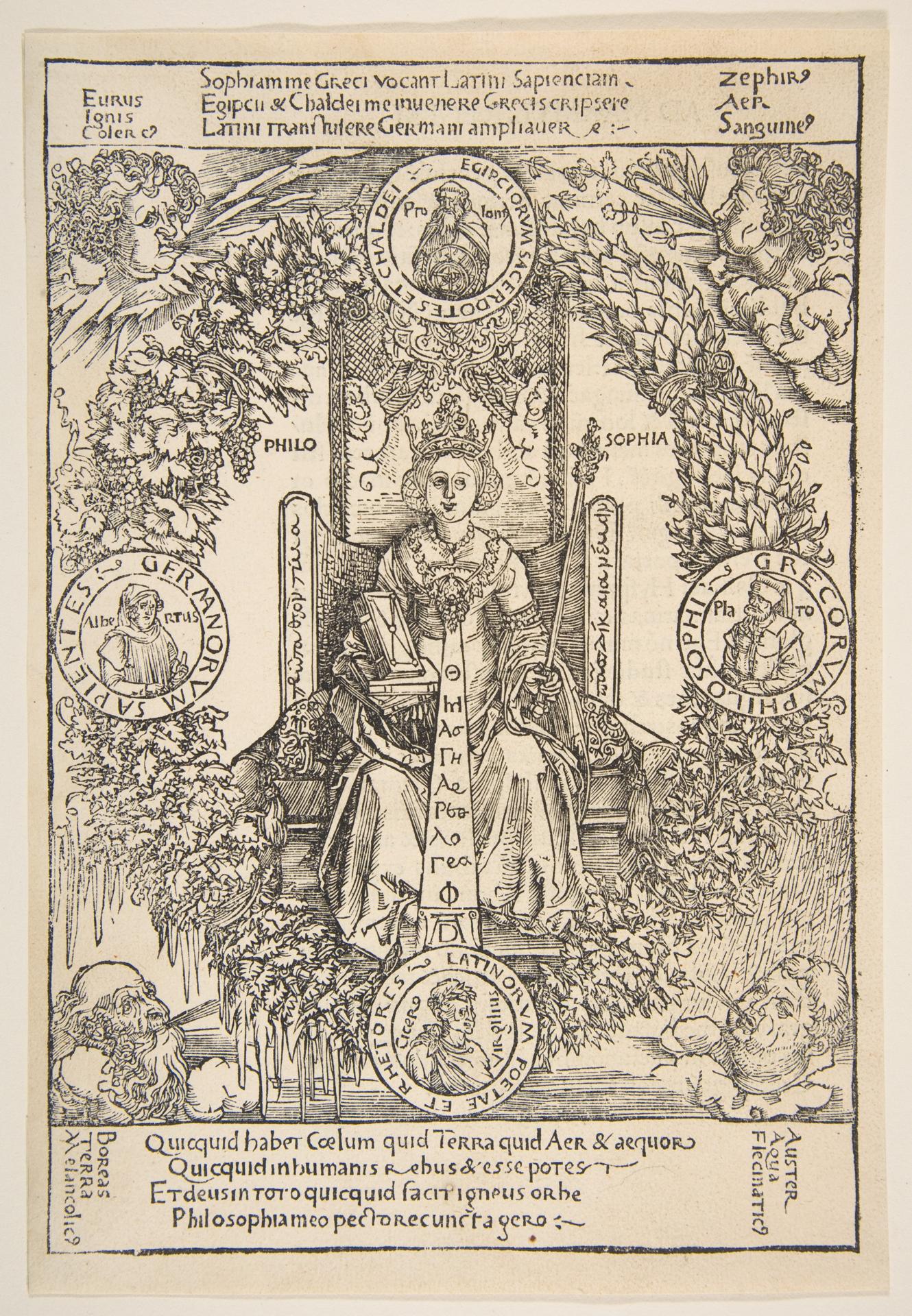
Philosophy is a woodcut by Albrecht Dürer, dating from the early 16th century. It depicts the allegorical figure of Philosophy as a crowned woman seated on a throne, holding a book and a staff. The composition is rich with symbolic elements, including inscriptions and natural motifs, typical of Renaissance allegorical prints.
Description
The print centers on a female figure wearing a crown and a flowing robe, seated in a throne-like chair. She holds an open book in one hand and a staff-like object in the other, conveying authority and wisdom. Surrounding her are Greek and Latin inscriptions, as well as plants and fruits that likely symbolize knowledge and nature. In the lower section, a Latin poem adds to the philosophical theme. The composition is symmetrical, with clear, detailed lines and a monochromatic palette.
Context
Dürer created this woodcut as part of a series of allegorical representations, reflecting the Renaissance interest in classical philosophy and humanism. The figure of Philosophy was often depicted in medieval and Renaissance art as a queen-like personification, embodying the pursuit of wisdom. Dürer's work was influenced by his studies of Italian art and his engagement with humanist circles in Nuremberg. The inclusion of Greek and Latin texts underscores the period's reverence for classical learning.
Impact
The print conveys a sense of intellectual gravitas and timelessness. The symmetrical composition and regal bearing of the figure lend an air of authority, while the intricate details invite close inspection. The monochrome woodcut technique gives the image a stark, graphic quality that emphasizes line and form over color.
Technique
This work is a woodcut, a relief printing technique where the image is carved into a wooden block, inked, and transferred to paper. Dürer was a master of this medium, known for his precise and expressive line work. The uniform light and lack of tonal variation are characteristic of early woodcuts, which rely on bold outlines and cross-hatching to suggest depth.
AI-generated description text
Source: Metropolitan Museum of Art · Public domain (CC0)