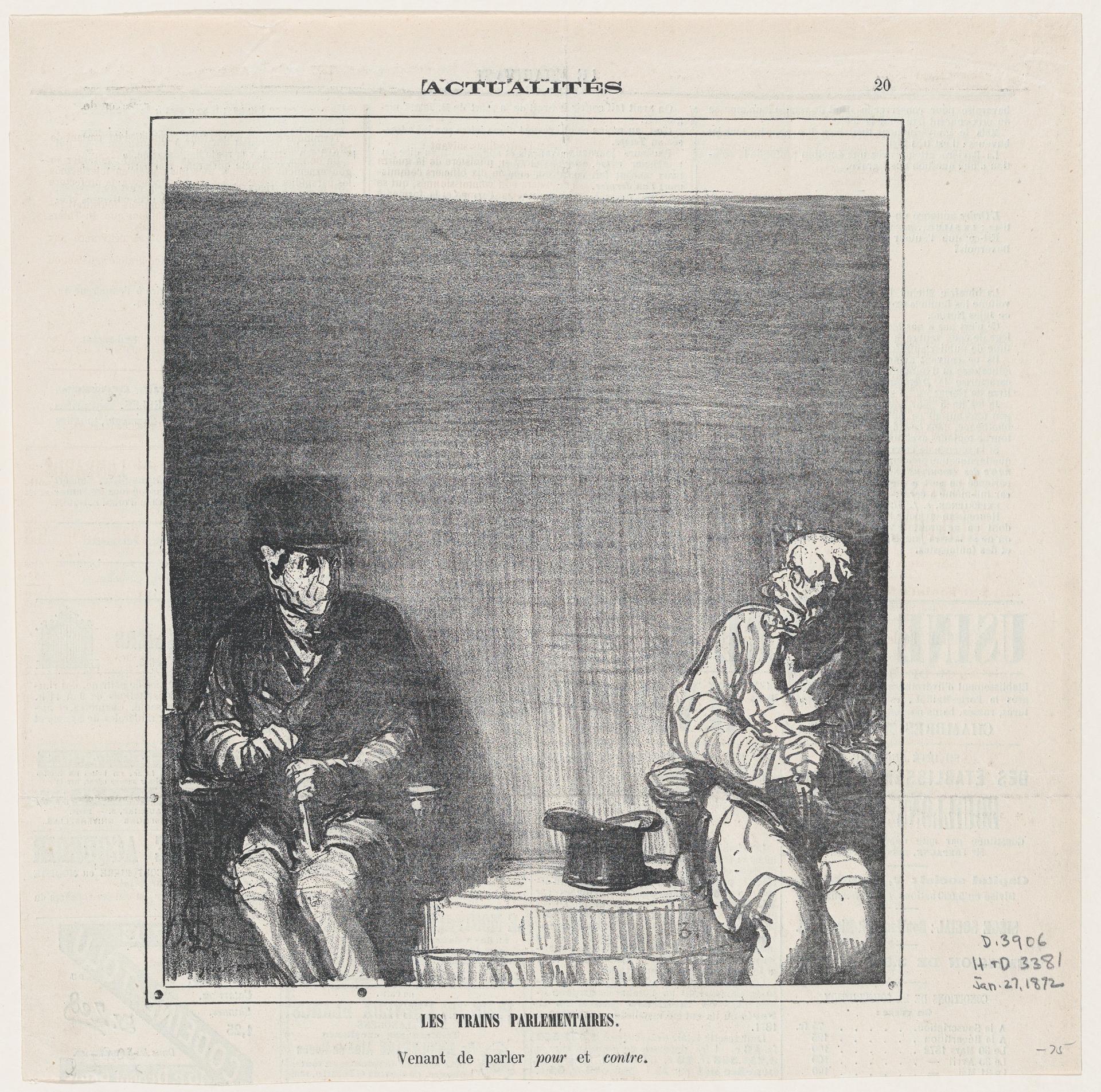
The parliamentary trains: One was for, the other against the government's proposal, from 'News of the day,' published in Le Charivari, January 27, 1872
Original title: The parliamentary trains: One was for, the other against the government's proposal, from 'News of the day,' published in Le Charivari, January 27, 1872
kurzbeschreibung
Two deputies locked in conversation, captured by Honoré Daumier in 1872. The lithograph appeared on January 27, 1872, in the series 'Actualités' in the satirical journal Le Charivari, and takes aim at the political dispute over a government proposal.
Description
In a dark, barely defined room, two men stand facing each other. The one on the left wears a hat, jacket and trousers; the one on the right has a beard and is dressed in a jacket and trousers. A hat lies on a table between them, and both figures' postures suggest an animated discussion. The top edge carries the series title 'ACTUALITÉS' and the page number '20'; below come the main title 'LES TRAINS PARLEMENTAIRES' and the subtitle 'Venant de parler pour et contre.'
Context
The print dates from the early French Third Republic, proclaimed in 1870 after the fall of Napoleon III. Daumier, known for his political caricatures, took up the parliamentary debates of those years. The title uses the metaphor of trains running in opposite directions, making the deputies' conflicting positions vivid. The print was published in the daily Le Charivari, valued for its satirical illustrations.
Impact
The spare visual language and hard black-and-white contrasts give the sheet an immediacy and skill. The stance of the two figures carries a tension that makes the political opposition visible without tipping into mere caricature. The dark, abstract background brings the men's exchange into focus.
Technique
Daumier worked in lithography: a drawing is transferred to a stone or metal plate and then printed. The sheet is executed on newsprint, as was usual for publication in a satirical journal. Finely graded lines and shading reveal a sure hand with the lithographic crayon.
AI-generated description text
Source: Metropolitan Museum of Art · Public Domain (CC0 1.0)