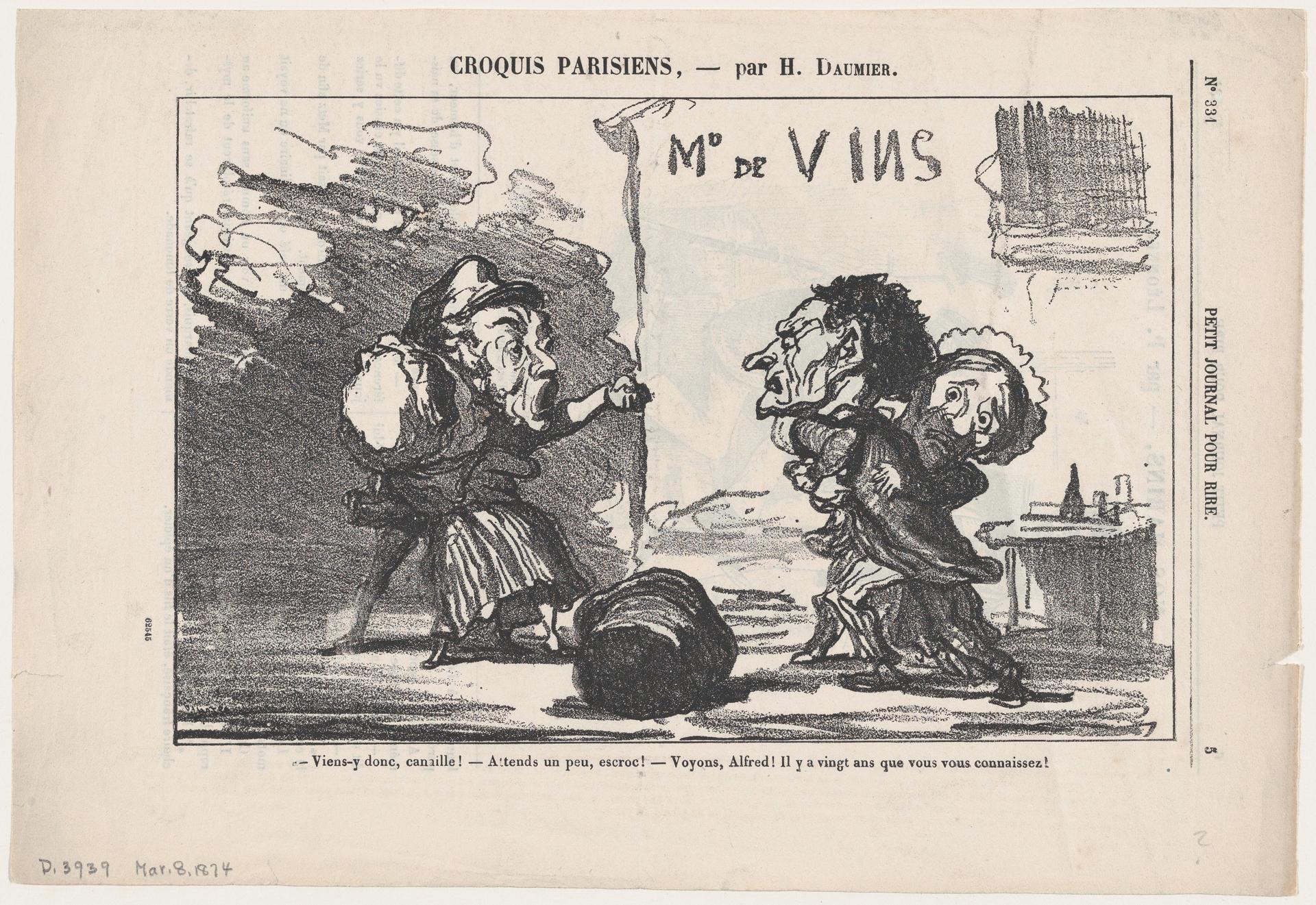
Come on, you scoundrel, come on! – Just you wait, you crook! – Oh come on Alfred, after all you've known each other for some twenty years!
Original title: –Come on, you scoundrel, come on! –Just you wait, you crook! –Oh come on Alfred, after all you've known each other for some twenty years!, from 'Parisian sketches,' published in Le Petit Journal pour Rire, March 8, 1874
kurzbeschreibung
Unlike many contemporary images of conflict, this 1874 lithograph by Honoré Daumier finds the comic side of a heated argument. The print belongs to the 'Pariser Skizzen' series and appeared on 8 March 1874 in the satirical journal Le Petit Journal pour Rire. It is printed in black and white on newsprint.
Description
Two men face each other in an agitated dispute. The figure on the left, in work trousers and shirt, grips a stick or tool, identifying him as a craftsman. The person on the right reacts with a startled, almost fearful expression. Both are heavily exaggerated, as is typical of Daumier's caricatures. At the top of the sheet, the name 'M. de Vins' appears in large letters, hinting at a role in the action.
Context
For the humorous weekly Le Petit Journal pour Rire, which ran from 1856 to 1884, Daumier drew the series 'Croquis Parisiens'. By the time of this lithograph, he had already spent more than four decades making caricatures for various Paris publications. The title suggests an absurd situation: two men who have known each other for about twenty years fall into a ridiculous quarrel. The publication on 8 March 1874 falls in Daumier's late years.
Impact
Exaggerated facial expressions and a lively arrangement make the caricature immediately funny and vivid. The dark, bare background pushes the two figures fully into the foreground; their gestures and faces carry the emotional tension of the moment. Daumier's drawing style gives the sheet an expressive energy that works even without knowing the occasion of the scene.
Technique
The work is a lithograph in the third state of three, printed on newsprint. In this process, one draws with greasy chalk on a stone, from which the image is then transferred to paper. Fine lines and a strong contrast between dark and light areas are characteristic of this printing technique. The sheet measures 21.4 × 31.1 cm, the actual image 15.6 × 24.2 cm.
AI-generated description text
Source: Metropolitan Museum of Art · Public Domain (CC0 1.0)