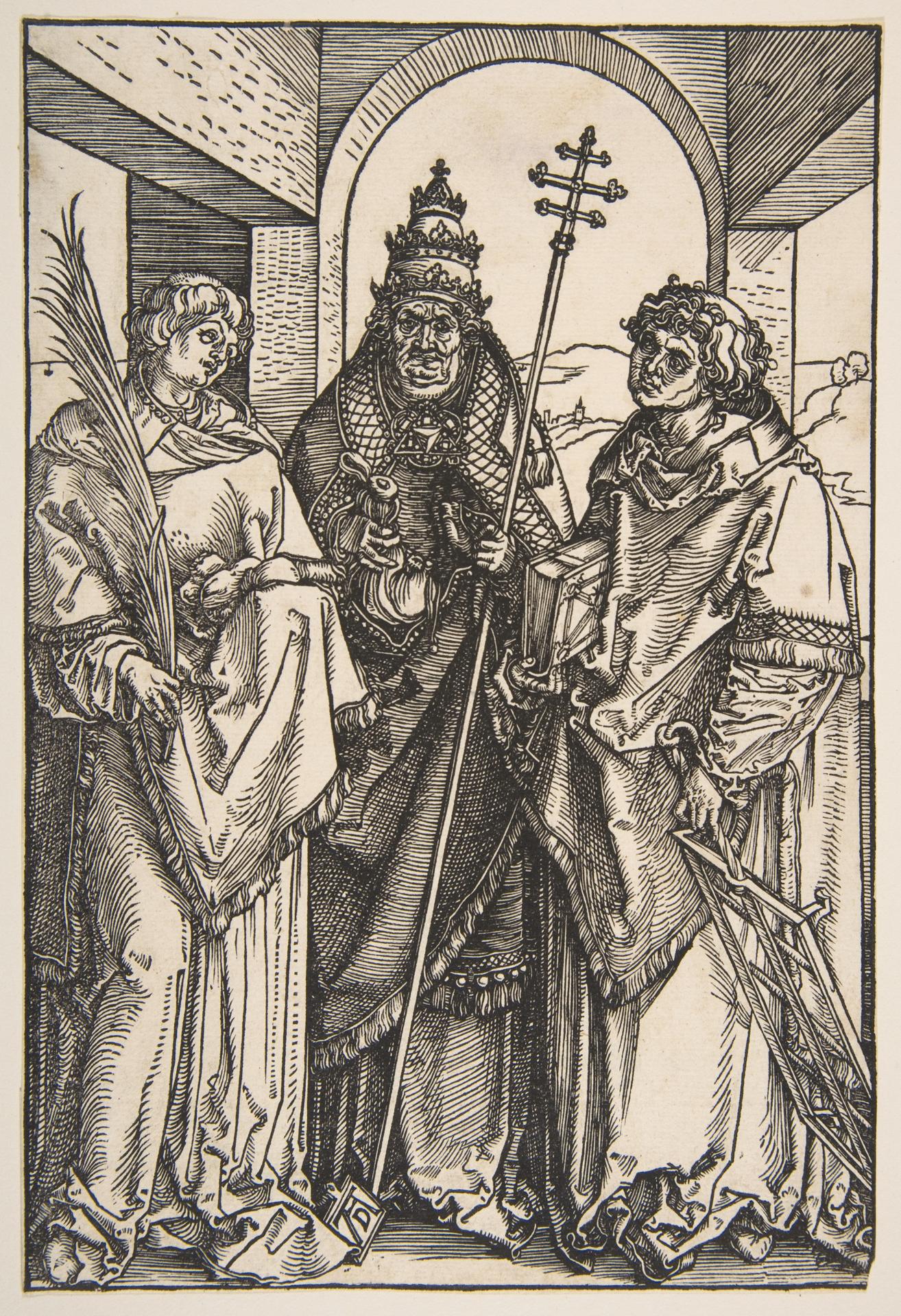
Saint Stephen, Saint Sixtus and Saint Lawrence
Original title: Saint Stephen, Saint Sixtus and Saint Lawrence
kurzbeschreibung
Three saints — Stephen, Sixtus and Lawrence — stand side by side in this undated woodcut by Albrecht Dürer. The Renaissance print is executed in black and white. Each figure wears traditional dress and carries the attributes associated with him.
Description
The layout is symmetrical: at the centre stands Saint Stephen with a crown, a book and a sceptre. To his left is Saint Sixtus holding a palm frond, to his right Saint Lawrence with a cross in his left hand and a book in his right. Fine lines and hatching work over the fabrics of the garments, bringing out their texture. Light falls evenly, as is usual in woodcuts. The faces of the saints are clearly outlined.
Context
Dürer produced numerous woodcuts on religious subjects, which circulated widely during the Renaissance. The print with the three saints was probably made as a devotional image or for a church audience. No precise date is known, but the style fits Dürer's working phase around 1500. Woodcuts often reached the market as series and were sold cheaply.
Impact
The symmetrical arrangement and clear lines give the print a calm, solemn presence. The detailed rendering of the garments and the even distribution of light produce a harmonious, balanced effect. Through the saints' attributes the meaning of the image becomes clear without detour.
Technique
The motif was incised into a wooden stock, and the resulting impression renders the three saints with fine, varying linework that models the folds of their robes, the details of Stephen's crown and book, and the features of their faces. The uniform black-and-white lighting, typical of the medium, keeps the symmetrical composition clear while the contrast of dense and open lines gives the figures a sculptural presence.
AI-generated description text
Source: Metropolitan Museum of Art · Public Domain (CC0 1.0)