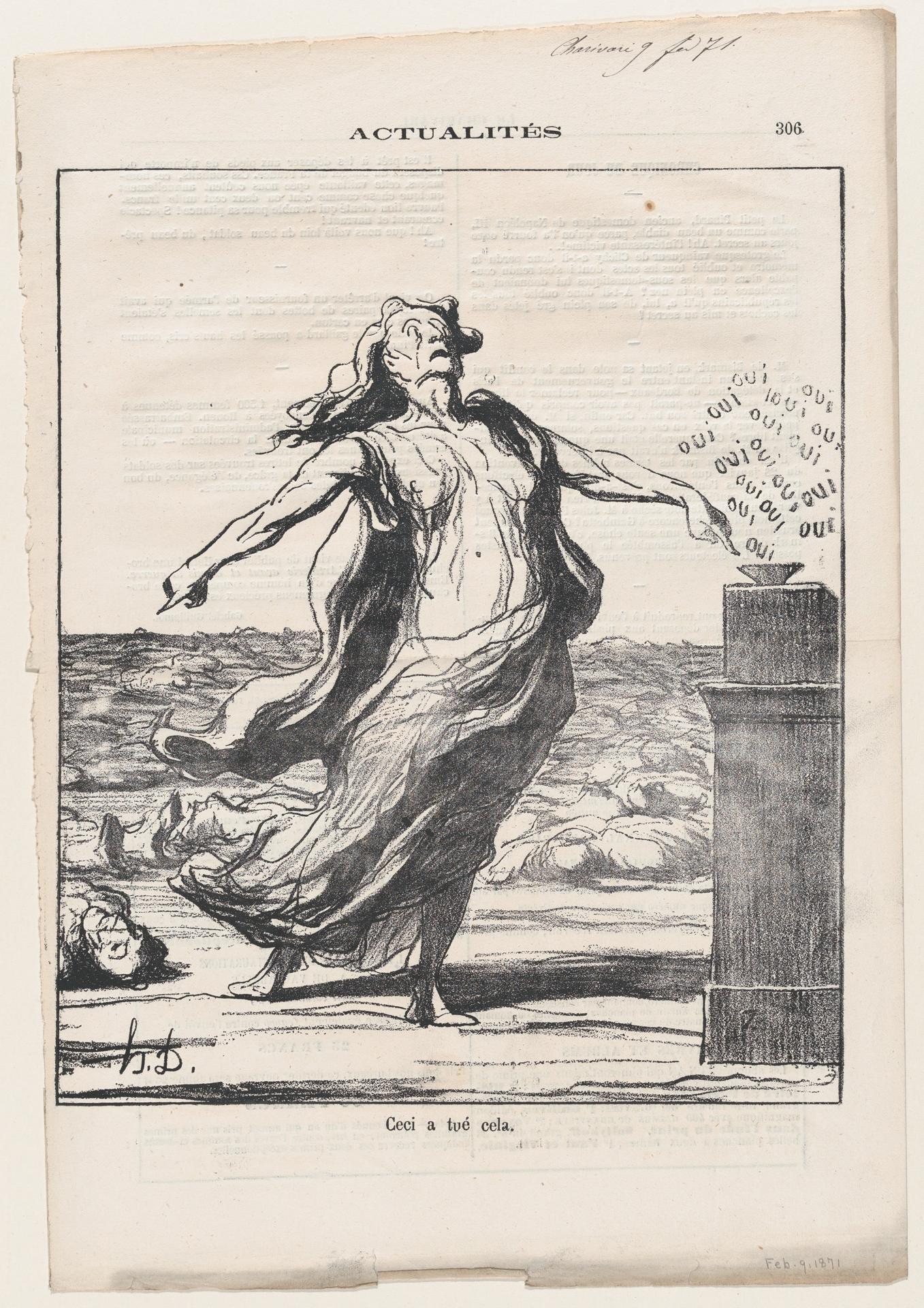
These are responsible for those, from 'News of the day,' published in "Le Charivari"
Original title: These are responsible for those, from 'News of the day,' published in "Le Charivari"
kurzbeschreibung
Unlike most sheets in the 'News of the day' series, this 1871 lithograph by Honoré Daumier centers not on an everyday episode but on an allegorical figure in the manner of an ancient god or philosopher. The black-and-white print appeared in the satirical journal 'Le Charivari'; the image area measures 23.7 × 20 cm.
Description
A bearded man in a long robe stands on a pedestal, thrusting a staff forward with his right hand as if to point at something; his stance feels expansive and animated. Behind him shimmer the outlines of a landscape or city, text lines run across the top of the image, and on the right a sign repeats the word 'OUI'. Along the bottom edge one reads 'Ceci a tué cela' ('This has killed that'). The arrangement draws everything toward the figure, light falls evenly, and the lithograph works with precise strokes.
Context
The caricature was made during the Franco-Prussian War, a few weeks after the capitulation of Paris in January 1871, and went to press in 'Le Charivari', for which Daumier regularly contributed political and social satires. The phrase 'Ceci a tué cela' quotes Victor Hugo's novel 'The Hunchback of Notre-Dame', in which printing displaces architecture as the leading medium. Current events and social shifts are taken up here with the artist's customary ironic refraction.
Impact
The exaggerated, almost monumental figure and the harsh contrasts are quickly imprinted on the memory. Between ancient pathos and day-to-day political commentary arises a mixture of reflection and mockery, and both gesture and lettering draw the viewer directly into the action of the image.
Technique
The sheet was printed as a lithograph on newsprint, a process that allowed Daumier fast and inexpensive editions. The present example is the second of four states (Delteil). The technique manifests itself in clear lines and dense detail, as is characteristic of his prints.
AI-generated description text
Source: Metropolitan Museum of Art · Public Domain (CC0 1.0)