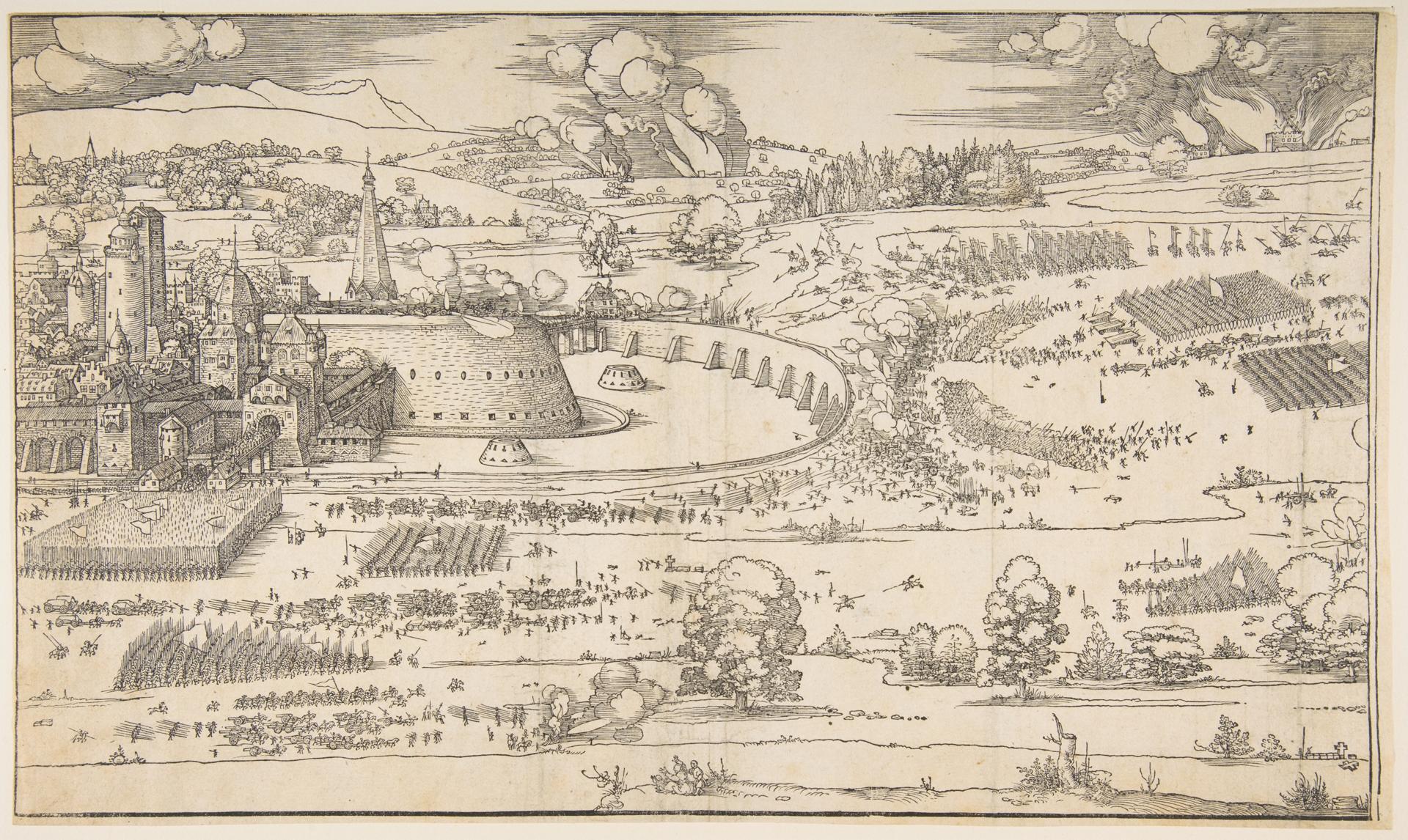
The Siege of a Fortress
Original title: The Siege of a Fortress
kurzbeschreibung
This woodcut by Albrecht Dürer depicts a fortified city under siege, with troops massed in the foreground and smoke rising from distant fires. The scene is part of Dürer's exploration of military subjects, likely created in the early 16th century. The print showcases his skill in rendering complex landscapes and architectural details.
Description
The composition is horizontally oriented, with a heavily fortified city on the left featuring high walls, towers, and a prominent tall spire. A large semicircular bastion stands before the city, with two small circular structures directly in front of it. To the right, rows of troops are arranged in formation, while smoke plumes rise in the background, suggesting battle. The landscape includes hills, trees, and a body of water with boats at the lower right.
Context
Dürer was a leading German Renaissance artist known for his prints and theoretical works. This woodcut likely reflects the military innovations and siege techniques of his time, possibly inspired by the Ottoman wars or Italian campaigns. Dürer's interest in fortification is also evident in his later treatise on the subject.
Impact
The print conveys a sense of organized chaos, balancing detailed architecture with the dynamic movement of troops and smoke. The stark contrast of black ink on paper gives the scene a dramatic, almost theatrical quality. The viewer is drawn into the strategic layout, contemplating the scale of the conflict.
Technique
Dürer employed the woodcut technique, carving the design into a wooden block and printing it with ink. His precise line work allows for intricate details in the architecture and figures. The use of varied line thicknesses suggests depth and texture, typical of his mature printmaking style.
AI-generated description text
Source: Metropolitan Museum of Art · Public domain (CC0)