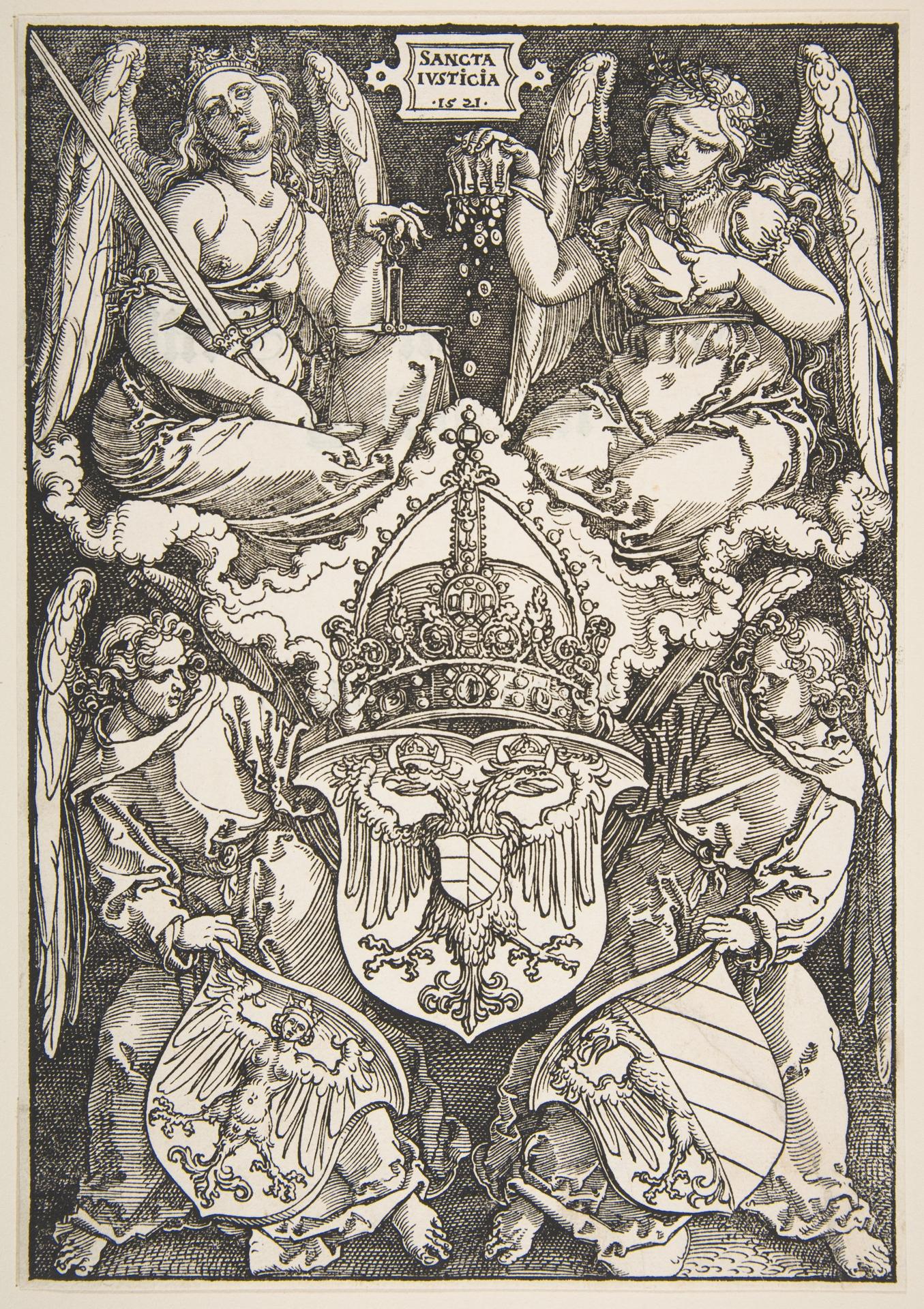
The Arms of the Empire and of Nuremberg
Original title: The Arms of the Empire and of Nuremberg
kurzbeschreibung
The Arms of the Empire and of Nuremberg is a woodcut by Albrecht Dürer, dated 1521. It depicts two female figures holding crowns, surrounded by angels, above a coat of arms featuring an eagle and two shields. The print is monochromatic, typical of Dürer's graphic work.
Description
In the center, two female figures stand side by side, each holding a crown above their heads. They are flanked by angels, also holding crowns, creating a symmetrical composition. Below, a large eagle with outstretched wings supports two shields, each emblazoned with heraldic motifs. The scene is set against a background of swirling clouds, with the inscription 'SANCTA IUSTICIA' visible at the top. The woodcut is monochrome, with strong contrast between dark and light areas, and the lines are sharp and detailed.
Context
Albrecht Dürer created this woodcut in 1521, a period when he was at the height of his artistic career. The work likely celebrates the imperial city of Nuremberg, where Dürer lived and worked, and its connection to the Holy Roman Empire. The inscription 'SANCTA IUSTICIA' (Holy Justice) suggests an allegorical or political meaning, possibly referencing the ideals of justice associated with the empire. Dürer was known for his intricate woodcuts, which were widely disseminated and influential across Europe.
Impact
The composition conveys a sense of grandeur and authority, reinforced by the symmetrical arrangement and the celestial setting. The intricate linework draws the viewer's eye across the detailed heraldic elements and the flowing drapery of the figures. The stark contrast between black and white gives the print a dramatic, almost monumental presence.
Technique
This is a woodcut, a relief printing technique where the image is carved into a wooden block, inked, and transferred to paper. Dürer's mastery of the medium is evident in the fine, controlled lines and the subtle variations in texture. The use of cross-hatching and parallel lines creates depth and shading, while the bold outlines define the forms clearly.
AI-generated description text
Source: Metropolitan Museum of Art · Public domain (CC0)