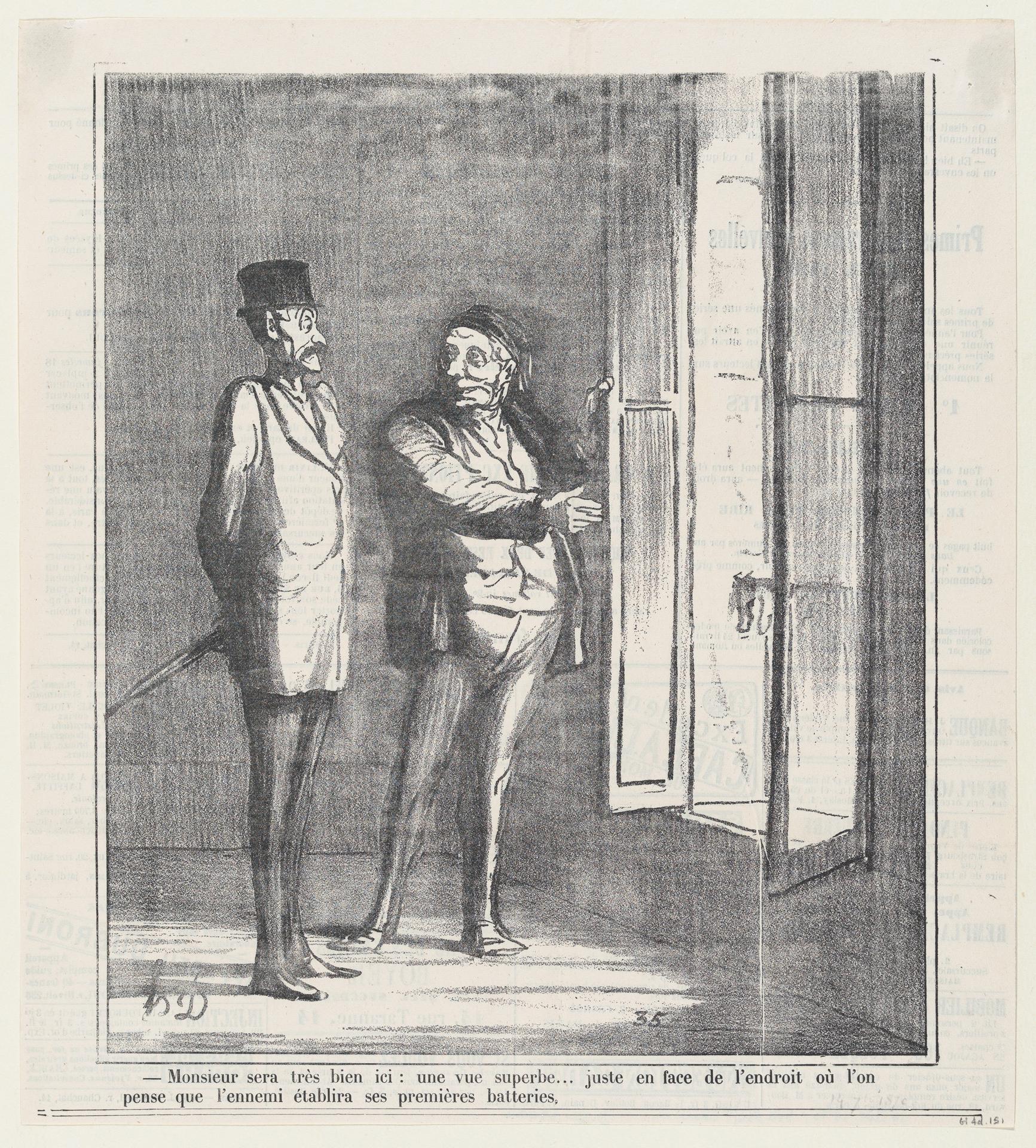
Monsieur will be very satisfied here: a superb view... Right in front of the spot where they think the enemy will set up his first forces, from 'News of the day,' published in Le Charivari, September 14, 1870
Original title: Monsieur will be very satisfied here: a superb view... Right in front of the spot where they think the enemy will set up his first forces, from 'News of the day,' published in Le Charivari, September 14, 1870
kurzbeschreibung
Honoré Daumier made this lithograph on September 14, 1870. It shows two men indoors discussing a military situation. The print belongs to the series 'News of the Day' and appeared in the satirical journal Le Charivari. It is a lithograph on newsprint, second state of two (Delteil).
Description
Two figures occupy a room: on the left, a man in a top hat, sleeveless shirt and trousers looks toward the door. On the right, a person in a suit and tie holds the door open; both are deep in conversation. A wall with a window forms the background, through which a city view with buildings and a tree can be seen. The image is monochrome in shades of gray, evenly lit and without striking shadows. The style is caricatural, with exaggerated facial features and humorous figures.
Context
Daumier made this lithograph during the Franco-Prussian War, at the time of the Siege of Paris. It appeared in the satirical journal Le Charivari, known for its political and social criticism. The caption refers to expectations about an enemy position and thus reflects the war situation. Through his art, Daumier commented on the absurdities of war and bourgeois attitudes.
Impact
The caricatural style and ironic caption make the print both humorous and thought-provoking. The two men engaged in a war-related discussion create a distance from the seriousness of the situation that invites a smile but also emphasizes the absurdity of the moment. The clear arrangement and even lighting draw the eye to the interaction between the figures.
Technique
Lithography—a planographic process in which a design is drawn on stone with greasy chalk. It was printed on newsprint, indicating inexpensive mass production for the newspaper. The gray tones arise from varying densities of ink application, as is typical of lithographs.
AI-generated description text
Source: Metropolitan Museum of Art · Public Domain (CC0 1.0)