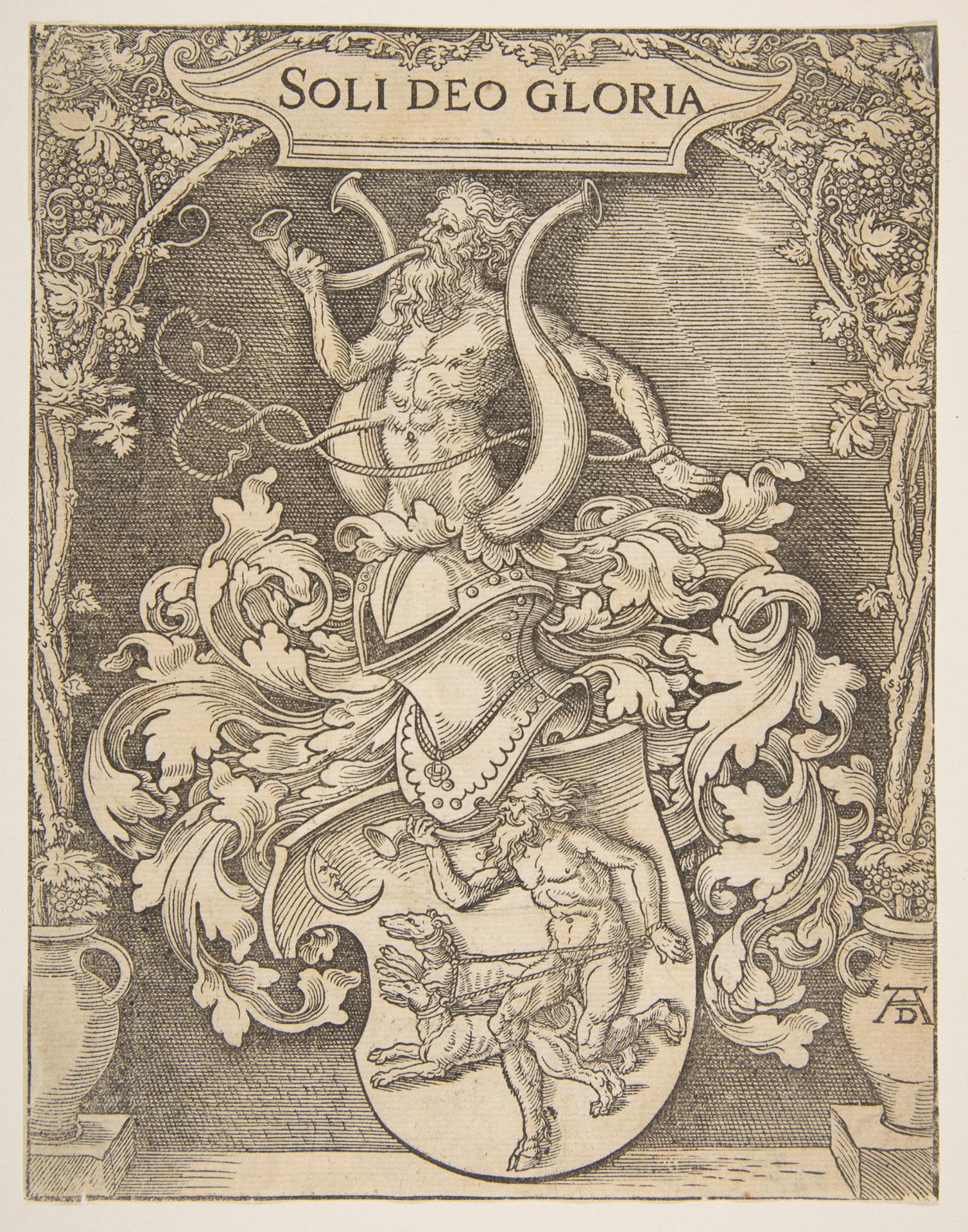
The Arms of Johann Tscherte
Original title: The Arms of Johann Tscherte
kurzbeschreibung
This woodcut by Albrecht Dürer depicts the heraldic arms of Johann Tscherte, featuring a shield with two anthropomorphic figures. The composition is framed by intricate floral ornaments and includes the motto 'SOLI DEO GLORIA' at the top. The work is executed in monochrome tones typical of Dürer's graphic oeuvre.
Description
The central shield is occupied by two male figures, one bearded and one clean-shaven, each holding a horn. The bearded figure sits atop the shield, which is surrounded by a decorative floral border. Below the shield, a small barefoot child is seated on an animal, while grapevines and leaves fill the background. The composition is symmetrical, drawing the eye to the central heraldic device, and the fine, precise linework is characteristic of woodcut printing.
Context
Johann Tscherte was a Viennese court architect and engineer, and this woodcut likely served as a bookplate or personal emblem. Dürer created numerous heraldic designs for patrons, and this work reflects the Renaissance interest in classical motifs and personal symbolism. The motto 'SOLI DEO GLORIA' (Glory to God alone) underscores the religious sentiment common in Dürer's art.
Impact
The interplay of intricate detail and bold outlines gives the print a sense of both delicacy and strength. The symmetrical composition and the use of negative space create a balanced, harmonious visual impression. The monochrome palette allows the viewer to focus on the intricate linework and the symbolic elements.
Technique
This is a woodcut, a relief printing technique where the image is carved into a wooden block, inked, and transferred to paper. Dürer's mastery of the medium is evident in the fine, controlled lines and the subtle gradations of tone achieved through varying line density. The print is monochromatic, with shades of gray produced by the ink and paper.
AI-generated description text
Source: Metropolitan Museum of Art · Public domain (CC0)