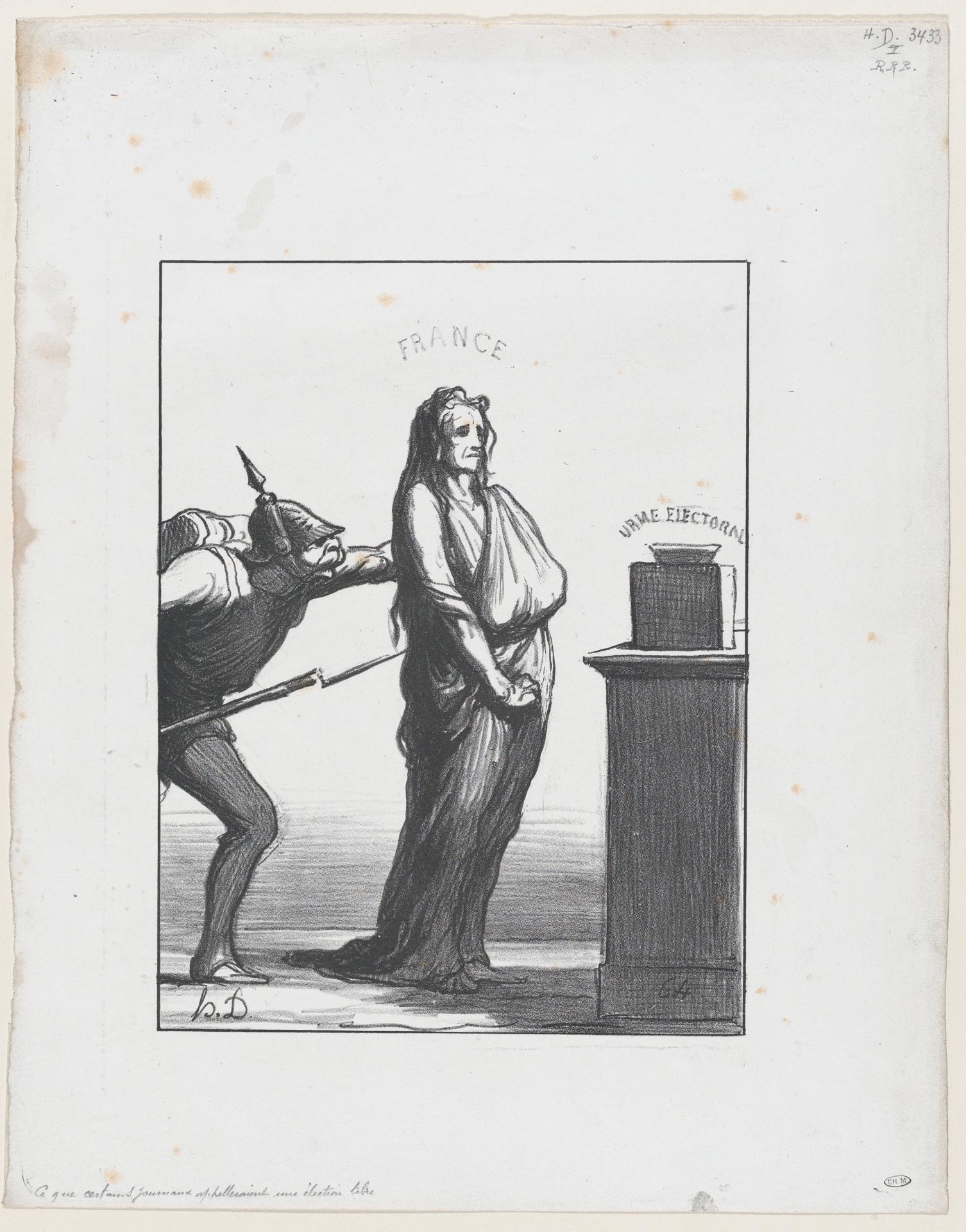
What certain newspapers would call a free election, from 'News of the day'
Original title: What certain newspapers would call a free election, from 'News of the day'
kurzbeschreibung
Honoré Daumier's lithograph of 1870 sets two figures against each other in a satirical encounter: a grieving embodiment of France and an armed soldier threatening her. This black-and-white sheet on wove paper belongs to the series 'Nachrichten des Tages' (News of the Day).
Description
The arrangement feels deliberately lopsided. On the left stands a figure labeled 'France' in a long robe, her posture and expression downcast and pensive. Facing her at right is a soldier in helmet and weapon, his bearing readable as a threat. Between the two sits an urn inscribed 'URNE ELECTORALE'. Caricatural exaggeration of proportion and firmly drawn contours define the motif; the lighting stays flat and shadowless, as is usual for lithographs.
Context
The print was made on November 24, 1870, in the middle of the Franco-Prussian War and during the siege of Paris. Daumier thus targets the sham elections held under the provisional Government of National Defence, which took place despite the presence of Prussian troops. The tension between the claim to free elections and the actual military threat from the enemy forms the critical core.
Impact
The confrontation of defenseless grief and military force produces immediate unease. Through the satirical distortion of the figures and the legible inscriptions, the political message comes across quickly. The restriction to black and white underlines the seriousness of the subject.
Technique
Lithography on wove paper, a printing process based on the repulsion of grease and water on limestone. What is at hand is the first of two states (Delteil), pointing to later reworking. The linework is precise and so matches Daumier's characteristic hand.
AI-generated description text
Source: Metropolitan Museum of Art · Public Domain (CC0 1.0)