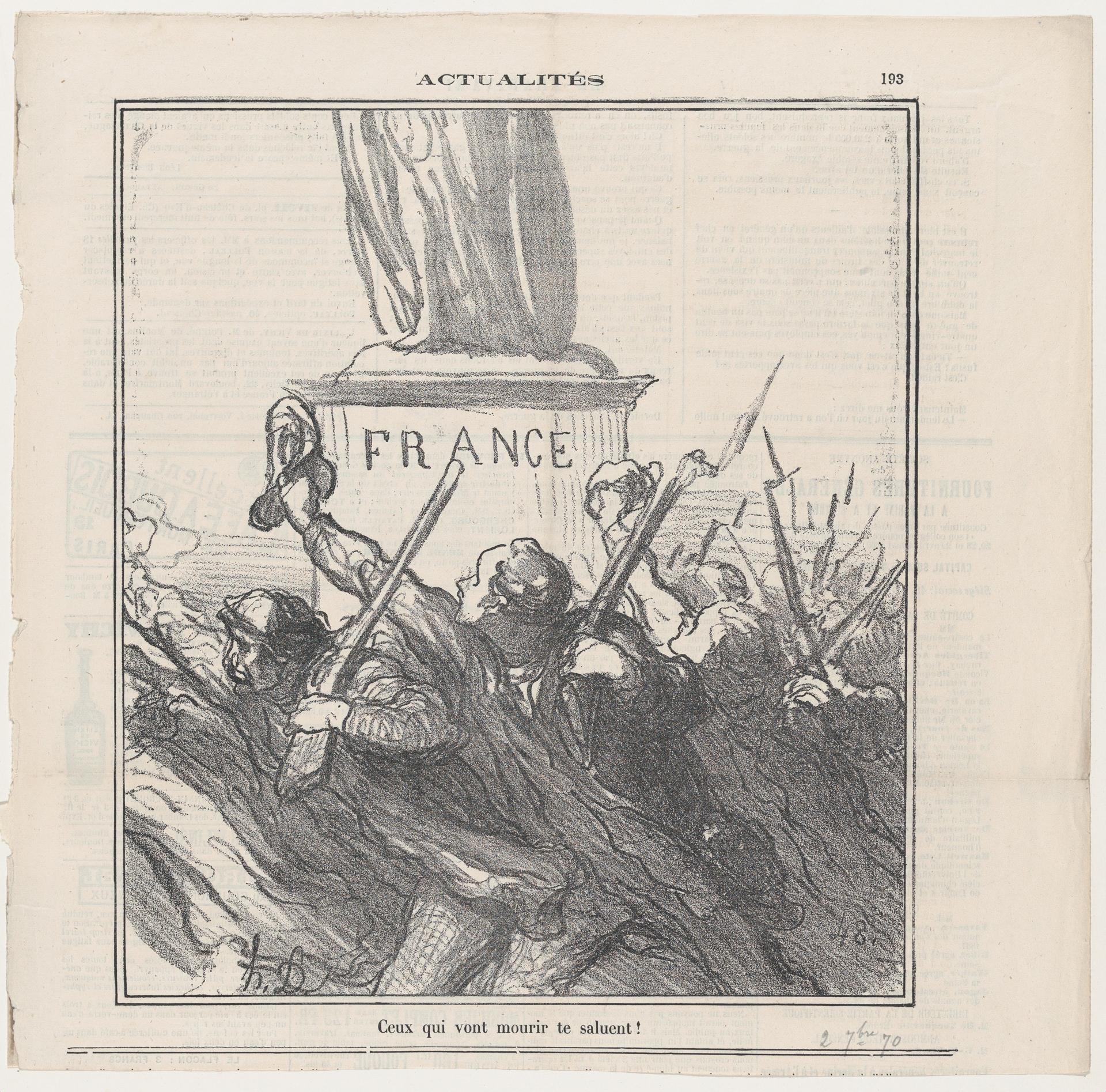
Those who are about to die, salute thee, from 'News of the day,' published in Le Charivari, September 2, 1870
Original title: Those who are about to die, salute thee, from 'News of the day,' published in Le Charivari, September 2, 1870
kurzbeschreibung
Honoré Daumier made this lithograph in 1870, and it sets a statue of France amid a crowd of soldiers in a moment of turmoil. The print appeared in the satirical journal Le Charivari on 2 September 1870 and is the second state of two (Delteil).
Description
A figure labelled 'FRANCE' anchors the middle of the picture, hemmed in by a restless band of men in military uniform. Some carry weapons; others seem caught up in a scuffle. The layout is deliberately thrown off balance, built for tension and movement. Across the bottom runs the French line 'Ceux qui vont mourir te saluent!' (Those who are about to die salute you!). Everything is printed in a single colour, in shades of grey.
Context
Daumier drew this during the Franco-Prussian War, right after the French defeat at Sedan on 1 September 1870. He contributed political and social commentary to Le Charivari on a regular basis. The title borrows the gladiators' greeting from ancient Rome and speaks to France's plight now that Emperor Napoleon III had been taken prisoner.
Impact
Strong contrasts and deep shadows concentrate the subject into a strained, dramatic mood. Since the figures are arranged with no symmetry at all, the viewer gets a sense of crush and agitation that comes across directly.
Technique
The image was printed as a lithograph on newsprint: the drawing is set down on a stone with greasy chalk and then pulled. The thin strokes and graded shadows reveal Daumier's characteristic hand, which holds on to even the small details of the figures.
AI-generated description text
Source: Metropolitan Museum of Art · Public Domain (CC0 1.0)