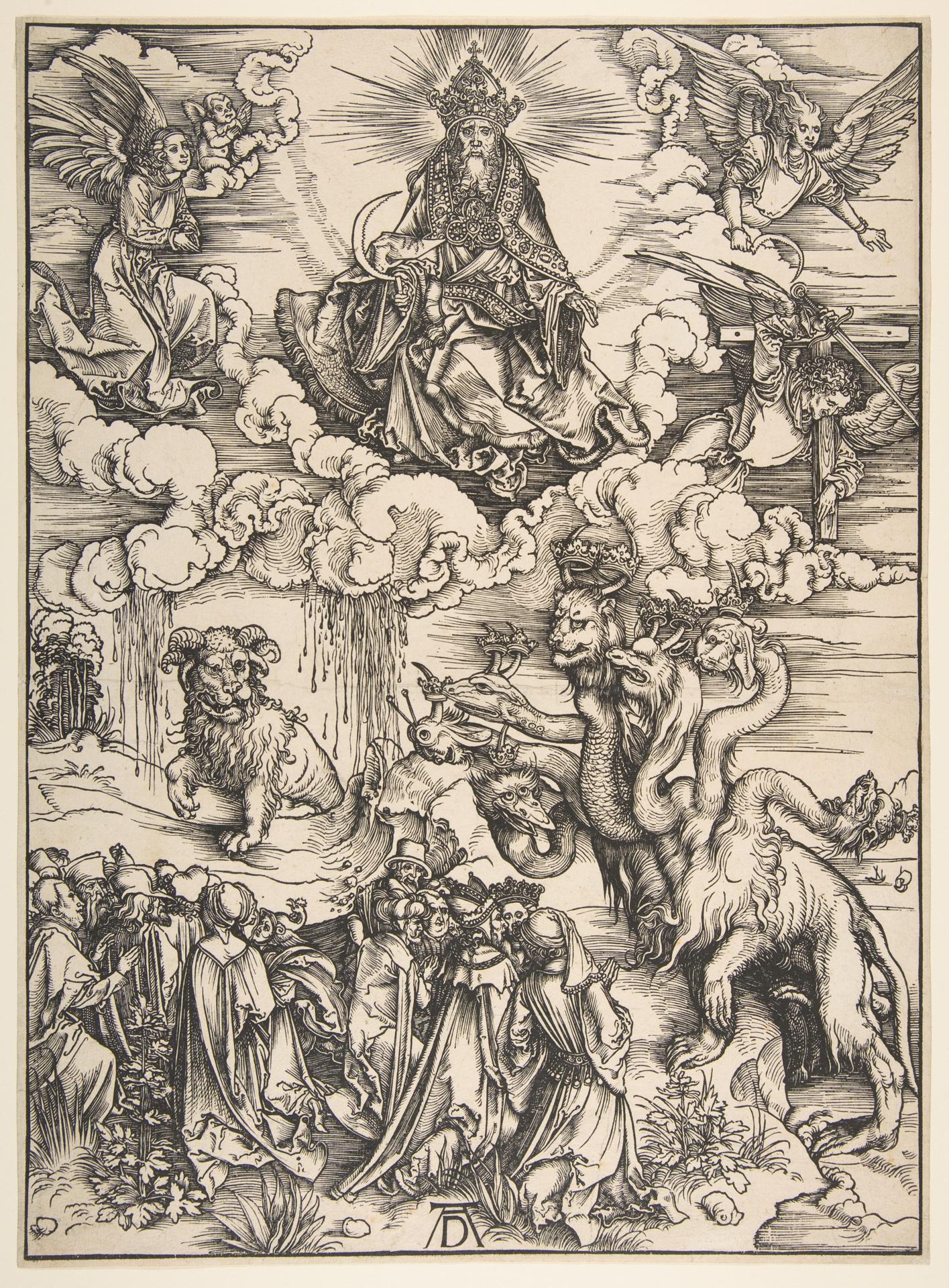
The Beast with the Seven Heads and the Beast with Lamb's Horns
Original title: The Beast with the Seven Heads and the Beast with Lamb's Horns
kurzbeschreibung
Albrecht Dürer's woodcut from 1511 illustrates a scene from the Book of Revelation, depicting the Antichrist enthroned in heaven and the two beasts emerging from the sea and the earth. The print is part of Dürer's famous Apocalypse series, known for its intricate detail and dramatic composition.
Description
The upper register shows a crowned figure, likely the Antichrist, seated among clouds with a radiant halo-like background, holding a sword. Two angels flank him, one bearing a lance. Below, the seven-headed beast rises from the sea, its heads a mix of animal and human forms, some horned. To the right, the beast with lamb's horns emerges, while a crowd of people in period attire looks on in fear.
Context
Dürer created this woodcut for his Apocalypse series, first published in 1498 and reissued in 1511. The series was groundbreaking for its time, as Dürer both designed and published the prints himself, a departure from traditional workshop practices. The imagery reflects late medieval anxieties about the end times and the perceived threats of heresy and false prophets.
Impact
The woodcut's stark black-and-white contrast and dense, swirling lines create a sense of apocalyptic urgency. The symmetry of the composition, with the Antichrist centered above and the beasts below, draws the eye downward, emphasizing the threat posed to the faithful. Dürer's precise linework lends the scene a sense of realism that makes the fantastical elements more immediate and unsettling.
Technique
Dürer employed the woodcut technique, carving the design into a wooden block, inking it, and pressing it onto paper. His mastery of cross-hatching and varied line weights allowed for remarkable tonal range and detail, elevating the medium beyond its traditional use for simple illustrations. The 1511 edition was printed with text on the reverse, integrating image and scripture.
AI-generated description text
Source: Metropolitan Museum of Art · Public domain (CC0)