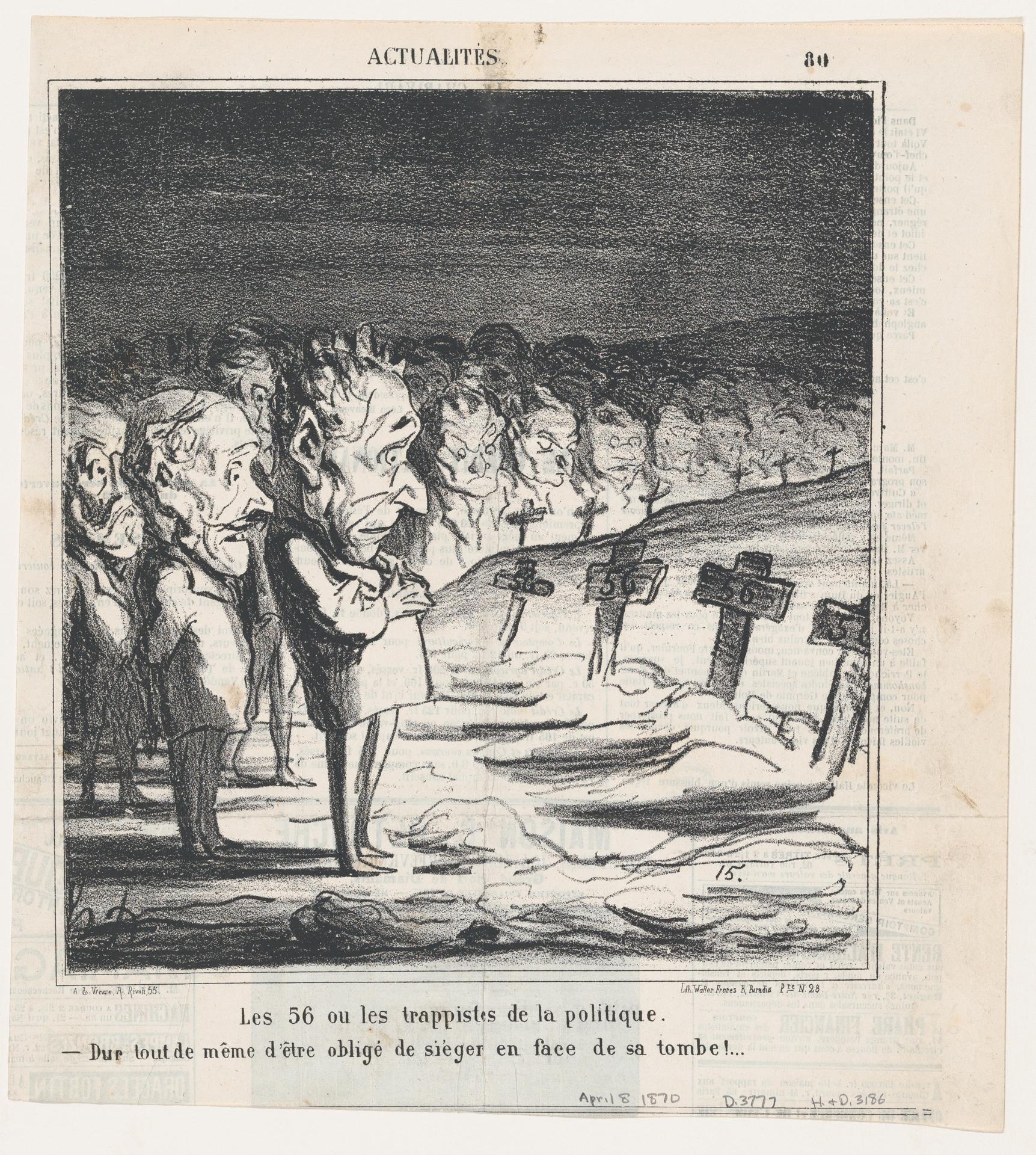
The 56, or the trappists of politics: –Tough to have a session in front of your own grave!
Original title: The 56, or the trappists of politics: –Tough to have a session in front of your own grave!, from 'News of the day,' published in Le Charivari, April 8, 1870
kurzbeschreibung
Honoré Daumier made this lithograph in April 1870. It lines up a row of politicians who have taken their places in front of graves marked with crosses. The satirical sheet appeared in the newspaper Le Charivari. It was executed as a lithograph, with added ink and pencil on newsprint.
Description
Across the foreground stands a row of political figures, stylised and plainly exaggerated. Behind them rise graves with crosses that point to the political situation. The men's faces carry the caricatural features typical of Daumier. The layout sets the figures clearly apart from the graves. Black and white dominates, with light spread evenly throughout.
Context
The lithograph was made in April 1870, a few months before the fall of the Second Empire in France. Daumier published it in the satirical journal Le Charivari, for which he regularly drew political caricatures. The title names the 'Trappists', a contemplative order, and the number 56, which may refer to a particular political group or vote. Showing politicians before their own graves alludes to their failure and the transience of their power.
Impact
The satirical exaggeration draws an immediate laugh and at the same time prompts reflection. Placing living politicians beside their graves creates an ironic distance that brings a smile. The clear arrangement and restrained colour strengthen the sheet's message.
Technique
The lithograph rests on a drawing made with greasy chalk on stone. Pen and brown ink were added for details, along with a red pencil on newsprint. What is shown here is the second state of three, a proof print that reveals how Daumier worked.
AI-generated description text
Source: Metropolitan Museum of Art · Public Domain (CC0 1.0)