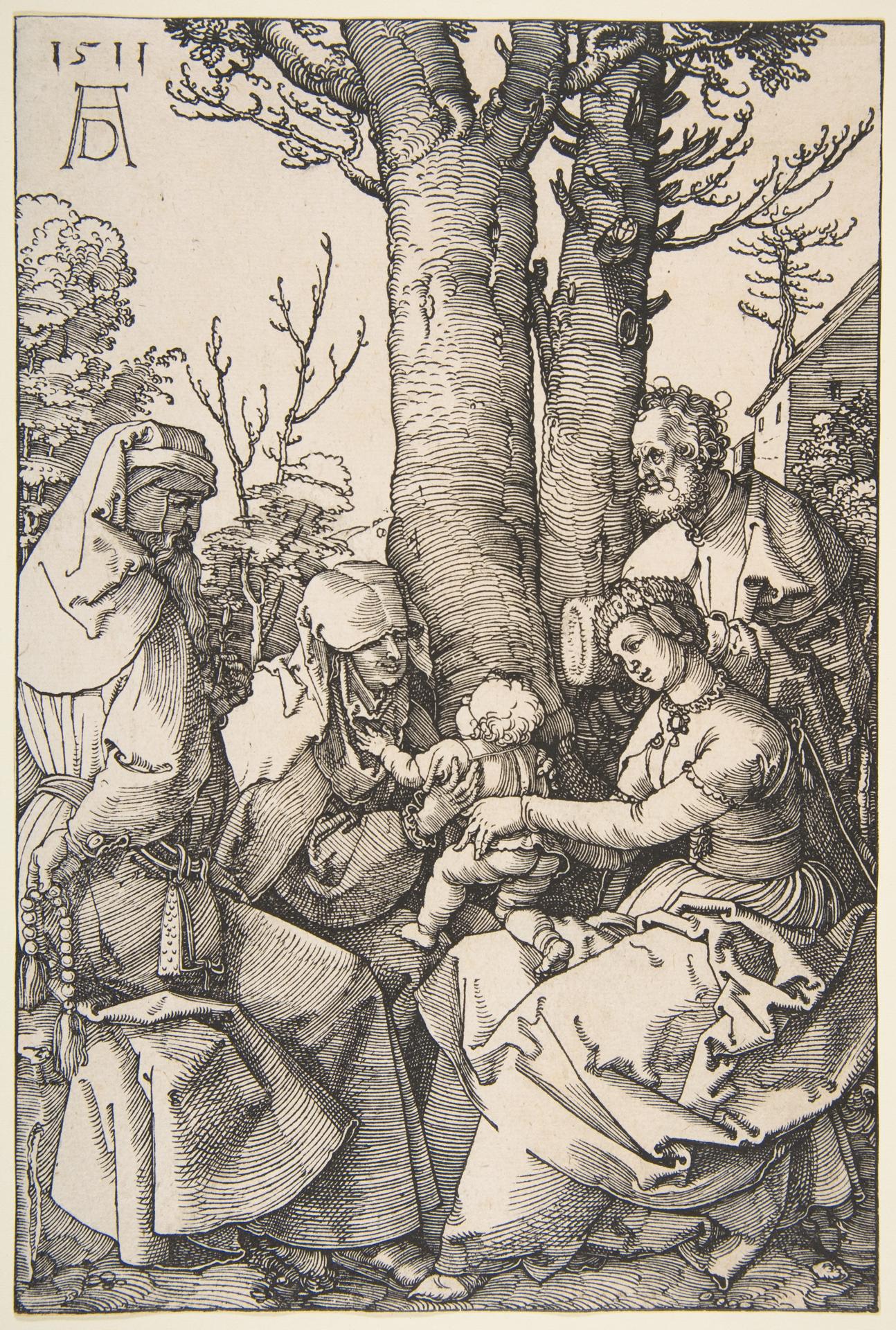
The Holy Family with Saint Joachim and Saint Anne
Original title: The Holy Family with Saint Joachim and Saint Anne
kurzbeschreibung
This woodcut by Albrecht Dürer, dated 1511, depicts the Holy Family with Saint Joachim and Saint Anne. The composition centers on the Virgin Mary holding the Christ Child, flanked by the two saints in a serene, rural setting.
Description
The scene shows Mary seated at the center with the infant Jesus on her lap, while Saint Joachim stands to the left and Saint Anne to the right. All figures wear traditional, flowing garments, and their poses are calm and almost static, lending a solemn, meditative air. In the background, trees and a house suggest a pastoral environment, and the overall arrangement is balanced and symmetrical. The monochrome woodcut relies on bold, even linework and uniform lighting, typical of early 16th-century prints.
Context
Dürer created this woodcut in 1511, during a period of intense printmaking activity in Nuremberg. The subject reflects the growing late-medieval devotion to Saint Anne, who was venerated as the mother of the Virgin and a patron of family life. This work belongs to a series of religious prints that Dürer produced for a broad audience, capitalizing on the demand for affordable devotional images. The composition also shows the influence of Netherlandish painting, which Dürer encountered on his travels, in its quiet domesticity and attention to detail.
Impact
The print conveys a sense of quiet intimacy and reverence, focusing on the familial bond among the holy figures. The balanced, symmetrical arrangement and restrained poses give the scene a timeless, iconic quality, while the rural backdrop adds warmth and approachability. Dürer's precise linework invites close viewing, drawing the eye across the figures and their gentle interactions.
Technique
This work is a woodcut, a relief printing technique in which the image is carved into a wooden block, inked, and pressed onto paper. Dürer's mastery of the medium is evident in his use of fine, controlled lines to model forms and create texture, from the folds of garments to the foliage. The monochrome palette and even lighting are inherent to the process, which relies on the interplay of black ink and blank paper to define the composition.
AI-generated description text
Source: Metropolitan Museum of Art · Public domain (CC0)