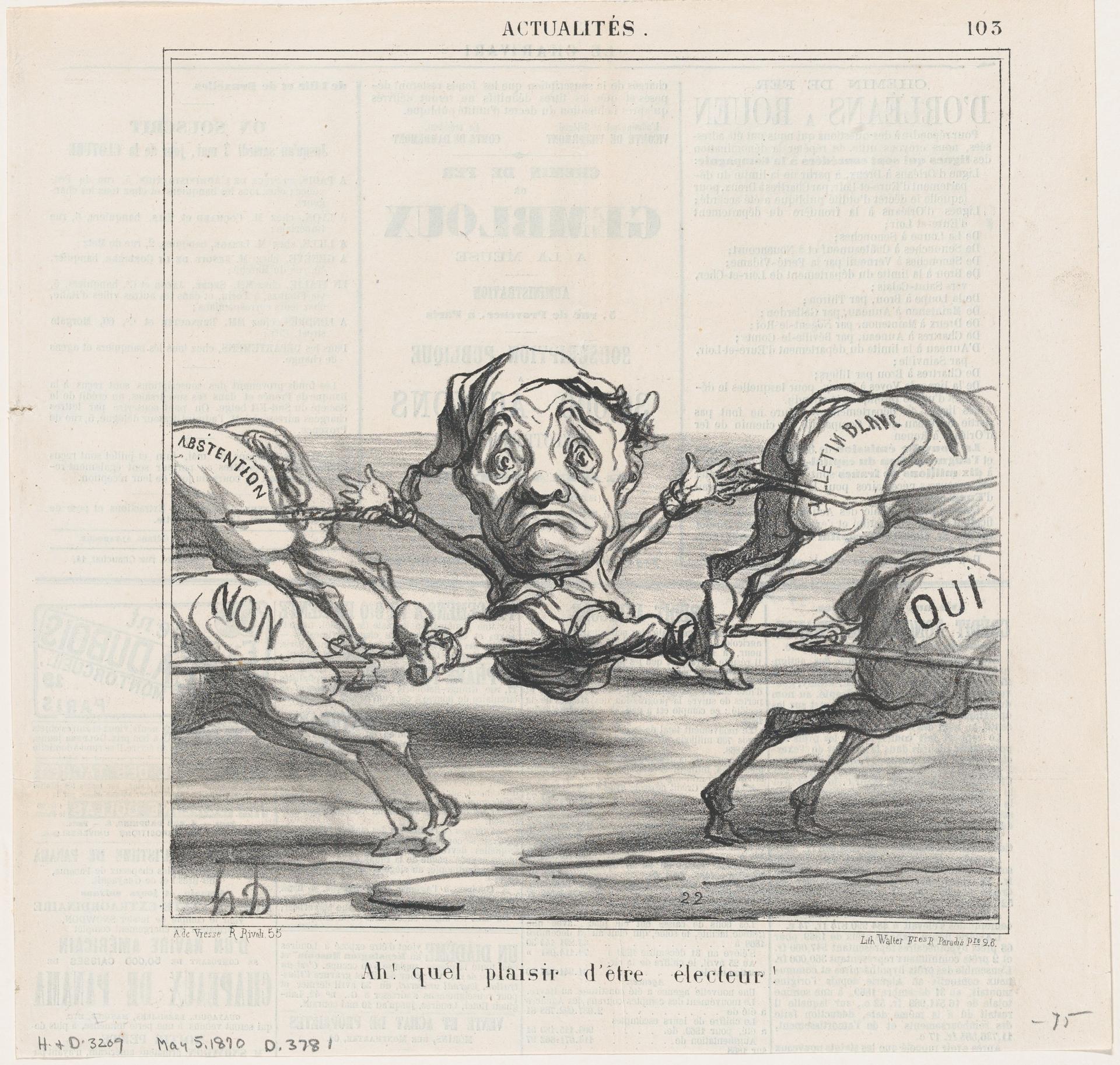
What a joy to be a voter!, from 'News of the day,' published in Le Charivari, May 5, 1870
Original title: What a joy to be a voter!, from 'News of the day,' published in Le Charivari, May 5, 1870
kurzbeschreibung
Honoré Daumier's lithograph 'Welch eine Freude, ein Wähler zu sein!' (What a Joy to Be a Voter!) from 1870 lampoons electoral practice in the Second Empire. It appeared on May 5, 1870, in the series 'News of the Day' in Le Charivari. The image features an overwhelmed head-shaped figure being pulled in opposite directions by two horses labeled 'ABSTENTION' and 'BULLETIN BLANC'.
Description
A stylized head with a worried, overwhelmed expression and a bow on top dominates the sheet. Two horses, their bodies bearing the words 'ABSTENTION' and 'BULLETIN BLANC', tug the figure apart. Newspaper pages titled 'ACTUALITÉS' and other text fragments suggest the context behind the scene. Below, the French sentence 'Ah! quel plaisir d'être électeur!' underscores the image's irony.
Context
The lithograph was made before the referendum of May 8, 1870, by which Napoleon III sought confirmation of his constitutional reforms. Daumier published it in the satirical journal Le Charivari, known for caricatures critical of the regime. The terms 'Abstention' (abstention from voting) and 'Bulletin blanc' (blank ballot) refer to protest forms against the plebiscite at the time. Daumier repeatedly addressed the manipulation and frustration of voters under the authoritarian system of the Second Empire.
Impact
The exaggeration of the overwhelmed head figure seems comic at first glance but reveals sharp political criticism on closer inspection. The horses pulling in different directions make visible the voters' torn position between boycott and empty ballot. The ironic title emphasizes the contradiction between the propagated joy of voting and the citizens' actual powerlessness.
Technique
Daumier's lithograph on newsprint uses a support typical of his series. The second state of two known impressions is recorded (Delteil). Lithography allowed fine line drawings and rapid print runs, ideal for publication in the daily press.
AI-generated description text
Source: Metropolitan Museum of Art · Public Domain (CC0 1.0)