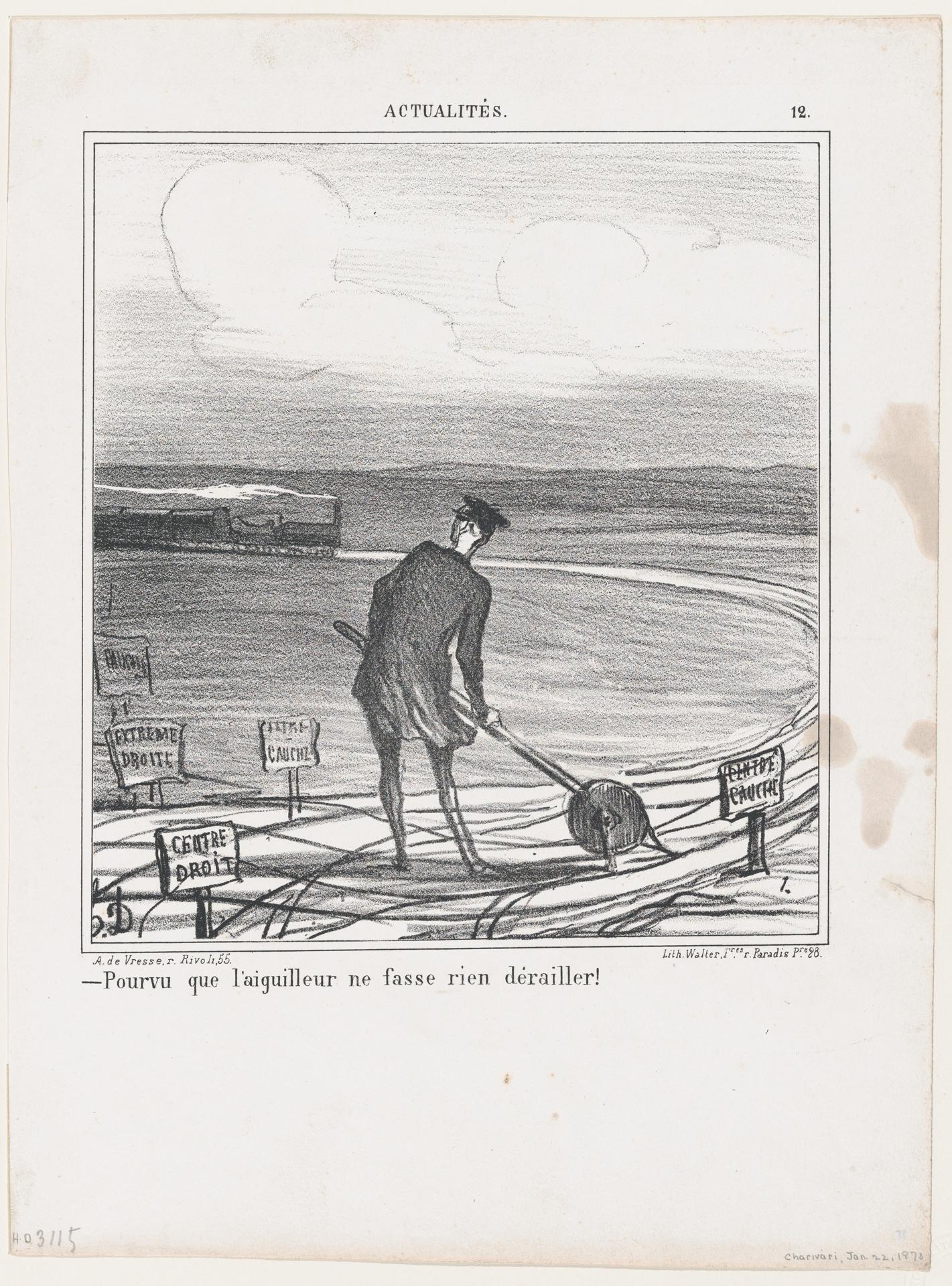
Provided that the switchman lets nothing derail, from 'News of the day,' published in "Le Charivari"
Original title: Provided that the switchman lets nothing derail, from 'News of the day,' published in "Le Charivari"
kurzbeschreibung
Honoré Daumier made this lithograph in 1870, showing a switchman striking the rails at a junction with a hammer. Part of the 'Actualités' series, it appeared on January 22, 1870, in the satirical journal 'Le Charivari'. As a political caricature, it targets the state of the French parliament around the elections of 1869–70.
Description
In the foreground, a man in a jacket and hat swings a hammer against the rails of a switch. At the junction stand several signs bearing labels such as 'EXTREME DROITE', 'CENTRE DROIT', 'CENTRE GAUCHE', and 'EXTREME GAUCHE', representing the parliamentary factions. Behind, two goods wagons sit on the tracks under a cloudy sky. Below the image runs the French caption 'Pourvu que l'aiguilleur ne fasse rien dérailler!', and above it the series title 'ACTUALITÉS' with the number '12'.
Context
The print dates from the late Second Empire under Napoleon III, a time when France's political forces were realigning. The signs' labels follow the seating order of deputies in the National Assembly, which ran from left to right. Daumier used the railway network as a metaphor to comment on the unstable parliamentary situation and the looming political 'derailment'. The lithograph was published in 'Le Charivari', known for its regime-critical caricatures.
Impact
The calm, almost static layout contrasts with the political sharpness of the subject, heightening the irony. Clear contours and precise labels draw the eye to the allegorical level, while the humorous caption underscores the absurdity of the situation. To the viewer, the print reads as a pointed comment on political conditions that remains understandable today.
Technique
The work was executed as a lithograph on wove paper, in the second state of two (Delteil). This technique allowed both fine, detailed lines and rapid reproduction, crucial for printing in a daily newspaper. Daumier used it to render the scene with clear outlines and restrained shading, without elaborate toning.
AI-generated description text
Source: Metropolitan Museum of Art · Public Domain (CC0 1.0)