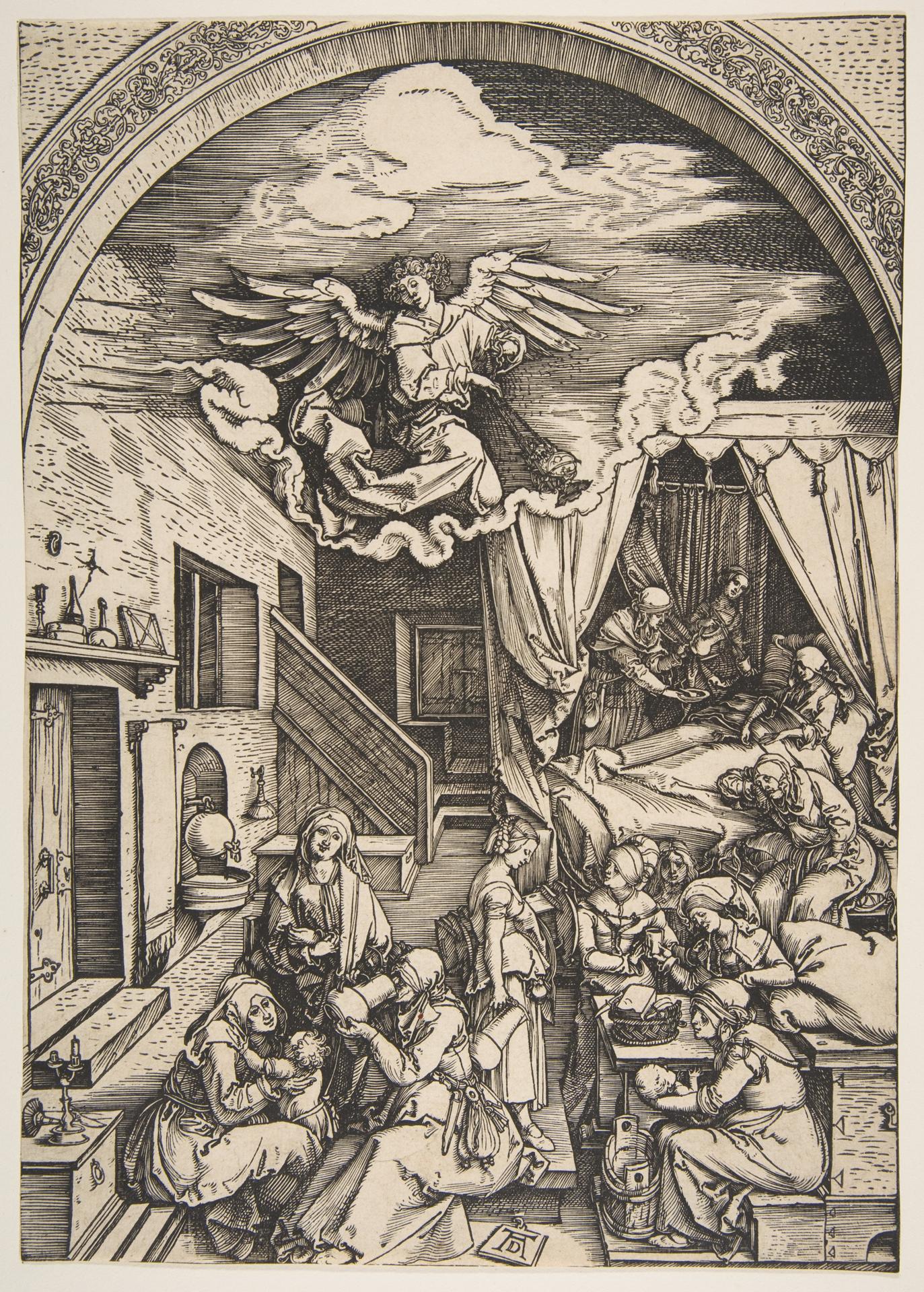
The Birth of the Virgin, from "The Life of the Virgin" (ca. 1503, Met-Objekt 359)
Original title: The Birth of the Virgin, from "The Life of the Virgin"
kurzbeschreibung
Unlike many contemporary portrayals of Mary's birth, Dürer's print shifts the emphasis to the quiet accessories of the lying-in period. Made around 1503, this woodcut belongs to the 'Life of the Virgin' cycle and brings Anna, the kneeling mother, into focus, while women surround her and an angel with a trumpet announces the birth above.
Description
A kneeling woman forms the calm anchor of the sheet, encircled by helpers. Above her, resting on clouds, hovers an angel with a trumpet, a nod to the annunciation of the birth. An open window, a staircase, a globe, and a shelf with various objects frame the scene. The garments follow Renaissance fashion, and the arrangement is mirror-symmetrically balanced. Black on white, without color values, light spreads evenly across the surface.
Context
Between 1502 and 1511, Dürer worked in Nuremberg on the series 'Life of the Virgin'. Sales went well, and the series cemented his reputation as a woodcut artist. Narratively, the image draws on the apocryphal tradition of Anna giving birth to Mary, a subject that met with growing interest in the Holy Family during the late Middle Ages.
Impact
The wealth of detail and the clear layout give the sheet a collected, devotional mood. Because the light falls evenly and the strokes remain delicate, a harmonious tone emerges that leads the eye calmly into the scene.
Technique
The fine lines and hatching in black printing ink sit on the laid paper with an even, unmodulated tone, since no colour plate was involved. The sheet's preservation leaves the impression largely intact and legible, so the varied density of the strokes still reads clearly as shading and surface. This linear structure gives the monochrome scene its detailed Renaissance texture.
AI-generated description text
Source: Metropolitan Museum of Art · Public Domain (CC0 1.0)