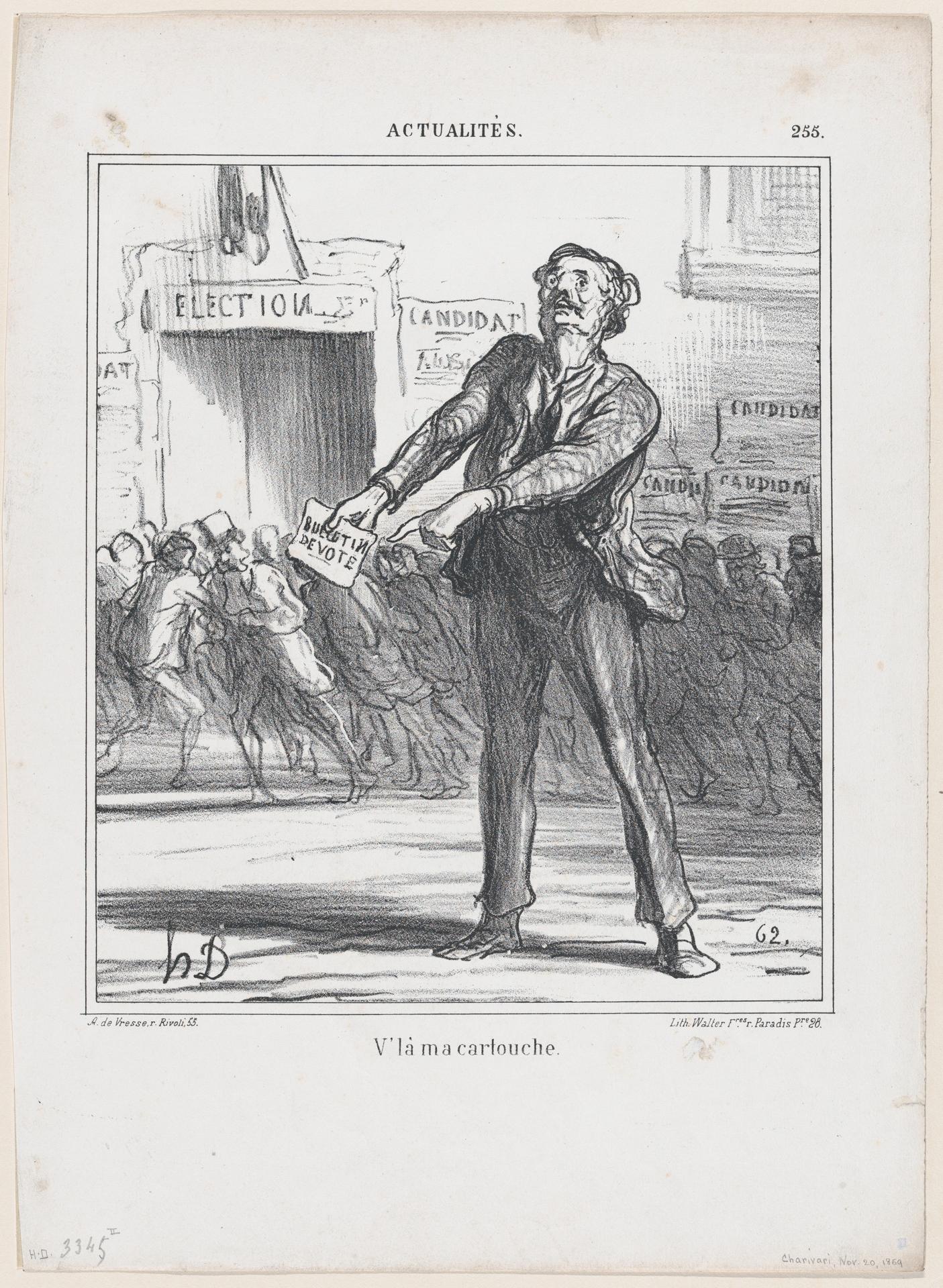
This is my 'bullet,' from 'News of the day,' published in Le Charivari, November 20, 1869
Original title: This is my "bullet," from 'News of the day,' published in Le Charivari, November 20, 1869
kurzbeschreibung
Dating from 1869, this lithograph by Honoré Daumier shows a man holding a ballot paper, his face clouded with worry. Behind him, several figures hurry toward a building marked "ELECTION". The sheet is a caricature made in the run-up to the French parliamentary elections.
Description
A man in a suit, ballot in hand and an anxious look on his face, anchors the sheet. Behind him, people stream toward a building labeled "ELECTION", its wall hung with signs reading "CANDIDAT". Printed on newsprint, the lithograph carries the caption "V'là ma cartouche."
Context
Le Charivari, the satirical journal known for its political caricatures, published the lithograph on 20 November 1869. It belongs to the series "News of the day" (Actualités), in which Daumier commented on current events. The French parliamentary elections of 1869 took place amid political tension under Napoleon III, and that setting shapes the satirical portrait of the voter.
Impact
By tying an ordinary voter to the word "ELECTION", the caricature keeps an ironic distance from the political process. The man's worried expression sits in contrast to the seeming routine of the elections and lends the image a reflective note. The motif feels pointed and timeless, since it speaks to the ambivalence of political participation.
Technique
Lithography on newsprint was a standard process for satirical prints in the nineteenth century, allowing fast and inexpensive editions. This is the second of two states, described as a proof (Delteil), which points to an early quality of pull. The print measures 24 × 20.7 cm (image) on a sheet of 35.8 × 27.7 cm.
AI-generated description text
Source: Metropolitan Museum of Art · Public Domain (CC0 1.0)