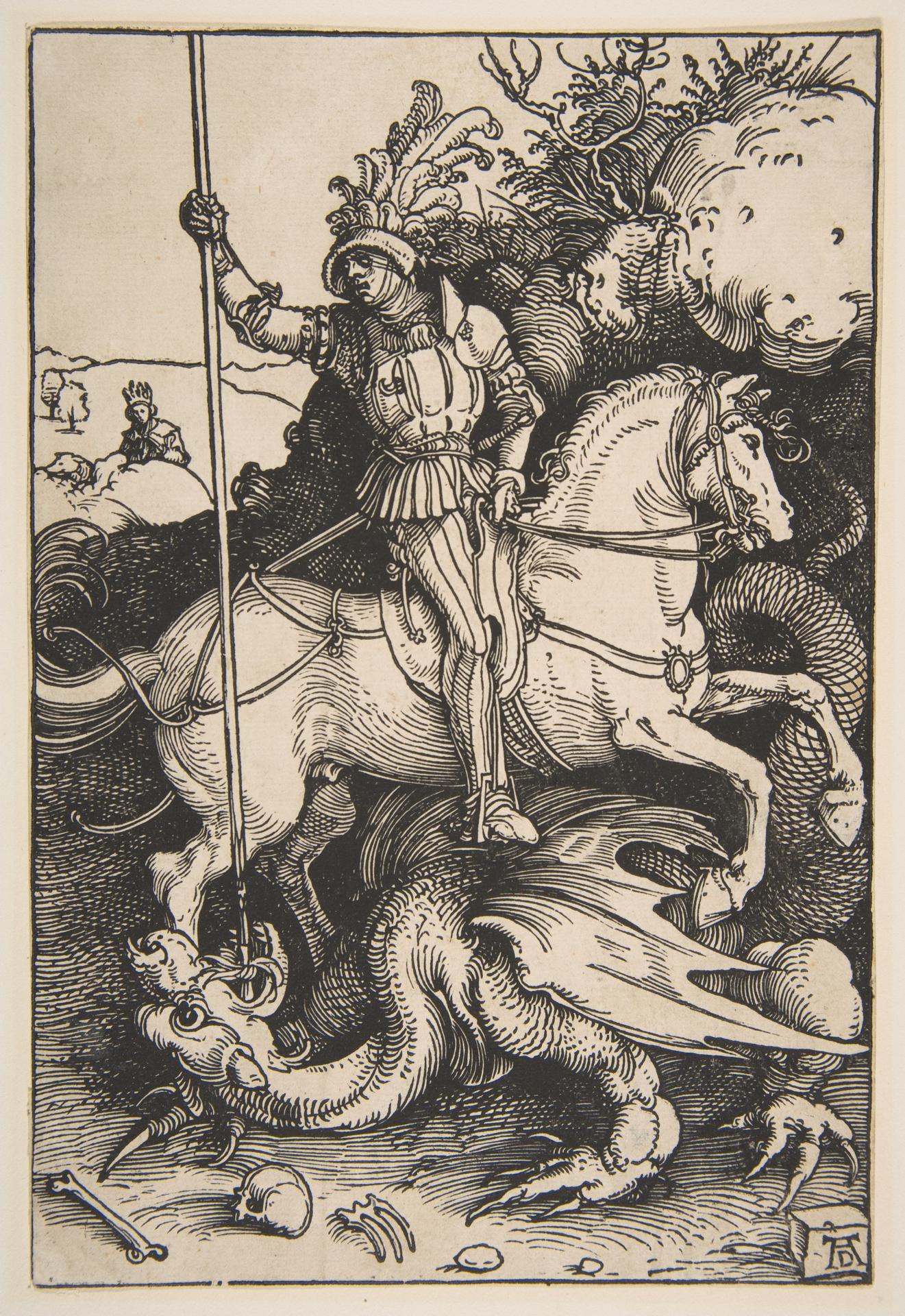
Saint George and the Dragon
Original title: Saint George and the Dragon
kurzbeschreibung
Albrecht Dürer made this woodcut around 1504, showing Saint George and the dragon. It presents the knight on horseback, driving a lance into the monster. The print stands as an example of Dürer's mastery of graphic art.
Description
A knight on horseback struggles with a dragon lying on the ground. The armored figure wears a helmet and holds the lance in his right hand. The horse moves forward, its hind leg raised, forelegs spread. The dragon is slain, its jaws wide open, teeth visible. Further back, figures and landscape elements appear, such as a shape on a hill and another in the distance. The layout is dynamic and directs the eye to the duel.
Context
Around 1504, when Dürer was deeply engaged with the possibilities of print, he created this woodcut. Saint George was a widespread motif in Christian art and stood for the victory of faith over evil. Dürer was working in Nuremberg at the time and absorbed influences from the Italian Renaissance, which is reflected in the naturalistic rendering.
Impact
The dynamic arrangement and precise linework give the battle tension. Because the print is only in black and white, the structure and graduated tones stand out, making the woodcut appear lively.
Technique
The exclusive reliance on black lines against white paper forces every texture and shadow to be articulated through hatching and cross-hatching rather than tone. Dürer exploits this constraint to build the knight's armour, the horse's musculature and the dragon's scales with a precision that makes the monochrome surface feel almost sculptural. The result is an image whose drama depends entirely on the rhythm of carved line, not on colour or painterly shading.
AI-generated description text
Source: Metropolitan Museum of Art · Public Domain (CC0 1.0)