Away with the ballast!
Original title: Away with the ballast!, from 'News of the day,' published in "Le Charivari"
kurzbeschreibung
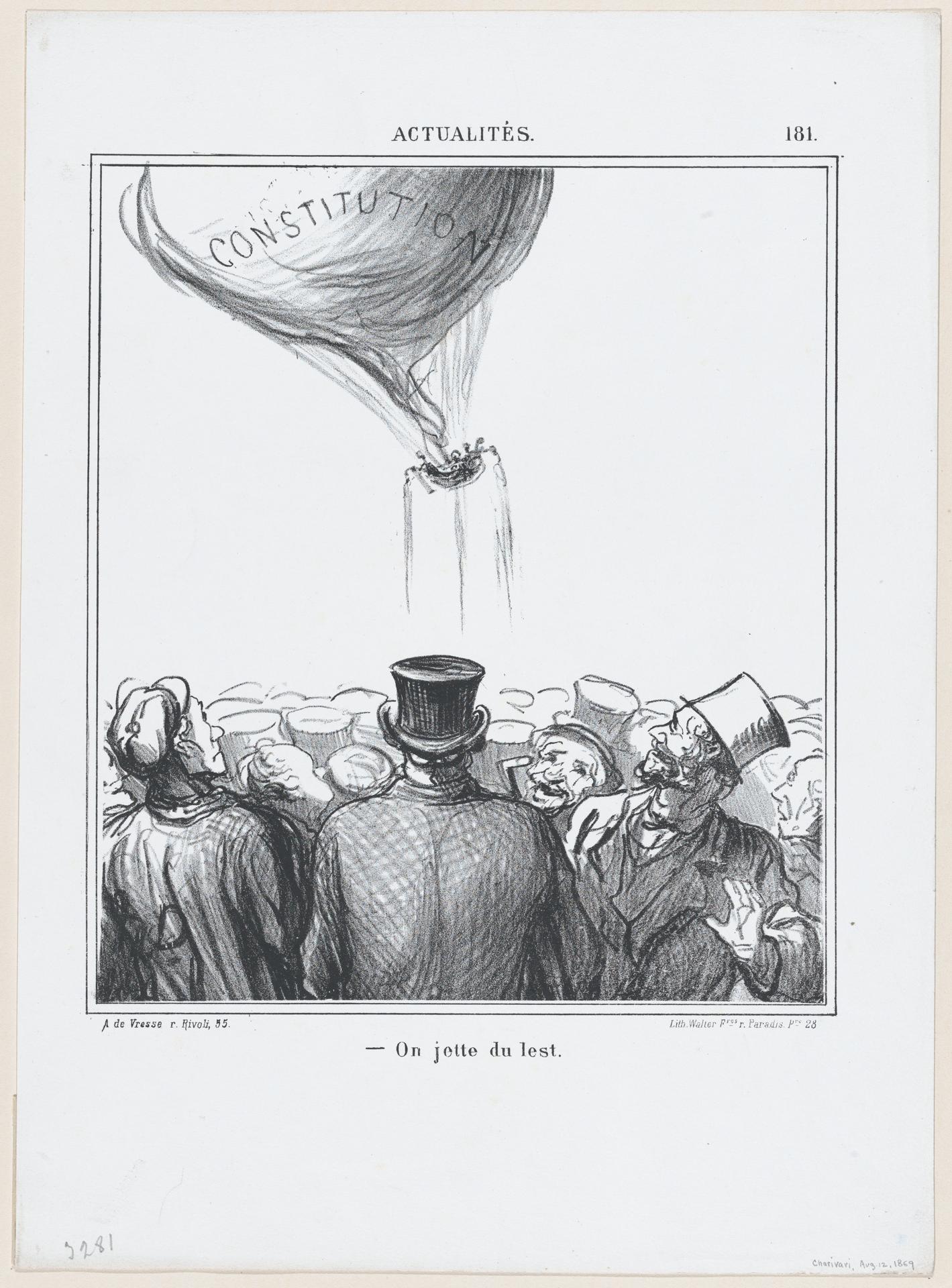
Unlike many contemporary balloon pictures that celebrate the spectacle of ascent, Honoré Daumier's 1869 lithograph 'Fort mit dem Ballast!' (Throw Out the Ballast!) turns attention to the crowd and its reaction. A balloon labeled 'CONSTITUTION' rises while passersby below watch the event. This black-and-white sheet on wove paper belongs to the series 'News of the day' and appeared in 'Le Charivari'.
Description
A balloon bearing the word 'CONSTITUTION' ascends in the middle of the image, with a cluster of people gathered below. Hats and jackets are visible, alongside traditional clothing; one figure raises a hand toward the balloon. At the bottom runs the text 'On jette du lest' (They are throwing out ballast). The layout is centralized, the drawing sketchy and caricatural, the light evenly distributed, and the rendering monochrome.
Context
On August 12, 1869, the lithograph appeared in the satirical journal 'Le Charivari'. Daumier used the balloon motif to address the political constitution ('Constitution') and its unstable state in France before the Franco-Prussian War. The title 'Fort mit dem Ballast!' refers to jettisoning ballast, which stabilizes a balloon—a metaphor for political shifts. The print exists in the second of two states (Delteil).
Impact
The central balloon metaphor and the gesturing figures give the sheet an immediate dynamism; a mood of excitement and discussion arises. The humorous, caricatural style softens the political message and opens it to a broad audience.
Technique
The lithograph was printed on wove paper—a common process for satirical journals of the time. It allowed fine, sketchy lines and rapid reproduction, which was essential for the timely publication in 'Le Charivari'.
AI-generated description text
Source: Metropolitan Museum of Art · Public Domain (CC0 1.0)