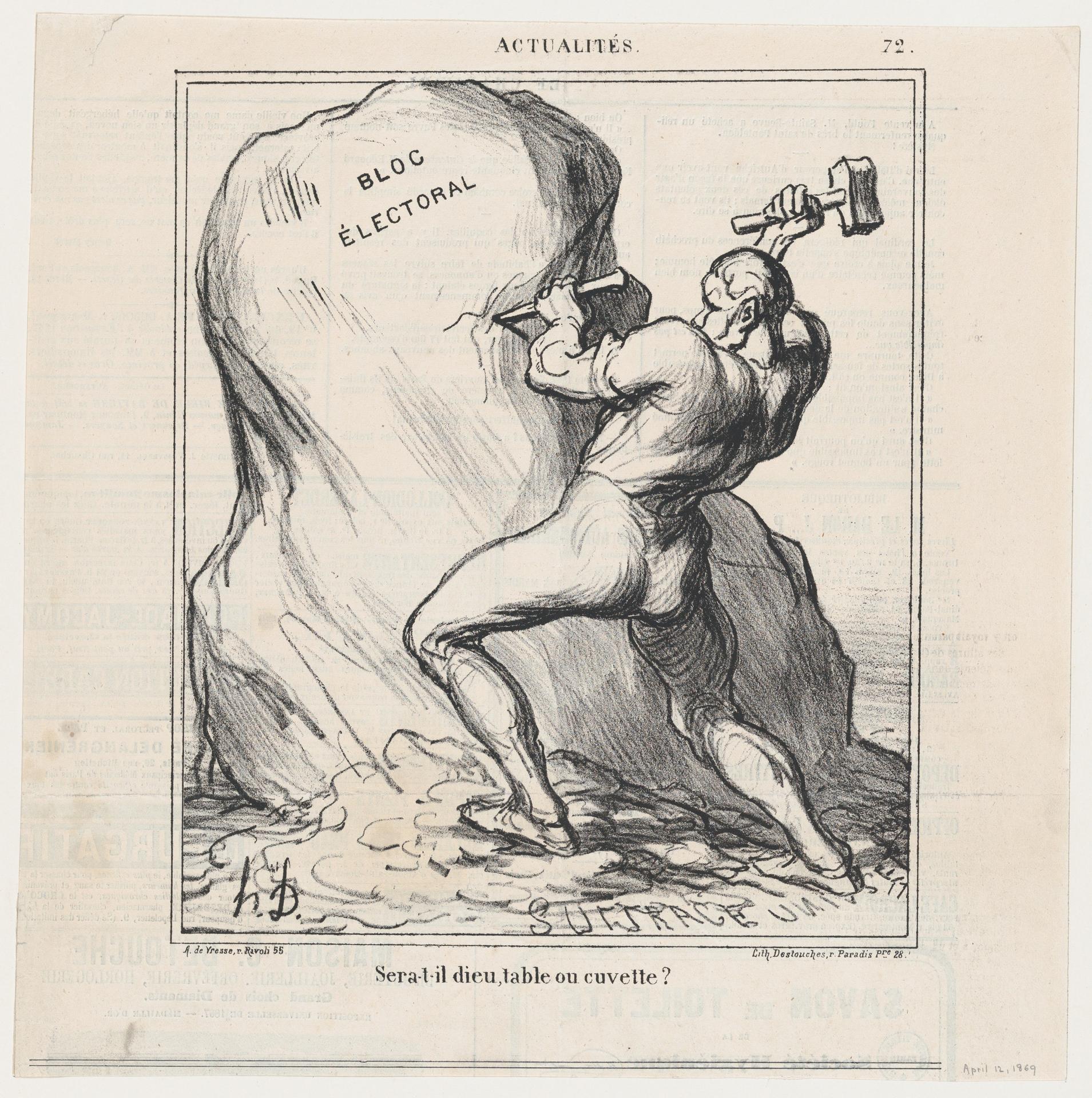
Will he be God, a table, or a basin?, from "News of the day"
Original title: Will he be God, a table, or a basin?, from "News of the day"
kurzbeschreibung
In 1869, around the time of the French elections, Honoré Daumier made this lithograph: a worker swings a hammer at a massive stone block. The print belongs to the series 'News of the Day' and exists in the third of three states (Delteil). At its heart lies the political situation in France during the election contests.
Description
A man in plain clothes brings a hammer down on a large stele inscribed with 'BLOC ÉLECTORAL'. His posture is dynamic and determined. Other stones lie around, and the ground is covered with rubble. Along the bottom edge runs the line 'SERA-T-IL DIEU, TABLE OU CUVETTE?' The layout stays black-and-white and graphic, emphasizing contours and textures, mostly in shades of gray.
Context
The print was made in 1869, shortly before parliamentary elections in France under the authoritarian rule of Napoleon III. In the 'News of the Day' series, Daumier repeatedly addressed political and social grievances. 'Bloc électoral' refers to the electoral bloc the government tried to form. The text in the image asks what will become of this bloc—whether it will serve as a god (power), a table (utility), or a washbasin (everyday object). It was printed as a lithograph on newsprint, as was usual for Daumier's satirical sheets.
Impact
The worker's dynamic pose and the clear arrangement make the motif immediate and emphatic. Because everything is restricted to black and white and the rough newsprint shows through, the sheet gains a political, combative edge. The inscribed question at the bottom invites reflection on the intentions of the political actors.
Technique
The lithograph was printed on newsprint in the third of three states (Delteil). It was drawn with greasy crayon on the stone and then transferred to paper. The gray values result from the varying density of the crayon strokes and from printing on absorbent newsprint.
AI-generated description text
Source: Metropolitan Museum of Art · Public Domain (CC0 1.0)