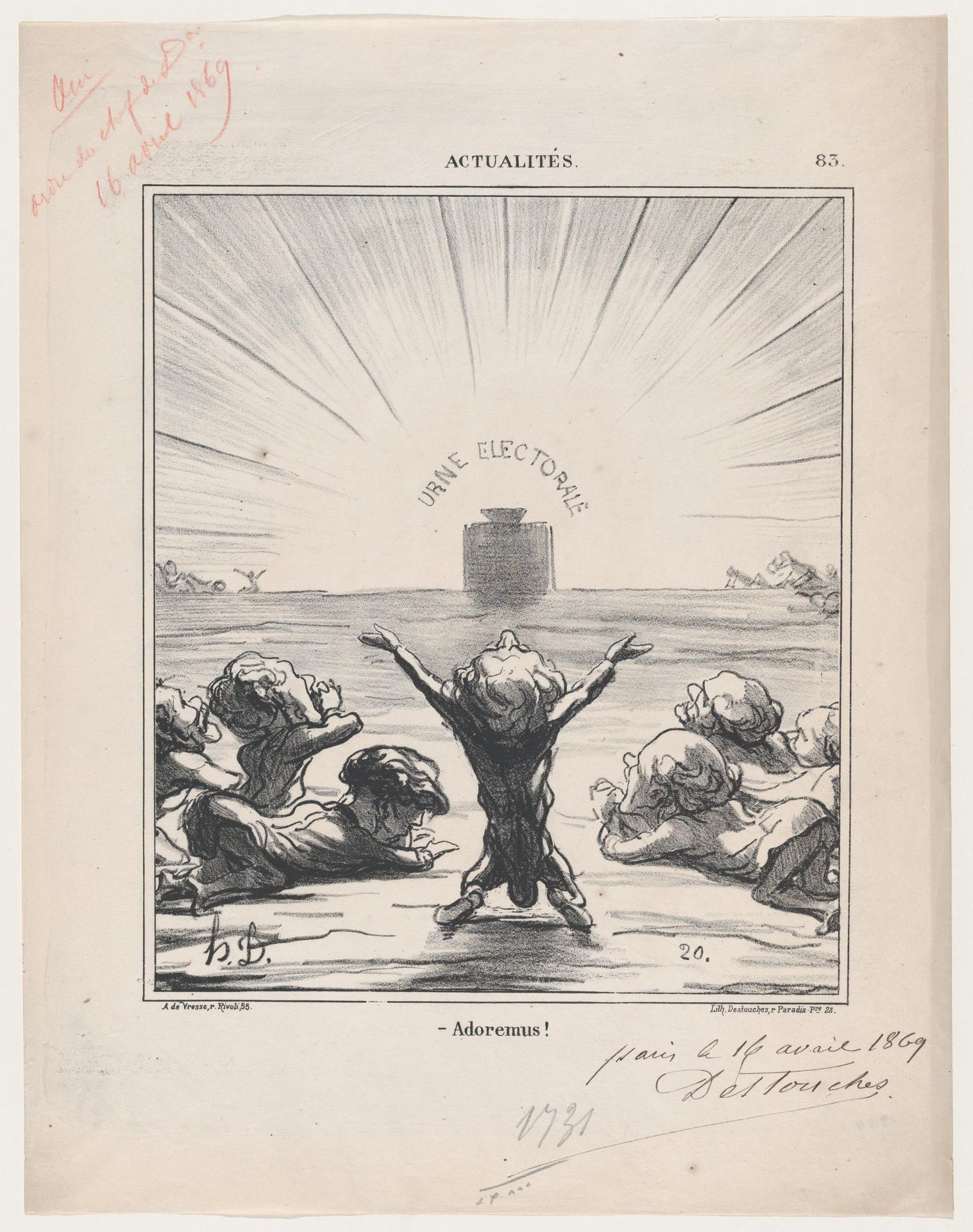
We worship you, beloved voter, from 'News of the day,' published in 'Le Charivari'
Original title: We worship you, beloved voter, from 'News of the day,' published in "Le Charivari"
kurzbeschreibung
Honoré Daumier made this lithograph on 5 May 1869 for the French satirical magazine Le Charivari, where it appeared in the series 'News of the day.' A crowd kneels before an oversized ballot box, adoring it with outstretched arms. The print is a black-and-white lithograph on newsprint, preserved in the fourth of four states.
Description
A massive, stylized ballot box dominates the sheet, framed by a bright surround that lends it an almost sacred aura. Around it, several figures in traditional dress lie or kneel, arms raised, frozen in prayer. The layout funnels everything toward the urn; the gestures heighten its veneration. Only black and white remain—just as lithography of those years dictated.
Context
The caricature was published in the 'News of the day' series of Le Charivari, a paper known for political and social critique. Daumier drew it in 1869, late in the Second Empire under Napoleon III, when France was fiercely debating voting rights and political participation. That the print is recorded as the fourth of four states (Delteil) points to careful reworking by the artist.
Impact
Between sacred imagery and political everyday life, an ironic tension arises because the ballot box appears as a holy relic. The exaggerated devotion of the kneeling figures is comic and at the same time reveals Daumier's critical view of the political culture of his time. The clear structure and spare color sharpen the satirical point.
Technique
Drawn with greasy chalk on stone and then printed—a lithographic process on newsprint. This allowed quick, cheap reproduction, which was decisive for a daily paper like Le Charivari. The fourth state shows that Daumier revised the printing process several times until the intended effect was achieved.
AI-generated description text
Source: Metropolitan Museum of Art · Public Domain (CC0 1.0)