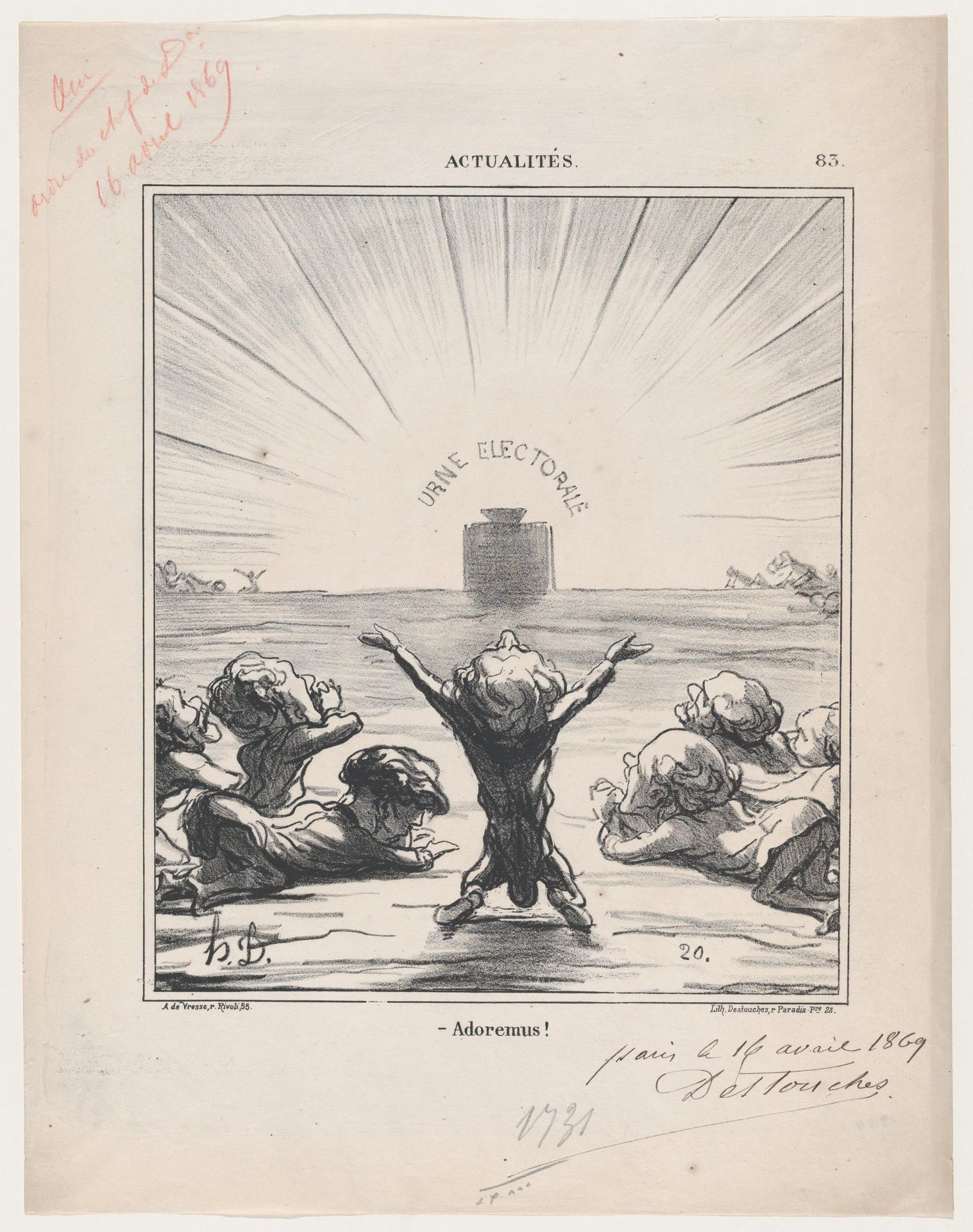
We worship you, beloved voter, from 'News of the day,' published in Le Charivari, May 5, 1869
Original title: We worship you, beloved voter, from 'News of the day,' published in Le Charivari, May 5, 1869
kurzbeschreibung
People lie flat on the ground and kneel before an oversized ballot box, praying to it. Honoré Daumier made this image in 1869. A lithograph reworked with pen, ink, and red pencil on newsprint, it survives as the third of four states and served as a proof.
Description
Some figures throw themselves face down, others kneel and stretch their arms upward. Their goal is a large urn inscribed 'URNE ELECTORALE', which radiates beams of light like a heavenly glow. Along the bottom edge of the sheet runs the word 'Adoremus!' (Let us adore!).
Context
The print appeared on 5 May 1869 in the satirical journal 'Le Charivari', within the series 'News of the day'. Daumier was taking aim at conditions under the Second Empire of Napoleon III, where elections were rigged and public opinion steered. The caricature scourges the blindness of voters who treat their ballot as an act of divine worship.
Impact
The figures' exaggerated devotion and the sacral air of the urn create an absurd, ironic contrast. The rays and gestures build a solemn atmosphere that tips into comedy through the profane object itself, a ballot box.
Technique
The work was executed as a lithograph, then reworked with pen, brown ink, and red pencil on newsprint. It is the third of four states and served as a proof. The mix of printing and hand-finishing reveals Daumier's method: he refined the plate after printing with drawn additions.
AI-generated description text
Source: Metropolitan Museum of Art · Public Domain (CC0 1.0)