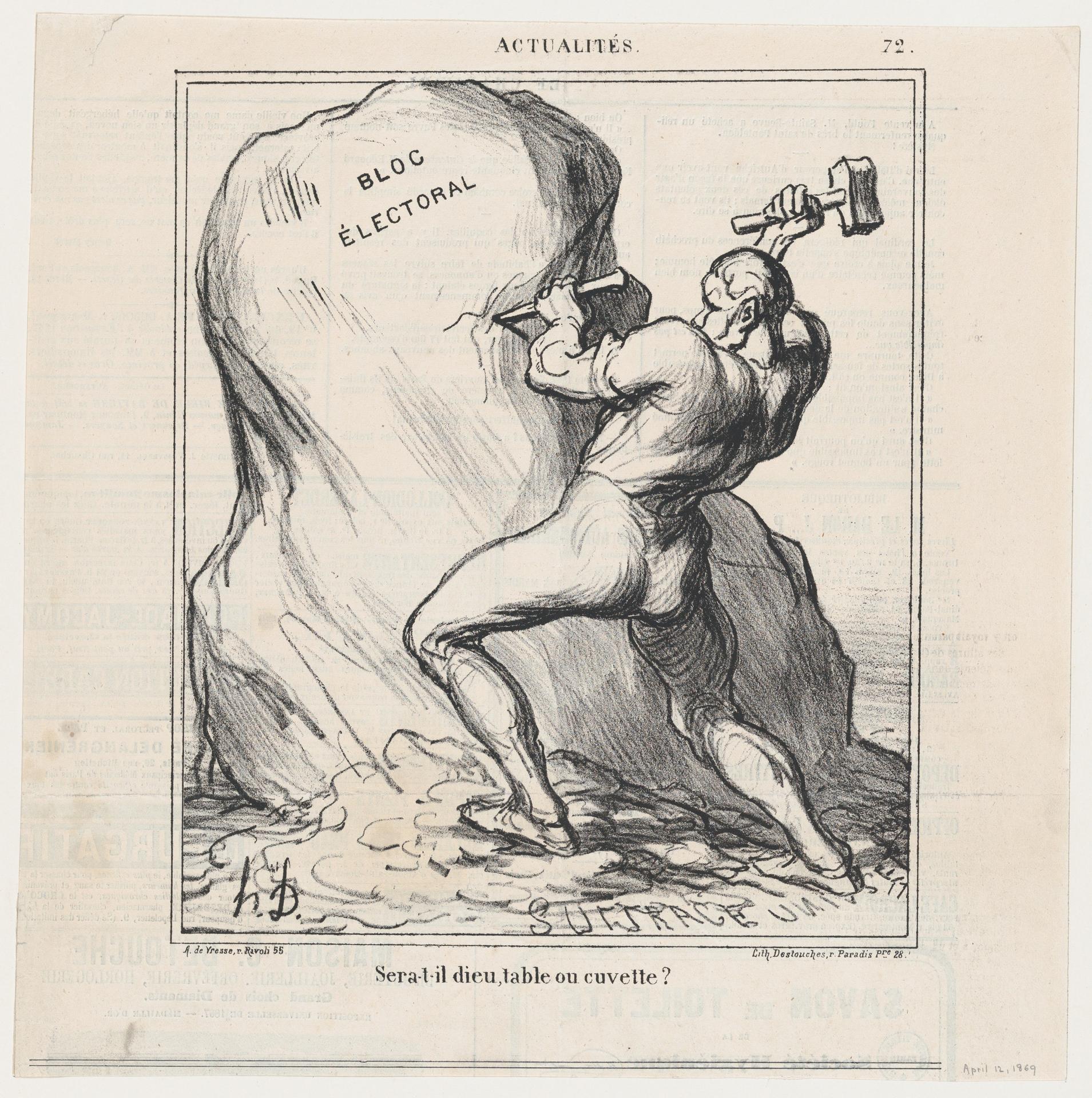
Will he be God, a table, or a basin? (April 12, 1869, Met-Objekt 3554)
Original title: Will he be God, a table, or a basin?, from 'News of the day,' published in Le Charivari, April 12, 1869
kurzbeschreibung
Honoré Daumier's 1869 lithograph presents a sculptor at work on a massive block of stone bearing the inscription "BLOC ÉLECTORAL". Published as a caricature in the satirical journal Le Charivari, the print takes aim at the political climate in France on the eve of the 1869 elections.
Description
A hefty stone block dominates the middle of the sheet, and a figure works at it with hammer and saw. The words "BLOC ÉLECTORAL" are cut into the stone, pointing to the business of elections. The man visibly struggles, as though shaping the enormous block demands real effort. Below, the handwritten title reads "Sera-t-il dieu, table ou cuvette?". Drawn in black and white, with delicate lines and firm shading that bring out the surface of the stone and the movement of the figure.
Context
This caricature appeared in Le Charivari on 12 April 1869, a journal known for its political and social mockery. The title takes up a saying that captures the uncertainty over the outcome of the coming elections. The sheet belongs to a series in which Daumier commented on the politics of his day. The unformed stone as an electoral block can be read as criticism of the political landscape under Napoleon III.
Impact
A mood somewhere between irony and seriousness settles over the image. The laborious work on the block feels heavy and slow, while the absurd title adds a comic note. The clear black-and-white rendering and the centred arrangement draw the eye straight to the emblem of the electoral block and prompt reflection on the political situation.
Technique
Daumier used lithography, in which the design is drawn on a stone and then transferred to paper. This sheet was executed with pen and brown ink and red pencil on newsprint and survives in the second of three states. That combination of printing and manual reworking makes Daumier's method visible, both as caricaturist and as artist.
AI-generated description text
Source: Metropolitan Museum of Art · Public Domain (CC0 1.0)