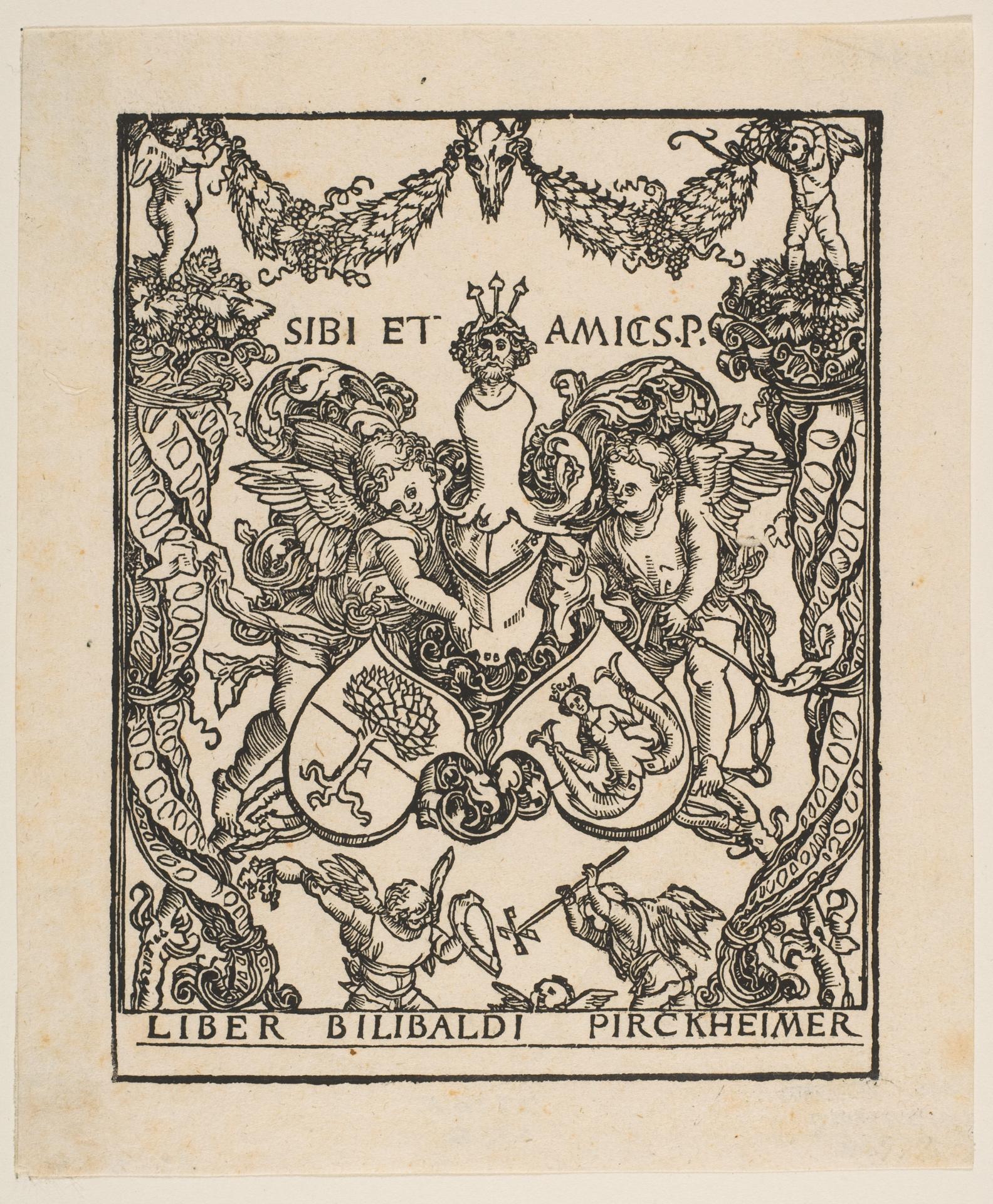
The Book Plate of Wilibald Pirckheimer
Original title: The Book Plate of Wilibald Pirckheimer
kurzbeschreibung
This woodcut by Albrecht Dürer serves as an ex libris for his friend Wilibald Pirckheimer, a prominent Nuremberg humanist. The print features a heraldic composition with cherubs and a central figure, framed by floral ornaments. It is a fine example of Dürer's graphic artistry, though it is undated.
Description
The composition centers on a coat of arms flanked by two cherubs, with a helmeted figure in the middle. Below, two additional cherubs hold a crown and a shield, adding to the heraldic symbolism. The background is filled with intricate floral tendrils that frame the central motif. At the top, the text 'SIBI ET AMICSP.' appears, while the bottom bears 'LIBER BILIBALDI PIRCKHEIMER'. The print is black and white, with strong contrasts between the detailed figures and the ornamental backdrop.
Context
Wilibald Pirckheimer was a close friend of Albrecht Dürer and a leading humanist in Nuremberg. This bookplate was likely created for Pirckheimer's personal library, reflecting the Renaissance interest in classical learning and personal branding. Dürer often collaborated with Pirckheimer, who provided classical texts and intellectual support. The exact date of the woodcut is unknown, but it fits within Dürer's mature period when he produced many prints for humanist patrons.
Impact
The print exudes a sense of scholarly prestige and humanist pride through its elaborate heraldic design. The dynamic poses of the cherubs and the intricate linework draw the viewer's eye, while the black-and-white contrast gives it a bold, graphic presence. It conveys both authority and intellectual refinement, fitting for a bookplate of a learned individual.
Technique
This is a woodcut, a relief printing technique where the image is carved into a wooden block, inked, and pressed onto paper. Dürer's masterful handling of the medium is evident in the fine lines and detailed textures, despite the inherent limitations of the process. The use of black ink on white paper creates a stark, high-contrast image typical of early modern prints.
AI-generated description text
Source: Metropolitan Museum of Art · Public domain (CC0)