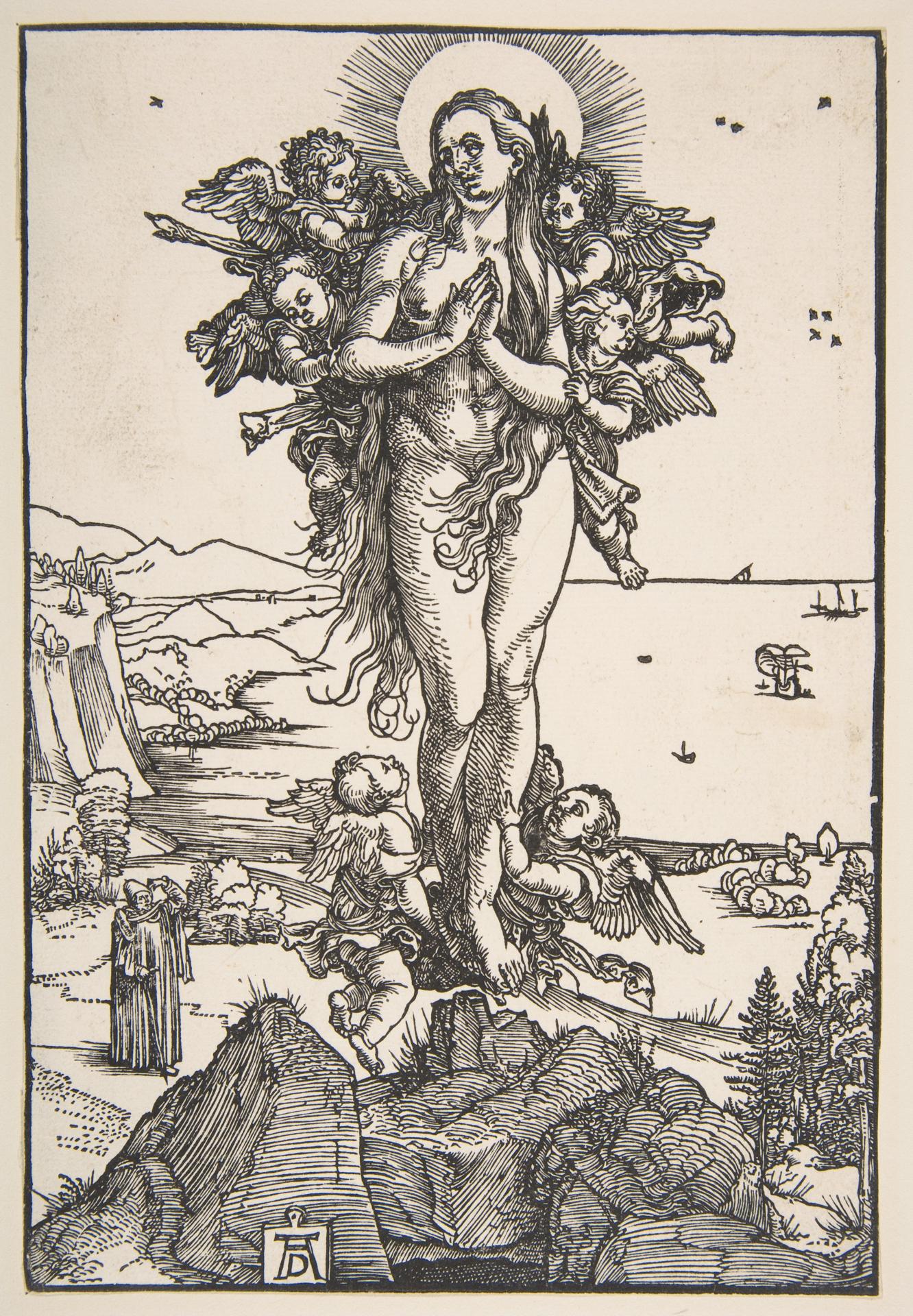
The Ecstasy of Saint Mary Magdalen
Original title: The Ecstasy of Saint Mary Magdalen
kurzbeschreibung
This woodcut by Albrecht Dürer depicts the ecstatic vision of Saint Mary Magdalen, surrounded by angels in a celestial landscape. The composition centers on the saint in a posture of deep reverence, with a radiant background emphasizing her divine experience. The work showcases Dürer's mastery of the woodcut medium, with intricate linework and hatching.
Description
The central figure of Saint Mary Magdalen is shown in a profound bow, her hands clasped in prayer, with a halo-like radiance emanating around her. She is encircled by several angels, some with wings, in various poses: one stands on a rock in the foreground, another kneels on the ground, and others float around her. In the background, a detailed landscape of mountains, trees, and a river unfolds, adding depth to the scene. The image is monochrome, relying on bold outlines and cross-hatching to create texture and shadow, typical of woodcut prints.
Context
Albrecht Dürer, a leading figure of the Northern Renaissance, created this woodcut as part of his exploration of religious themes, often depicting saints in moments of spiritual intensity. While the exact date is unknown, Dürer's woodcuts were produced during his mature period, when he was renowned for his technical skill and innovative printmaking. The scene reflects the late medieval and early modern fascination with mystical experiences, particularly the ecstatic visions of saints like Mary Magdalen, who was a popular subject for devotional art.
Impact
The print conveys a sense of divine awe and ecstasy through the saint's humble posture and the surrounding angelic presence. The contrast between the dark, textured lines and the bright, open areas around the saint draws the viewer's eye to her, creating a focal point of spiritual intensity. The landscape adds a serene, earthly dimension, grounding the heavenly vision in a recognizable world.
Technique
This work is a woodcut, a relief printing technique where the image is carved into a wooden block, inked, and pressed onto paper. Dürer's use of fine, parallel lines and cross-hatching demonstrates his exceptional control over the medium, allowing for subtle gradations of light and shadow. The monogram in the lower area likely identifies Dürer as the artist, a signature he used on many of his prints.
AI-generated description text
Source: Metropolitan Museum of Art · Public domain (CC0)