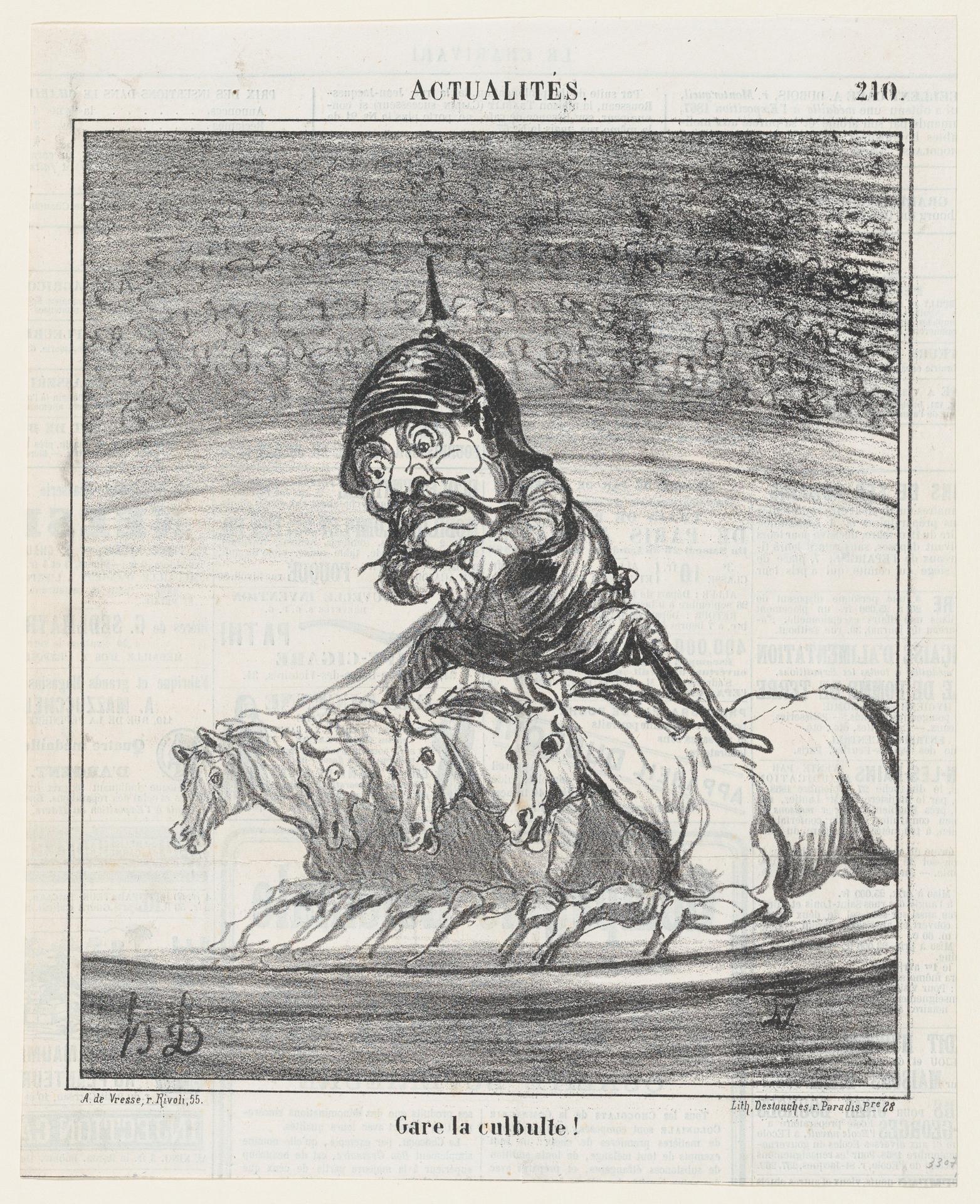
Don't fall!, from 'News of the day,' published in "Le Charivari"
Original title: Don't fall!, from 'News of the day,' published in "Le Charivari"
kurzbeschreibung
Where many equestrian prints of its day settle for a heroic pose, Honoré Daumier's lithograph 'Nicht fallen!' from 1868 fixes instead on the instant of wobbling. The sheet belongs to the series 'News of the day', published in the French satirical journal 'Le Charivari'. Drawn with a thin line and pushed toward caricature, it lays out the awkward predicament of a rider.
Description
A soldier in a helmet sits on a horse rearing in violent motion. His eyes are wide open, his nose juts forward with exaggerated straightness, and both hands clutch at the helmet. The horse's legs stretch out long, and kicked-up earth betrays the speed. Behind the figure stand a few people who clearly watch what is happening. Black and white dominates, with graded greys produced by the lithographic process.
Context
On 24 September 1868 the sheet appeared in the satirical paper 'Le Charivari', within the 'News of the day' series. Daumier drew it during a period of political and social tension in France, when the military was often a target of caricature. The work survives in the second of two states, printed on newsprint.
Impact
The soldier's distorted features and the restless horse add up to a comic, almost slapstick impression. One smiles at the rider, whose precarious position also lets a quiet criticism of military overconfidence sound through.
Technique
The sheet was printed as a lithograph on newsprint: the drawing is set down on the stone with greasy chalk and then pulled. The gradations of grey and shadow come from how densely the chalk is applied. That a second state exists points to later reworking of the stone.
AI-generated description text
Source: Metropolitan Museum of Art · Public Domain (CC0 1.0)