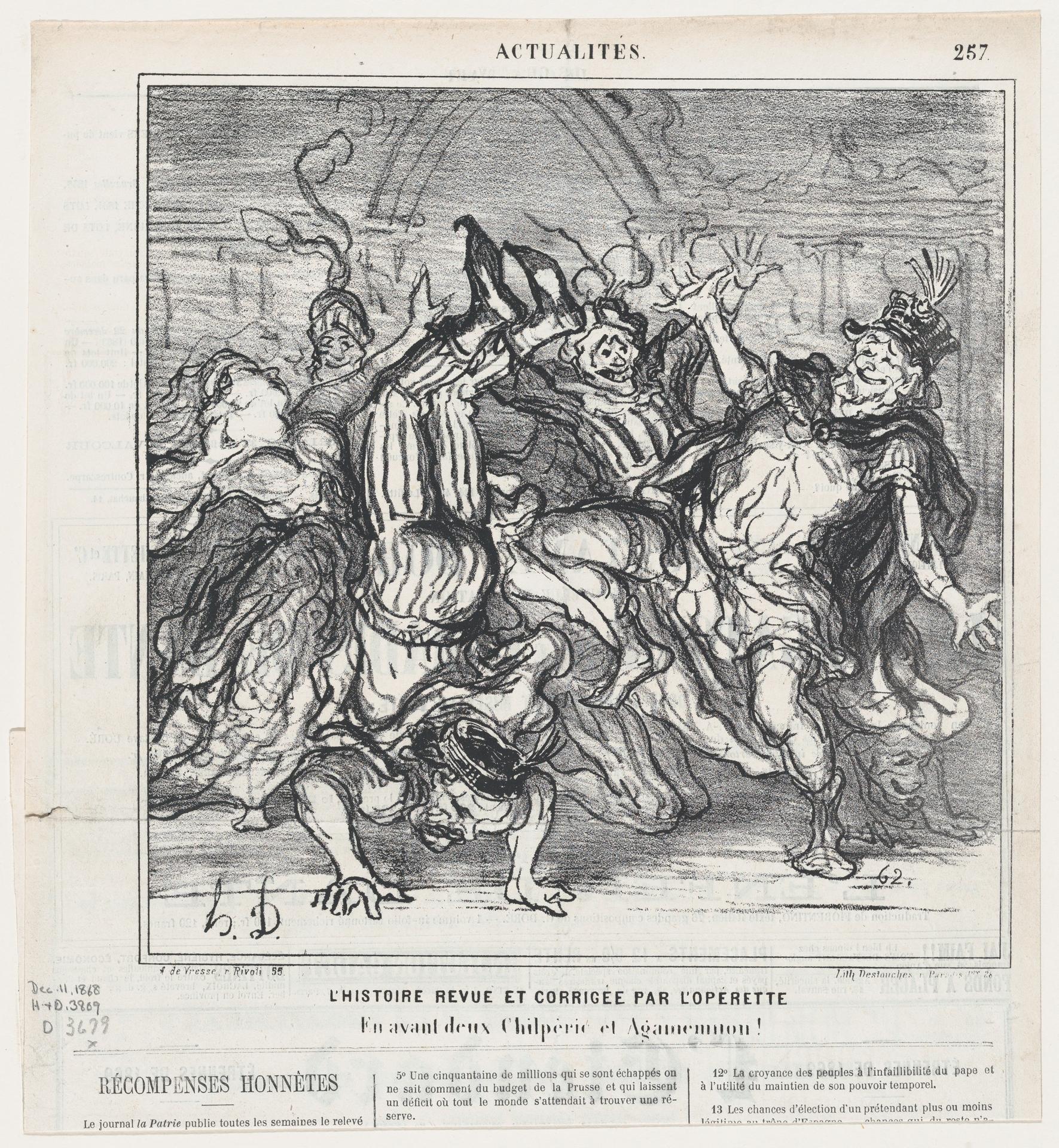
History revised and corrected by the operetta: Go ahead Chilperic and Agamemnon! (December 11, 1868, Met-Objekt 3521)
Original title: History revised and corrected by the operetta: Go ahead Chilperic and Agamemnon!, from 'News of the day,' published in Le Charivari, December 11, 1868
kurzbeschreibung
Created on December 11, 1868, in the orbit of the series 'News of the Day', this lithograph by Honoré Daumier appeared in the newspaper Le Charivari, where he published regularly. A turbulent crowd fills the sheet: figures in mock-antique and carnival costumes dance or grapple with one another. The print works as a satirical comment, and it ran as part of that series.
Description
Whirling chaos governs the layout — arms fly up, bodies lock into fighting stances, and one shape spills into the next. The costumes mix classical touches with fool's gear, which sharpens the comic bite. A stage with an arch serves as the setting, and heavy strokes build the figures. Everything stays black and white, as lithography dictates.
Context
Daumier made this sheet for Le Charivari, the satirical journal where he routinely skewered political and social matters. The caption alludes to 'Chilpéric', an operetta by Hervé staged in Paris in 1868 that parodied historical material. Daumier seized the occasion to take a critical look at how his contemporaries consumed history through popular entertainment. The work belongs to his late output, when he turned increasingly to caricature of the bourgeoisie.
Impact
The exaggerated figures and the muddled motion stir immediate amusement and irony. The satirical intent — aimed at the trivializing of history — comes through plainly, without the scene losing any clarity.
Technique
The lithograph was printed on newsprint and then reworked with brown ink and graphite, a sign of a corrected proof, the second state of two. Pairing lithography with hand-drawn overwork gives the sheet more density and liveliness.
AI-generated description text
Source: Metropolitan Museum of Art · Public Domain (CC0 1.0)