Saint Jerome in His Study
Original title: Saint Jerome in His Study
kurzbeschreibung
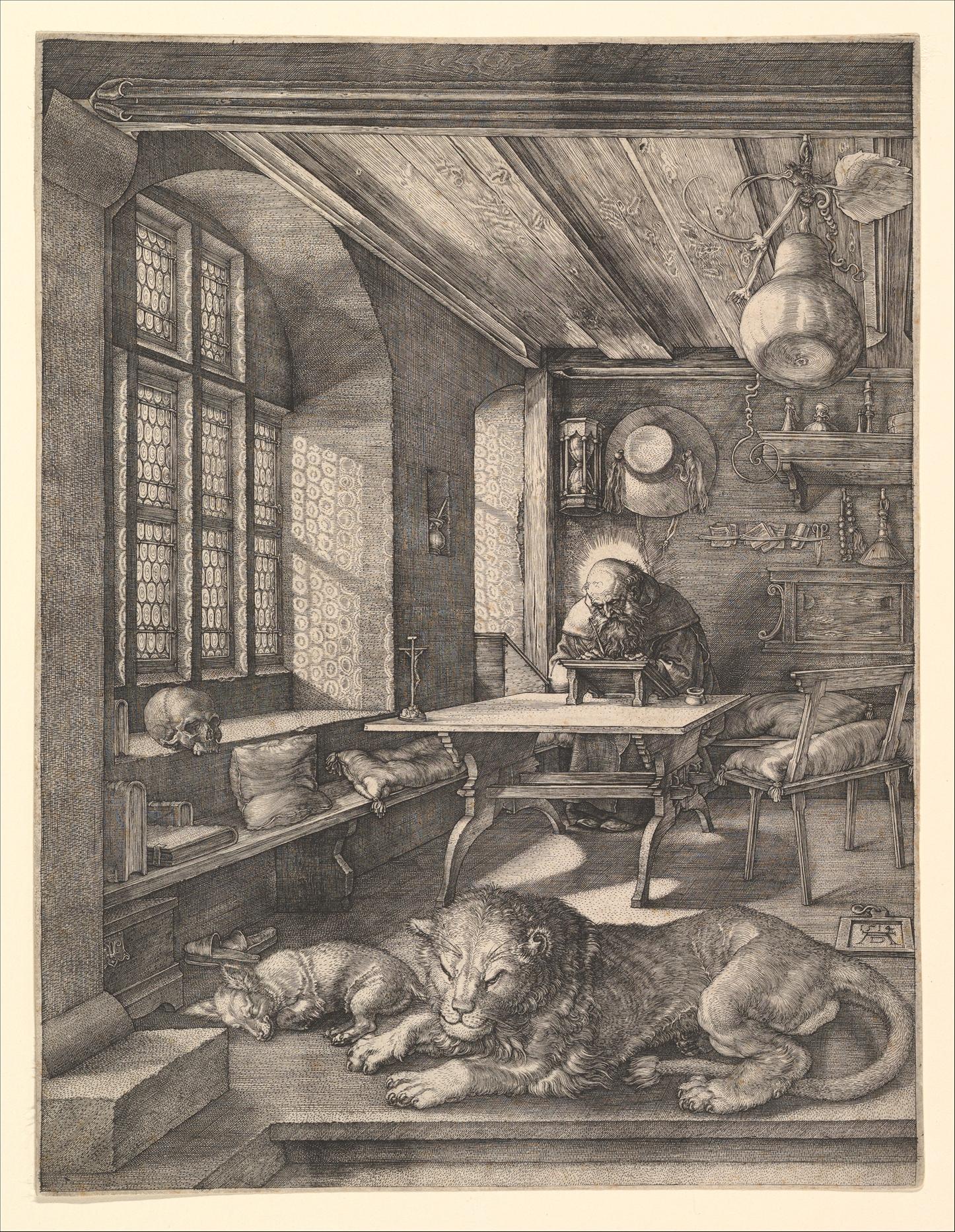
Albrecht Dürer's woodcut from 1514 depicts Saint Jerome in his study, a scene of scholarly solitude. The saint is shown writing at a desk, accompanied by a sleeping lion and a small dog, while divine light radiates from his head. This print is one of Dürer's masterpieces of the medium.
Description
The composition centers on Saint Jerome, an elderly man seated at a desk, his head encircled by a radiant halo. A large lion lies asleep at his feet, serving as a makeshift footrest, while a small dog rests nearby. The room is filled with objects: books on the desk, a stand holding a writing instrument, and a hanging hourglass and hat on the wall. Sunlight streams through a multi-arched window, casting a soft, diffuse glow across the scene, and a curtained window adds depth to the background.
Context
Created in 1514, this woodcut is part of Dürer's series of 'Master Prints,' which also includes 'Knight, Death, and the Devil' and 'Melencolia I.' Dürer was deeply engaged with humanist thought, and Saint Jerome, the patron saint of scholars, embodied the ideal of intellectual devotion. The print reflects the artist's interest in classical learning and the Northern Renaissance's emphasis on detailed observation of the natural world.
Impact
The print conveys a sense of quiet contemplation and scholarly peace, inviting the viewer into a private world of study. The precise linework and careful shading create a realistic interior that feels both intimate and monumental, a testament to Dürer's skill in the woodcut medium.
Technique
This is a woodcut, a relief printing technique where the image is carved into a wooden block, inked, and pressed onto paper. Dürer's exceptional craftsmanship is evident in the fine, parallel lines and cross-hatching that model form and light, achieving a tonal range unusual for the medium. The print is monochromatic, relying on black ink on paper to create its grayscale palette.
AI-generated description text
Source: Metropolitan Museum of Art · Public domain (CC0)