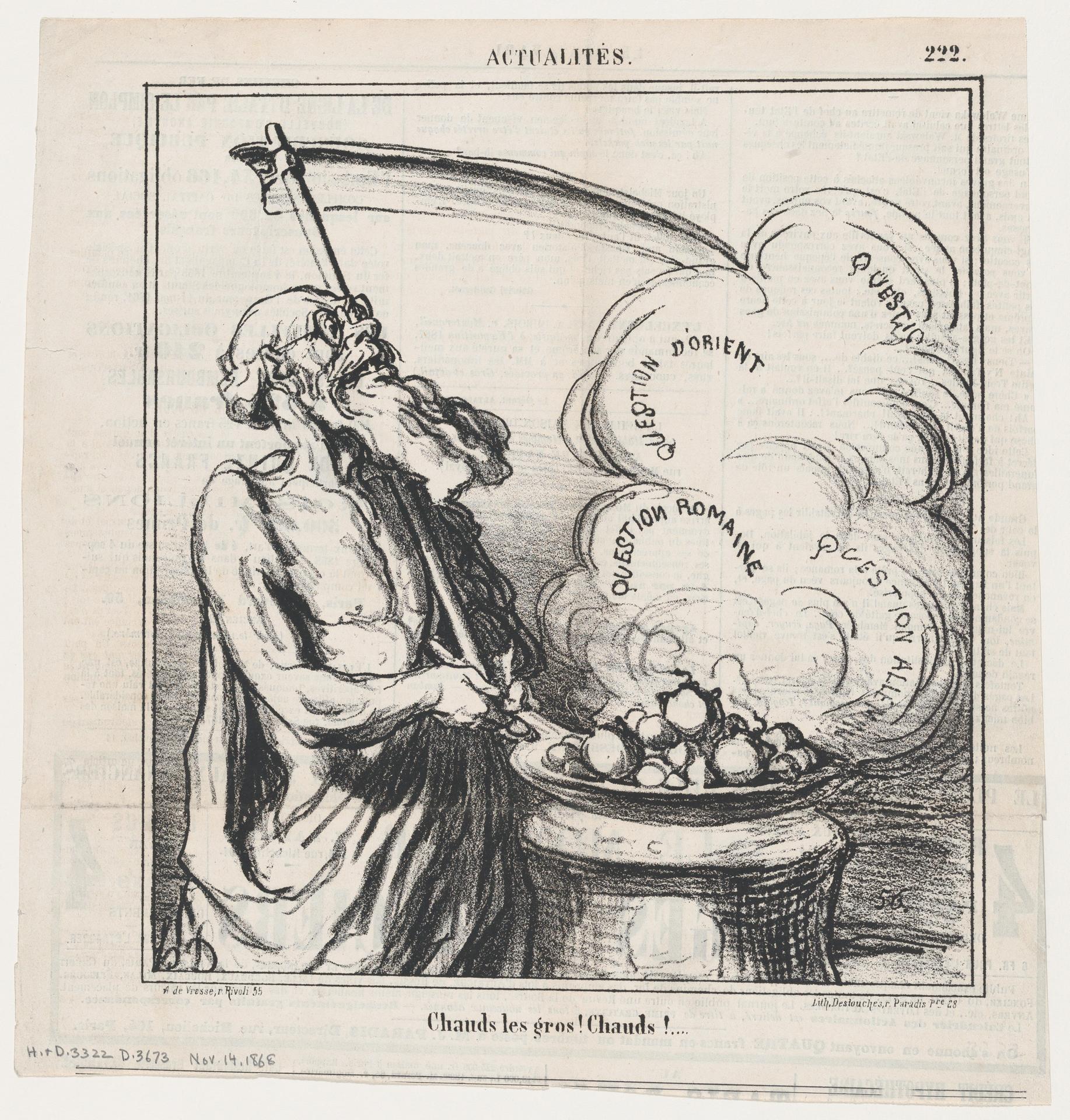
Big hot ones! Hot!, from 'News of the day,' published in Le Charivari, November 14, 1868
Original title: Big hot ones! Hot!, from 'News of the day,' published in Le Charivari, November 14, 1868
kurzbeschreibung
In this 1868 lithograph by Honoré Daumier, an old man holds a staff and a cauldron from which small figures rise. The figures bear the labels 'QUESTION D'ORIENT,' 'QUESTION ROMAINE,' and 'QUESTION ALLEMANDE,' alluding to the political tensions of the day. The print is a satirical contribution to the European crises of the late 1860s.
Description
An old man with a bare torso dominates the image, gripping a staff or shield in one hand and carrying a cauldron before him with the other. From the cauldron, several small figures or heads float upward, surrounded by the words 'QUESTION D'ORIENT,' 'QUESTION ROMAINE,' and 'QUESTION ALLEMANDE.' The man's posture suggests anger or resolve as he brandishes the staff aloft. Black and white governs the entire view, as is typical of a lithograph on newsprint. At the bottom and top edges appear the inscriptions 'ACTUALITÉS' and '222.'
Context
The lithograph was published on November 14, 1868, in the French satirical journal Le Charivari as part of the series 'Actualités.' Daumier thus addressed the political tensions in Europe, especially the Eastern Question (the conflict over the Ottoman Empire), the Roman Question (the struggle for Italian unification), and the German Question (the rivalry between Prussia and Austria). The caricature appeared at a time when press freedom was restricted under Napoleon III, yet papers like Le Charivari continued to voice political criticism. The work is known as the third state of three and was printed on newsprint, underscoring its character as up-to-the-minute commentary.
Impact
The swinging motion of the staff and the rising figures that personify political problems create an immediate, almost aggressive dynamism. The clear lettering and the central figure direct the viewer's gaze straight to the conflicts named, sharpening the satire. The restriction to black and white and the coarse linework give the sheet a bold, newspaper-like impact aimed at shaping public opinion.
Technique
Lithography on newsprint: in this process, a design is drawn with greasy chalk on a stone and then printed on paper. Daumier often turned to lithography for his political caricatures because it allowed fast, inexpensive printing. This impression survives as the third state of three, indicating that the plate was reworked; the dimensions are 24.1 × 22.1 cm (image) and 29.2 × 27.8 cm (sheet).
AI-generated description text
Source: Metropolitan Museum of Art · Public Domain (CC0 1.0)