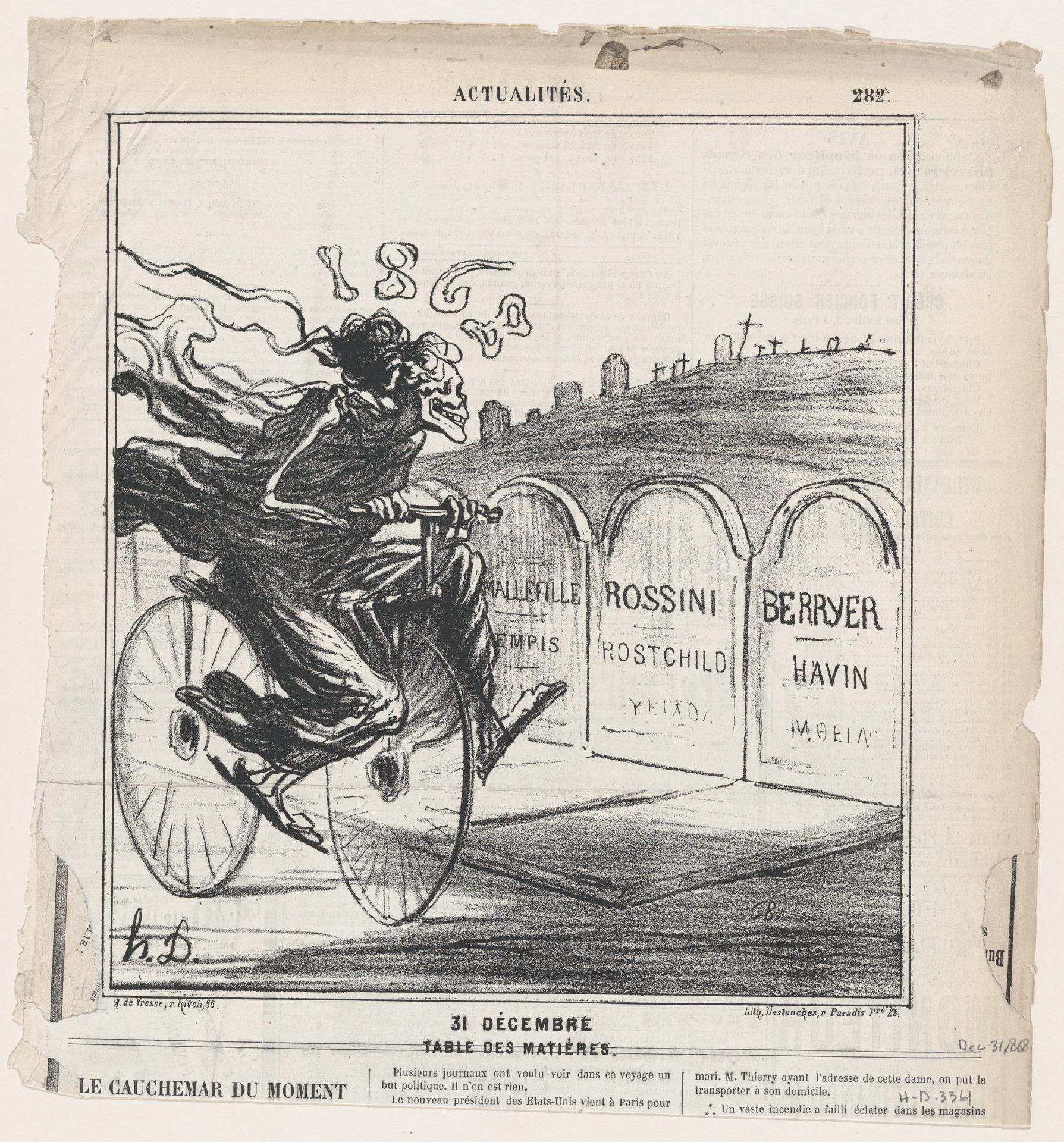
December 31st, Table of contents, from 'News of the day,' published in Le Charivari, December 31, 1868 (December 31, 1868, Met-Objekt 3514)
Original title: December 31st, Table of contents, from 'News of the day,' published in Le Charivari, December 31, 1868
kurzbeschreibung
On December 31, 1868, the satirical journal Le Charivari published a lithograph by Honoré Daumier titled 'December 31st, Table of contents.' It shows a skeleton on a bicycle in front of a row of tombstones and served as the illustrated table of contents for the 'Actualités' section. This impression is the second state of two (Delteil) and was printed on newsprint.
Description
A skeleton in a billowing coat speeds across the sheet on a bicycle, its motion underscored by sweeping lines. Behind it, a row of tombstones bears the names 'NALLEFILLE,' 'ROSSINI,' 'BERRYER,' and 'HAVIN.' At the top, the word 'ACTUALITÉS' stands out; at lower left is the signature 'H.D.' The monochrome print uses gradations of gray to bring out depth and contours, in a caricatural and grotesque style.
Context
The lithograph was part of the satirical 'Actualités' section in the daily newspaper Le Charivari, famous for its political and social caricatures. Daumier drew for the paper for decades, commenting on current events. The names on the tombstones recall contemporaries who died in 1868, including the composer Gioachino Rossini and the politician Pierre-Antoine Berryer. The print served as a year-end piece, a look back at the year's deaths.
Impact
The sight of the cycling skeleton provokes an odd laugh—macabre yet comic. The bicycle's flowing movement contrasts with the motionless row of tombstones, making transience palpable. The caricatural exaggeration presents death as an everyday companion of the year's end, without tipping into the morbid.
Technique
For the rapid printing of timely sheets, Daumier used lithography on newsprint, a typical method for him. The drawing is black and white with fine gray tones created by hatching and tonal gradations. The print is the second state of two, as recorded in the Delteil catalogue raisonné.
AI-generated description text
Source: Metropolitan Museum of Art · Public Domain (CC0 1.0)