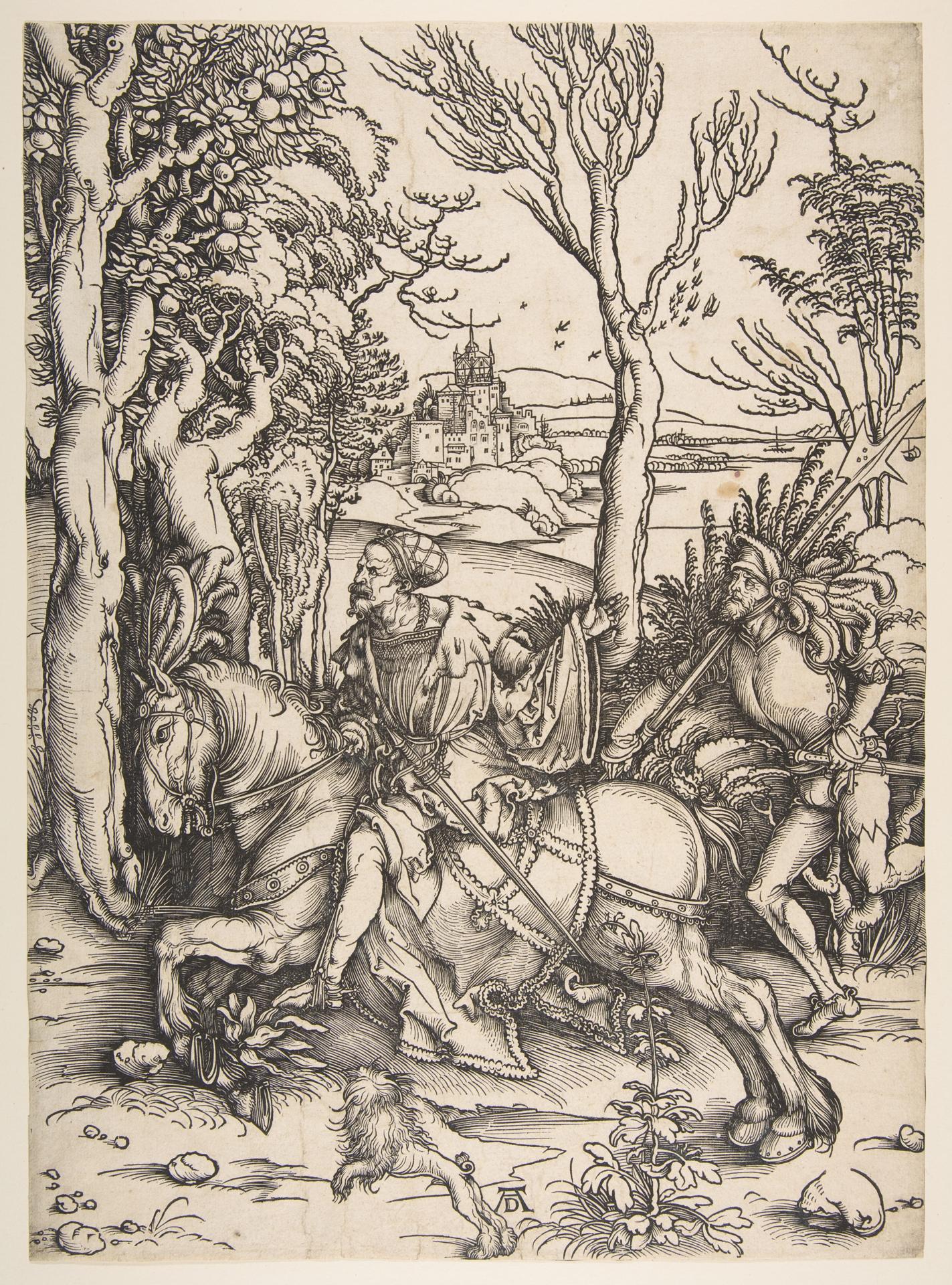
The Knight and Man-at-arms
Original title: The Knight and Man-at-arms
kurzbeschreibung
This woodcut by Albrecht Dürer depicts a knight on horseback accompanied by a man-at-arms. The undated work showcases Dürer's mastery of the medium, with detailed linework and a serene landscape backdrop. The print captures a moment of quiet vigilance, with the figures poised in a natural setting.
Description
The composition places the knight and his companion prominently in the foreground, framed by trees and shrubs. The knight, clad in armor with a hooded helmet, holds a lance, while the man-at-arms, also armored, carries a shield and lance. In the background, a castle surrounded by a lake adds depth and a sense of tranquility. The monochromatic palette and even lighting are characteristic of woodcut prints, and the symmetrical arrangement of figures and architecture gives the scene a balanced, orderly feel.
Context
Albrecht Dürer (1471–1528) was a leading German Renaissance artist known for his prints and theoretical works. This woodcut reflects the period's interest in chivalric themes and military subjects, common in early 16th-century German art. Dürer's prints were widely circulated and contributed to his international fame, and this piece exemplifies his skill in rendering detailed figures and landscapes in a relatively small format.
Impact
The scene evokes a calm and orderly atmosphere, with the knight and his companion appearing both resolute and composed. The detailed linework and balanced composition draw the viewer's eye across the print, while the peaceful landscape softens the martial subject. The overall effect is one of dignified stillness, typical of Dürer's ability to infuse his prints with a sense of narrative and mood.
Technique
Dürer employed the woodcut technique, carving the design into a wooden block, inking it, and transferring it to paper. The medium allows for bold contrasts and fine lines, which Dürer manipulated to create texture and detail in the armor, foliage, and architecture. The even distribution of light and the absence of color highlight the precision of the cutting, making this a striking example of Renaissance printmaking.
AI-generated description text
Source: Metropolitan Museum of Art · Public domain (CC0)