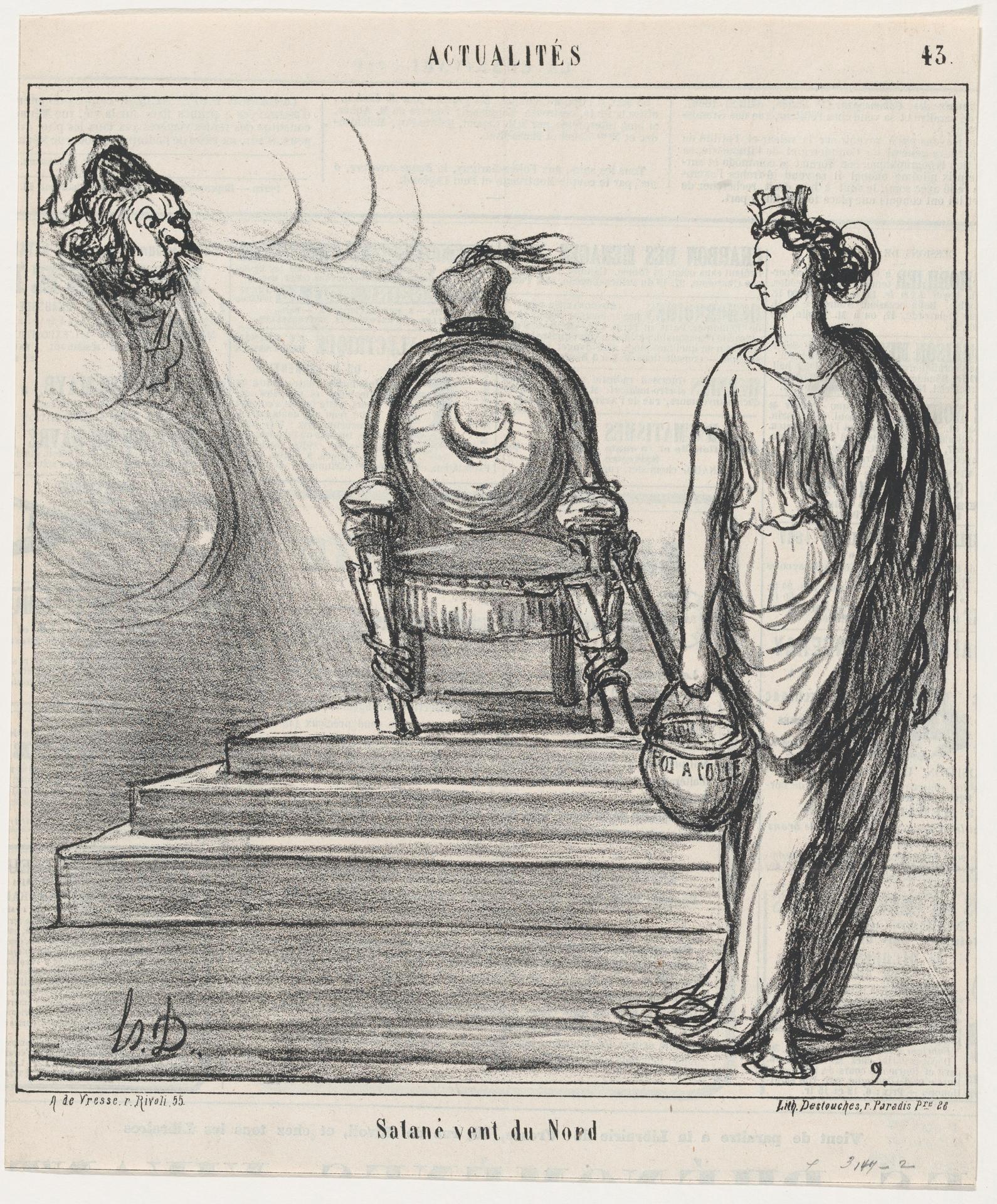
Devilish north wind!
Original title: Devilish north wind!, from 'News of the day,' published in "Le Charivari"
kurzbeschreibung
Honoré Daumier's lithograph "Teuflischer Nordwind!" ("Satané vent du Nord") dates from 1868 and belongs to the series "News of the day," made for Le Charivari. The print sets a throne-like object, a hooded figure and a woman holding a bowl before the viewer, with the caption "Satané vent du Nord" running along the bottom.
Description
A large, puzzling object that reads like an antique chair or throne with a face dominates the middle of the sheet. To its left stands a hooded figure with a menacing expression, ringed by rays of light. On the right, a woman in classical dress holds a bowl inscribed "FOI A COUPE." The caption "Satané vent du Nord" runs along the lower edge. The arrangement is lopsided, and the throne object pulls the eye toward it.
Context
The lithograph appeared in the satirical journal Le Charivari on March 3, 1868; Daumier drew political and social caricatures for the paper regularly. The series "News of the day" took up current events and moods in France under the Second Empire. This is the second of two known states, printed on newsprint of the kind a daily paper would use.
Impact
A threatening figure, harsh rays of light and the enigmatic throne object create a disquieting, almost surreal mood. Hard black-and-white contrasts and exaggerated proportions give the sheet its satirical edge and invite reflection on what the image is saying.
Technique
For this lithograph Daumier drew with greasy chalk on the stone and then printed on newsprint. Fine shading and clear contours come from the different stages of the lithographic process. The print stays black and white and shows the sure line typical of Daumier's hand.
AI-generated description text
Source: Metropolitan Museum of Art · Public Domain (CC0 1.0)