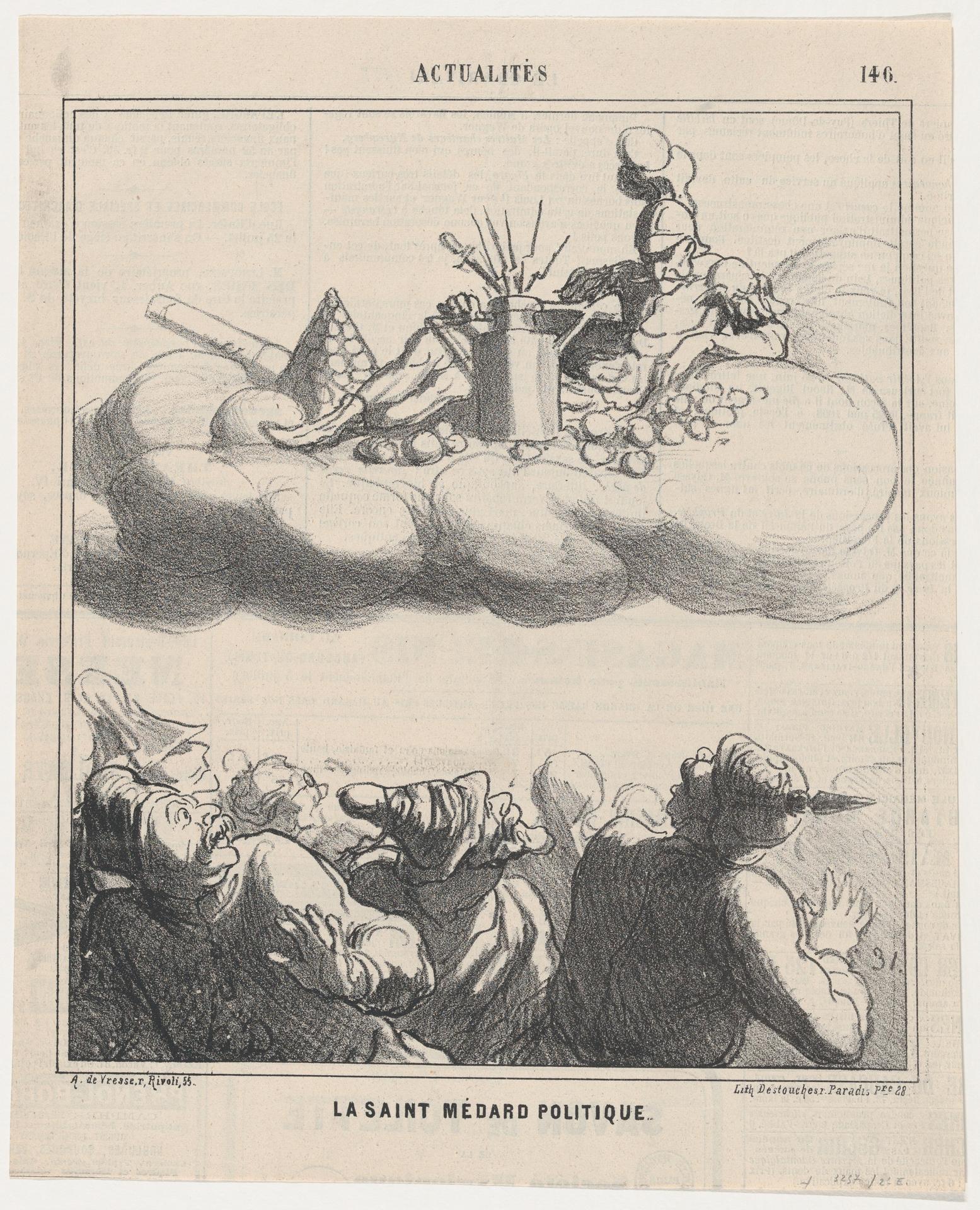
Saint Médard of politics, from 'News of the day,' published in "Le Charivari"
Original title: Saint Médard of politics, from 'News of the day,' published in "Le Charivari"
kurzbeschreibung
Unlike many contemporary caricatures, Honoré Daumier's lithograph 'The Holy Médard of Politics' from June 27, 1868, relies on an unusual constellation: an allegorical figure sits enthroned atop clouds, equipped with a bottle, a bowl of fruit, and a sword, while below a crowd gazes up in astonishment. Printed on newsprint, the work belongs to the series 'News of the Day' and combines everyday objects with political symbolism.
Description
What sets this view apart from other prints in the series is the clear vertical division: above, a single figure resides on a bed of clouds, holding a bottle, a fruit bowl, and a sword, crowned by a helmet-like headpiece that suggests power. Below, several people in traditional clothing have gathered; their surprised expressions are directed upward. The layout feels asymmetrical and draws the eye both to the central figure and to the reactions of the crowd. Grays dominate, light is evenly distributed, and the style blends realistic details with caricatural exaggeration.
Context
The motif appeared on June 27, 1868, in the satirical journal 'Le Charivari', famous for its political caricatures. Daumier published this print within the series 'News of the Day', which commented on current events and conditions in the Second Empire. The title refers to Saint Médard, the patron saint invoked against bad weather, and presents this figure as a parable for political circumstances. In a phase of growing press freedom, caricatures played an important role in public debate.
Impact
An ironic distance arises because the heavenly staging of power meets the astonished gazes of the population. Everyday things next to symbols of rule seem absurd and prompt reflection on the nature of political authority. The detailed drawing and expressive faces give the scene something lively, almost theatrical.
Technique
For this print, Daumier used lithography: the motif was drawn with a greasy crayon on a limestone and then transferred to paper. This is an impression in the second state, printed on newsprint as was customary for mass production in journals. The gray tones result from the varying fat content of the drawing, which allows fine gradations of light and dark during printing.
AI-generated description text
Source: Metropolitan Museum of Art · Public Domain (CC0 1.0)