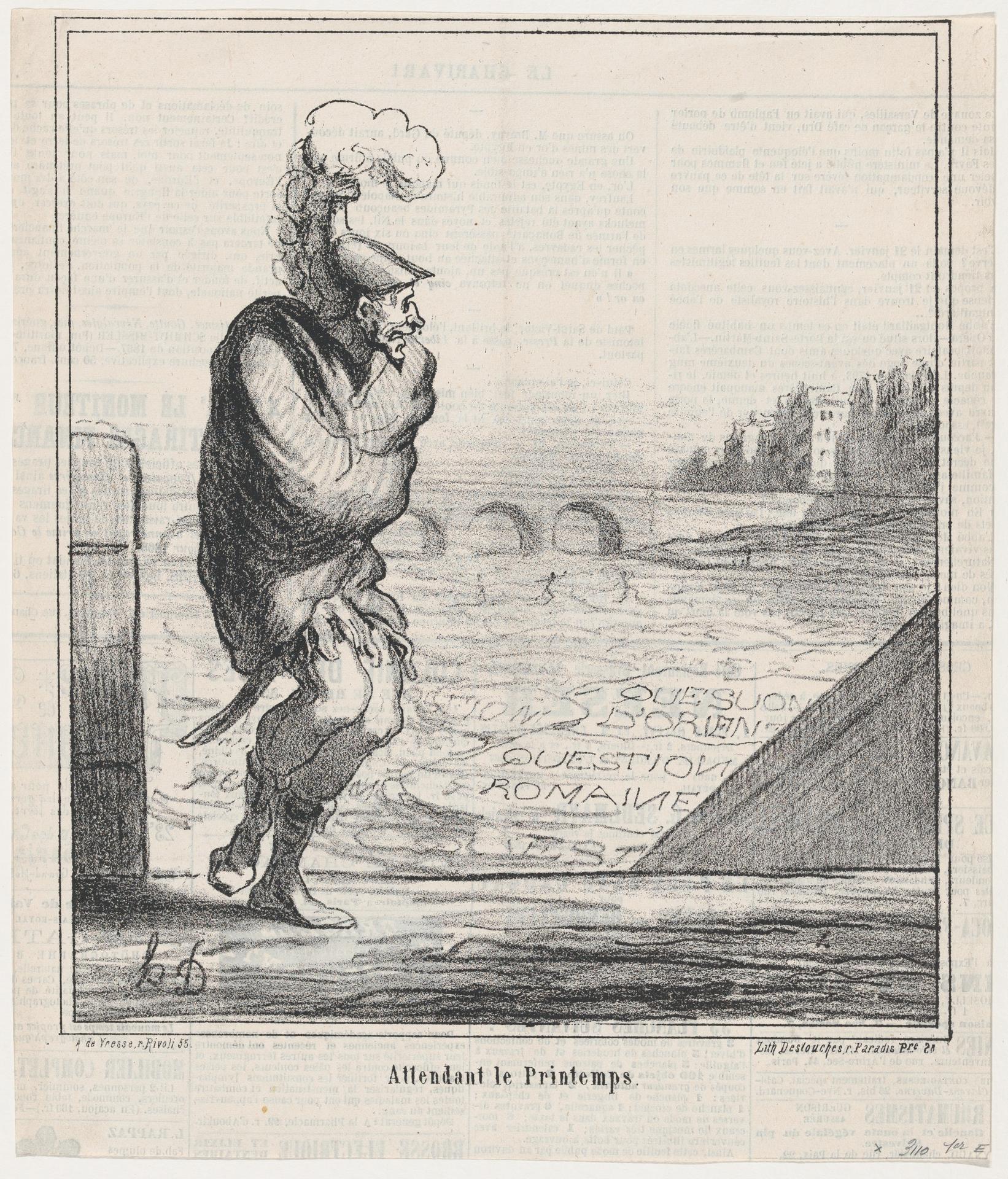
Waiting for spring, from 'News of the day,' published in "Le Charivari"
Original title: Waiting for spring, from 'News of the day,' published in "Le Charivari"
kurzbeschreibung
Honoré Daumier's lithograph 'Waiting for Spring' from 1868 shows a man in traditional dress standing on a bridge, gazing into the distance lost in thought. The print belongs to the series 'News of the day' and appeared on January 20, 1868, in the magazine 'Le Charivari'. It was executed as a lithograph on newsprint, in the second of two states (Delteil).
Description
A man in traditional dress stands on a bridge, his gaze turned thoughtfully toward the distance. Cap, jacket and trousers define what he wears, and his posture suggests impatience or expectation. On the ground before him lie inscriptions reading 'QUESTION D'ORIENT' and 'QUESTION ROMAINE'. A river, a bridge and buildings make up the setting behind him. The layout is asymmetrical: the man on the left, the buildings on the right. Monochrome tones and even light are characteristic of the lithograph.
Context
In January 1868 Daumier was working regularly for the satirical magazine 'Le Charivari', and the print grew out of that circle. The series 'News of the day' took aim at current political and social events. 'QUESTION D'ORIENT' and 'QUESTION ROMAINE' refer to the diplomatic crises of the time, the Eastern and the Roman Question, which were debated intensely in France. For Daumier the lithograph served as a medium of political caricature.
Impact
Clearly structured, with a pensive protagonist set between the political catchwords, the print feels calm and ironic at once. Monochrome tones and even lighting give it a matter-of-fact, almost documentary note that supports the satirical intent. The man in traditional clothing contrasts with the political terms on the ground, and from that a subtle tension arises.
Technique
Drawn with greasy chalk on the limestone and then printed, the result is a lithograph on newsprint. The present impression is the second of two states (Delteil), which points to later reworking of the printing stone. Crisp lines and fine shading shape the execution in a manner typical of Daumier; figures and landscape are captured precisely with them.
AI-generated description text
Source: Metropolitan Museum of Art · Public Domain (CC0 1.0)