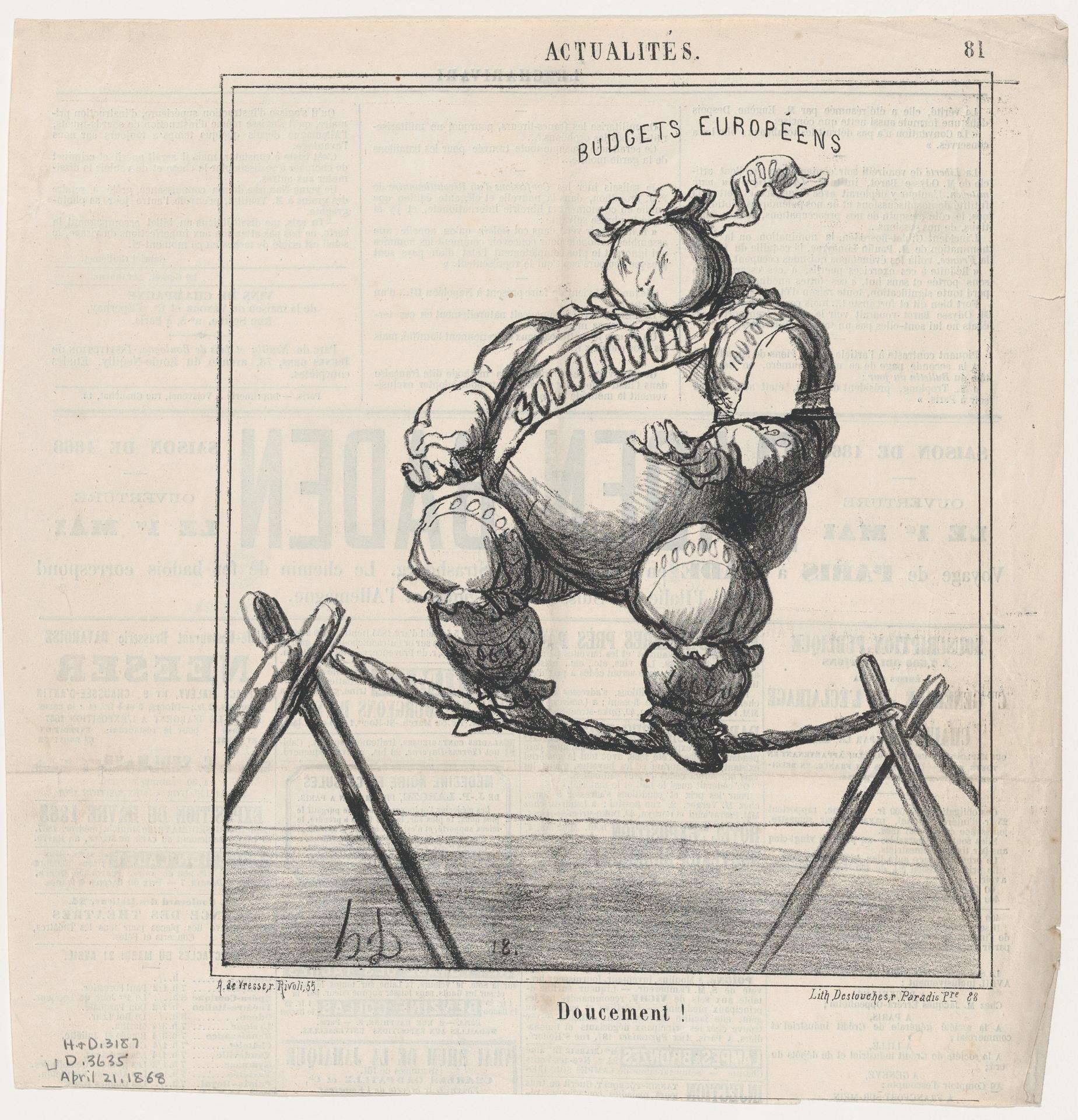
Gently!, from 'News of the day,' published in Le Charivari, April 21, 1868
Original title: Gently!, from 'News of the day,' published in Le Charivari, April 21, 1868
kurzbeschreibung
Honoré Daumier contributed “Sachte!” in April 1868 as a lithograph to the series “News of the day” in Le Charivari. It shows a veiled figure on a rope dragging a huge money bag labelled “30000000”; beside it is “BUDGETS EUROPÉENS.” The print caricatures European state budgets and the burden they carry.
Description
An exaggerated figure dominates the layout, a massive money sack on its back. The pose recalls a tightrope walker, the face hidden behind a veil, a long robe enveloping the body. On the sack the number “30000000” stands out, with “BUDGETS EUROPÉENS” set above. Everything remains black and white, with delicate strokes and hatching that define the contours of figure and sack without real shadows.
Context
Daumier made this print in April 1868 for the satirical magazine Le Charivari, where he regularly published political and social caricatures—a period when France and Europe were debating budgets and finances. The European budgets appear here as a heavy burden, echoing contemporary criticism of state spending and tax policy. Daumier was known for his pointed commentaries on current events, which he liked to dress in humorous images.
Impact
The print oscillates between comedy and seriousness: the exaggerated figure and tightrope-walker pose amuse, while the enormous sum and the label “BUDGETS EUROPÉENS” point to the grave issue of public debt. Without being preachy, the image prompts reflection on the weight of public finances. The clear, precise linework gives it an aesthetic quality that does not feel tied to its time.
Technique
The print was made as a lithograph on newsprint—a process in which a drawing is made with greasy chalk on the stone and then pulled. With delicate lines and hatching, Daumier worked out the surface of the robe and the money sack. The present impression is the second state of two (Delteil), suggesting the plate was reworked. The black-and-white version matches 19th-century printmaking and allowed cheap reproduction in the newspaper.
AI-generated description text
Source: Metropolitan Museum of Art · Public Domain (CC0 1.0)