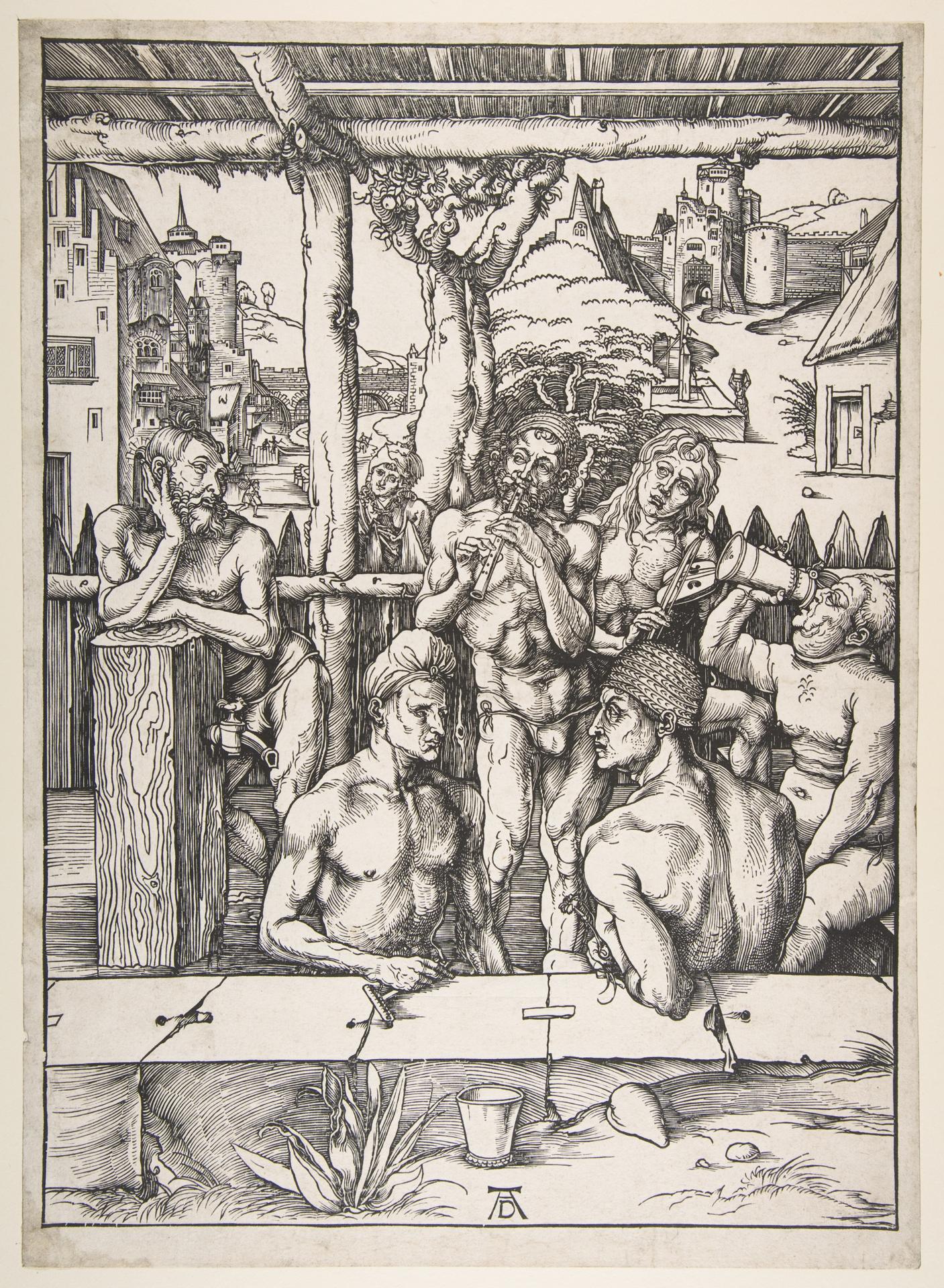
The Men's Bath
Original title: The Men's Bath
kurzbeschreibung
Albrecht Dürer's woodcut 'The Men's Bath' depicts a group of men bathing in a public bathhouse, a common social scene in Renaissance Germany. The print, created around 1496–1497, showcases Dürer's skill in capturing the human figure and architectural detail.
Description
The composition shows several male figures in various poses: some sit on the edge of a pool, others stand or lean against wooden beams. The figures are partly clothed, wearing simple loincloths or towels. In the background, a cityscape with towers and walls is visible through the open structure of the bathhouse. A large water basin and a plant appear in the foreground, while the scene is framed by a roof with wooden beams and foliage. The black-and-white woodcut relies on strong outlines and detailed cross-hatching to define forms.
Context
Created during Dürer's early career in Nuremberg, this woodcut reflects the popularity of public baths in German cities, which served as places of hygiene, socializing, and even business. The bathhouse was a common motif in Renaissance art, symbolizing both physical and moral cleansing. Dürer's work also demonstrates his interest in classical antiquity, as the figures' poses echo ancient statues, blending contemporary life with humanist ideals.
Impact
The scene feels lively and intimate, capturing a moment of everyday leisure with a sense of realism. The detailed rendering of the figures and architecture invites the viewer to explore the image closely, while the overall composition balances activity and calm.
Technique
Dürer used the woodcut technique, carving the design into a wooden block and printing it with ink. The print features sharp contours and fine hatching to create texture and depth, typical of Dürer's mastery in this medium. The careful use of line work gives the scene a sense of volume and spatial clarity.
AI-generated description text
Source: Metropolitan Museum of Art · Public domain (CC0)